I found this an interesting comparison between the “asymmetry of signals”, that is, the asymmetry between the feedback we have for observing, monitoring and measuring efficiency versus safety. Source below.
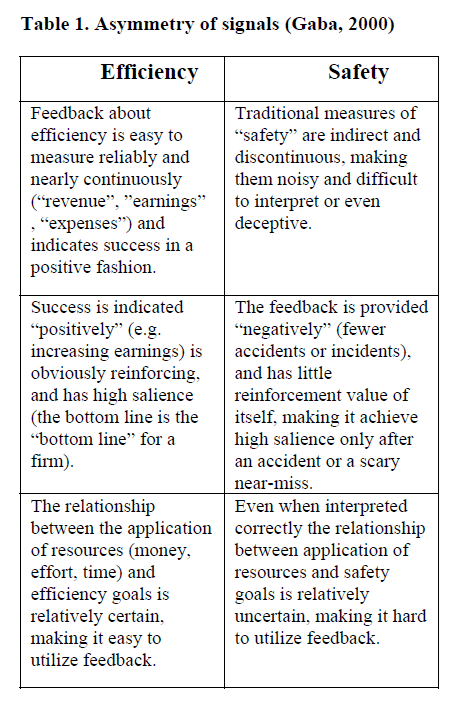
The asymmetry is characterised by:
1. Safety measures often being indirect and “noisy” compared to efficiency goal feedback.
2. Successful efficiency is generally more reinforcing compared to feedback from fewer incidents generally only becoming salient after hurting somebody.
3. The relationship between resources and goals is generally clearer for efficiency compared to safety goals – which tend to involve more noise and uncertainty.
They argue that it’s generally difficult, if not impossible, to prioritise both safety and performance goals and gain consensus on these [*** other research counters this view, arguing that they are more synergistic than oppositional].
Nevertheless, they say that “Safety goals often do not coincide with performance and efficiency goals”.
Safety is rarely the primary goal of any organisation—they usually produce or sell products or services—and thus, “non-safety goals (efficiency and/or performance) are best achieved in ways that are not consistent with designing and operating for the lowest possible risk”
One example of a shift across industry in healthcare delivery systems. These systems were said to be loosely coupled in the past, which allowed system buffer to many short-term surges. However, modern techniques and environmental pressures have resulted in tighter couplings, reducing slack.
These effects result in “new organizational interfaces implying that the system becomes brittle and difficult to manage”.
In any case, the figure below highlights how much more visible efficiency feedback can be, compared to safety intel.
(Source: Aase, Wiig, Hoyland. (2009). Safety first!? Organizational efficiency trends and their influence on safety. Safety Science Monitor, 2(7).

 SafetyInsights.org