ABSTRACT
Night-shift workers are at high risk of drowsiness-related motor vehicle crashes as a result of circadian disruption and sleep restriction. However, the impact of actual night-shift work on measures of drowsiness and driving performance while operating a real motor vehicle remains unknown.
Sixteen night-shift workers completed two 2-h daytime driving sessions on a closed driving track at the Liberty Mutual Research Institute for Safety: (i) a postsleep baseline driving session after an average of 7.6 ± 2.4 h sleep the previous night with no night-shift work, and (ii) a postnight-shift driving session following night-shift work. Physiological measures of drowsiness were collected, including infrared reflectance oculography, electroencephalography, and electrooculography. Driving performance measures included lane excursions, near-crash events, and drives terminated because of failure to maintain control of the vehicle.
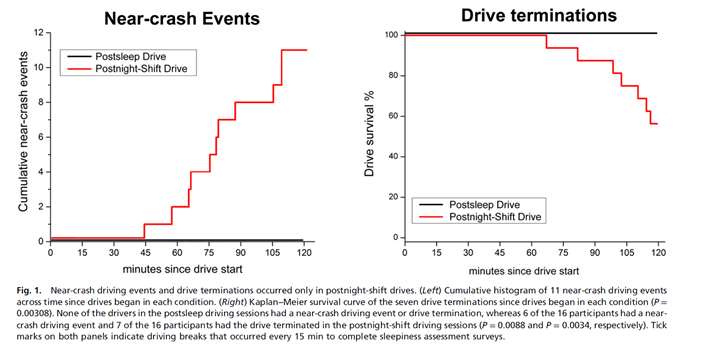
Eleven near-crashes occurred in 6 of 16 postnight-shift drives (37.5%), and 7 of 16 postnight-shift drives (43.8%) were terminated early for safety reasons, compared with zero near-crashes or early drive terminations during 16 postsleep drives (Fishers exact: P = 0.0088 and P = 0.0034, respectively). Participants had a significantly higher rate of lane excursions, average Johns Drowsiness Scale, blink duration, and number of slow eye movements during postnight-shift drives compared with postsleep drives (3.09/min vs. 1.49/min; 1.71 vs. 0.97; 125 ms vs. 100 ms; 35.8 vs. 19.1; respectively, P < 0.05 for all).
Night-shift work increases driver drowsiness, degrading driving performance and increasing the risk of near-crash drive events. With more than 9.5 million Americans working overnight or rotating shifts and one-third of United States commutes exceeding 30 min, these results have implications for traffic and occupational safety.
******
From the full-text paper:
- This was a driving study on a closed track following night-shift work vs following a standard night sleep. A driving instructor sat in the vehicle for safety purposes.
- In alignment with real accident data, these findings “indicate that prolonged driving may be especially hazardous during the homeward commute following night-shift work” (p177).
- All of the emergency near crash events (when the safety instructor in the vehicle intervened to stop the vehicle) and drive terminations occurred in the post nightshift drive condition – none of these events occurred in the post-sleep drive condition.
- Nearly 40% of the post night-shift daytime drives required the use of emergency braking manoeuvres for near-crash driving events vs. 0% in the post-sleep condition.
- They found “a substantially increased risk of objectively measured drowsiness, impaired driving performance, and critical driving incidents when driving during the daytime following a night shift in actual night-shift workers” (p178).
- Drivers in the post night-shift condition frequently exhibited indicators of drowsiness that worsened as the drive progressed (e.g. increases in blink duration, frequency of slow eye movements, attentional failures, microsleep episodes). Time-on-task fatigue effects appeared to have interacted with night-shift work.
- While the most severe objective driving impairments were observed after the 45 minute mark, concerningly objective impairments in driving were observed from as early as 15 minutes into the drives.
- That is, “deficits in driving performance outcomes (lane crossings) and physiological measures indicative of drowsiness were also evident from the outset of the drive, indicating that impairment among these night-shift workers occurred within the first 15 min of postnight-shift driving” (p180).
- It’s worth noting however that simulator studies (on high-fidelity computer simulations) and closed track studies (like this one) may amplify the effects of objective driving impairment and also sleep-related physiological effects because real-world open road drives may be more stimulating, compared to closed tracks which are geometrically simpler and with less stimulations to navigate.
Authors: Lee, M. L., Howard, M. E., Horrey, W. J., Liang, Y., Anderson, C., Shreeve, M. S., … & Czeisler, C. A. (2016). Proceedings of the National Academy of Sciences, 113(1), 176-181.
Study link: www.pnas.org/cgi/doi/10.1073/pnas.1510383112
Link to the LinkedIn article: https://www.linkedin.com/pulse/high-risk-near-crash-driving-events-following-work-ben-hutchinson


