“Do an ICAM” is probably one of the most ubiquitous terms when working in construction. It’s almost like Newton’s unknown law of construction work that an ICAM be performed for a serious or serious potential event.
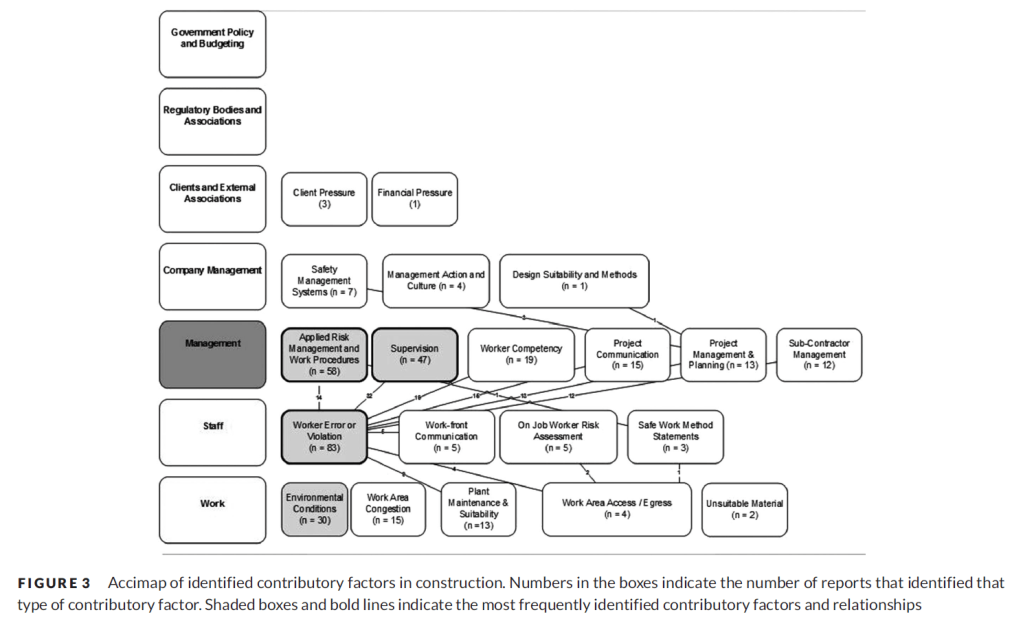
So how well do construction ICAM investigations align with systems thinking principles? How often do ICAMs evaluate upstream and broader organisational factors compared to frontline/operator factors? A study from Matt Woolley and colleagues explored this question, drawing on 100 ICAMs from 5 construction companies.
Results indicated that, overall, “construction has not moved beyond a human error focus and does not presently identify multiple actors and contributory factors or the interactions between them” (p7).
These investigation reports from the participating companies revealed that, for the causal analysis, actors involved at the government, regulatory, client or company levels of the framework were either not identified or not examined.
100% of reports identified the contribution of operational management and staff and indeed, staff-related factors were observed in 86% of reports. Of those reports, 83% attributed findings to “human error”.
The authors then report on the types of corrective actions assigned. One interesting observation is that when corrective actions directed attention towards raising awareness of issues that they were “typically framed as broad statements that appeared to shift responsibility to workers (e.g., “know your limits,” “stay safe,” “keep eyes on path,” and “fatigue causes accidents”), as opposed to concise countermeasures, capable of implementation and measurement” (p6).
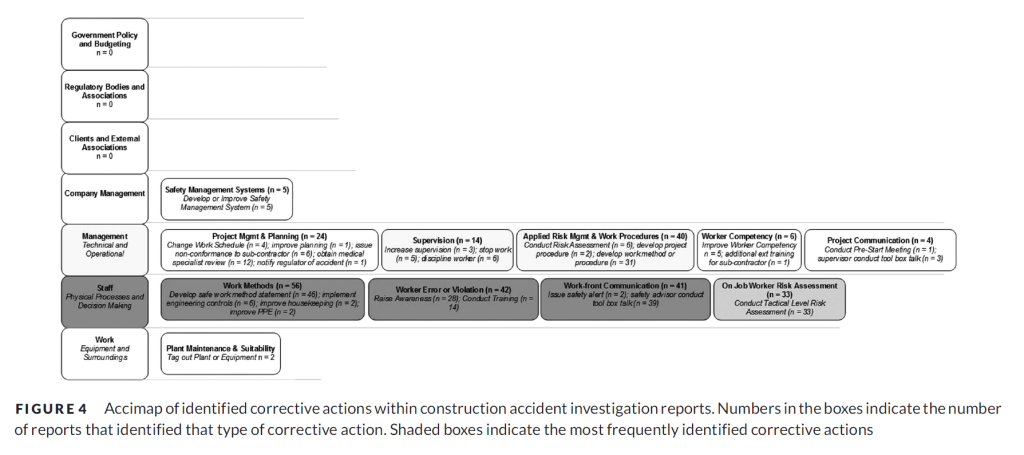
The authors note that:
• investigation processes and the investigation templates “appear to prevent analysts from adequately considering factors beyond the operational level” (p8).
• the existing focus on operational levels of construction systems doesn’t support investigators in considering the influence of multiple actors and factors and their relationships across the sociotechnical system.
• contributory factors that were identified didn’t venture beyond the company level and mostly focused at the lower hierarchical levels.
Authors: Matthew J. I. Woolley, Natassia Goode, Gemma J. M. Read, Paul M. Salmon. (2018). Human Factors and Ergonomics in Manufacturing & Service Industries, 28(6), 297-308.
Study link: https://doi.org/10.1002/hfm.20749
Link to the study summary: https://www.linkedin.com/pulse/moving-beyond-organizational-ceiling-do-construction-align-ben
Summary on my site: https://wordpress.com/post/safety177496371.wordpress.com/525

 SafetyInsights.org
I had an accident at the mine,they put the blame on me,even false information on icam.
I have all the papers for the investigation.
Can some one please check their findings.
LikeLike