This study explored the relationship between safety climate, hazard recognition and safety risk perception in US construction.
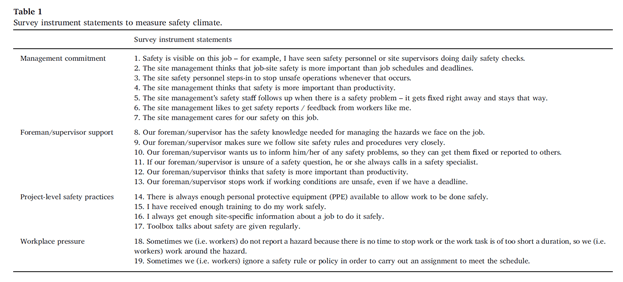
Data from 280 workers employed in 57 construction workplaces was gathered via surveys and use of image-based construction scenarios for participants to identify possible hazards.
Providing background on the topic, data is cited highlighting that:
- Up to 33.5% of safety hazards remain unrecognised in UK construction workplaces
- In Australian data up to 57% of workplace hazards remain unrecognised
- US data found over 40% of hazards remain unrecognised
They argue that “Much of this poor performance has been attributed to common weaknesses in existing hazard recognition methods (e.g., job hazard analysis, safety checklists)” (p45).
Further, some of the effects of risk perception and specifically, a normalisation of risk are cited. For instance, workers that commonly use ladders in their daily tasks become “increasingly insensitive to the risk of falls over time – even if the potential for falls is recognized as a relevant hazard” (p45). Other examples of normalisation include use of PPE, operating construction equipment and altering protective guards on tools.
[*** Note – other research has suggested that this normalisation isn’t just related to risk perception per se but also with increasing competency, specialisation and confidence.]
Results
Quoting the paper, key findings included: (p44, 51)
- “workers representing workplaces with a more positive safety climate demonstrate higher levels of hazard recognition and safety risk perception”.
- “the effect of safety climate on safety risk perception was mediated by hazard recognition performance” and thus “safety climate affected hazard recognition performance, which in turn affected safety risk perception levels”.
- “Apart from the indirect effect of safety climate on safety risk perception through hazard recognition performance, safety climate also affected safety risk perception independently of hazard recognition performance”.
- “a significant portion of the variability in hazard recognition and safety risk perception can be explained by the differences in safety climate in workplaces” (p51).
For some specific findings, while most crews reported a “somewhat agree” to “agree” range of safety climate responses, only ~43% of hazards in the scenarios were identified; leaving >50% unrecognised.
Based on regression calculations, crews with a safety climate score higher by 1-unit compared to other crews “are expected to identify an additional 5.72% of hazards” (p50).
A 1-unit change in safety climate score “translates into a 5.72% change in hazard recognition, which in-turn translates to a safety risk perception score which is higher by 0.126 standard deviations than the average” (p50).
Therefore, hypothetically, among two crews with “identical” hazard recognition performance, the crew with higher safety climate perception will perceive higher levels of safety risk. Unexpectedly, both hazard perception and safety climate contribute uniquely to safety risk perception levels.
[**** Not discussed in this paper, but a corollary to increased safety risk perception and things like chronic unease/preoccupation with failure is a *potential* link with heightened anxiety; which over time may have negative impacts on people. I’ll look to summarise some of this work in the future.]
Like anything there were some limitations. Two worth highlighting is that 1) the case image format for hazards may not capture the reality of construction operations (although they note previous work has shown a strong correlation between case image performance and real-world conditions), 2) the images weren’t assigned based on the participants’ trades.
Authors: Pandit, B., Albert, A., Patil, Y., & Al-Bayati, A. J. (2019). Safety science, 113, 44-53.
Study link: https://doi.org/10.1016/j.ssci.2018.11.020
Link to the LinkedIn article: https://www.linkedin.com/pulse/impact-safety-climate-hazard-recognition-risk-ben-hutchinson


One thought on “Impact of safety climate on hazard recognition and safety risk perception”