More on the links between sleep disruption, fatigue and injury risk.
The first image tracks workplace incident/injury rates as a product of hours per week and hours per day from a large US dataset over 13 years.
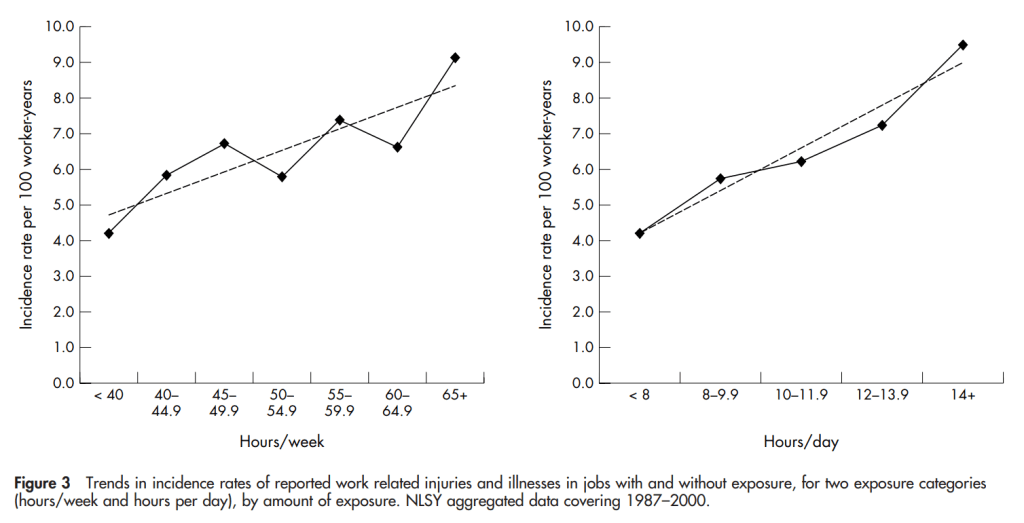
They found a clear dose-response relationship with increasing hours and workplace injury.
Interestingly, this wasn’t simply due to a greater period of exposure (e.g. somebody working 8 hours has twice the theoretical exposure for an injury compared to a 4 hour shift, all things equal).
Moreover, the results aren’t due simply to long working hours being concentrated in hazardous industries or occupations, as these were controlled for.
Rather, there appears to be other more foundational contributory factors at play, e.g. fatigue, sleep disruption and stress.
Image 2 is a little more difficult to describe here, but it looks at the effects of different degrees of chronic sleep loss on cognitive performance (via PVT, Psychomotor Vigilance Task, a type of sustained attention reaction time task where people respond to random stimuli).
TIB = time in bed, used as a surrogate for length of sleep. BL = baseline, the data before the sleep intervention started.
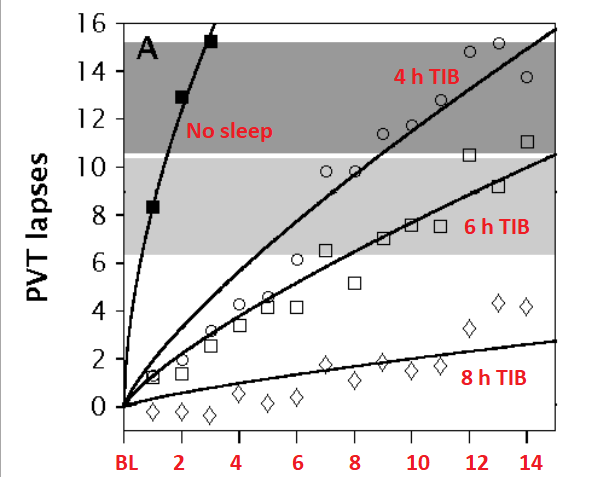
As expected, lapses increase as a function of sleep loss (a lapse is a signal that was missed by the participant during the PVT; higher lapses indicate higher cognitive impairment).
However, what I found more interesting is that performance deteriorated in both the 6- and 4-hour nightly sleep groups such that after 14 days these groups performed as **poorly as somebody kept awake for 24 hours continuously**.
Moreover, the 4-hour sleep group after 14 days performed as **poorly as somebody kept awake for 3 whole days**.
This is really problematic since chronic sleep loss is endemic across modern society, with small but consistent nightly losses of a little sleep that accumulate over time.
People are objectively impaired, but subjectively acclimatise to sub-par performance, believing themselves to be refreshed.
Link to the LinkedIn post: https://www.linkedin.com/posts/benhutchinson2_more-on-the-links-between-sleep-disruption-activity-7015081203728863232-N4df?utm_source=share&utm_medium=member_desktop
Sources
Image 1: Dembe, A. E., Erickson, J. B., Delbos, R. G., & Banks, S. M. (2005). Occupational and environmental medicine, 62(9), 588-597.
Image 2: Van Dongen, H., Maislin, G., Mullington, J. M., & Dinges, D. F. (2003). Sleep, 26(2), 117-126.

 SafetyInsights.org
2 thoughts on “Chronic sleep loss and occupational injury”