Drawing on a grounded theory approach and a mental model focus, this explored why electricians work on energised apparatus. 60 electricians provided in-depth interviews.
Results
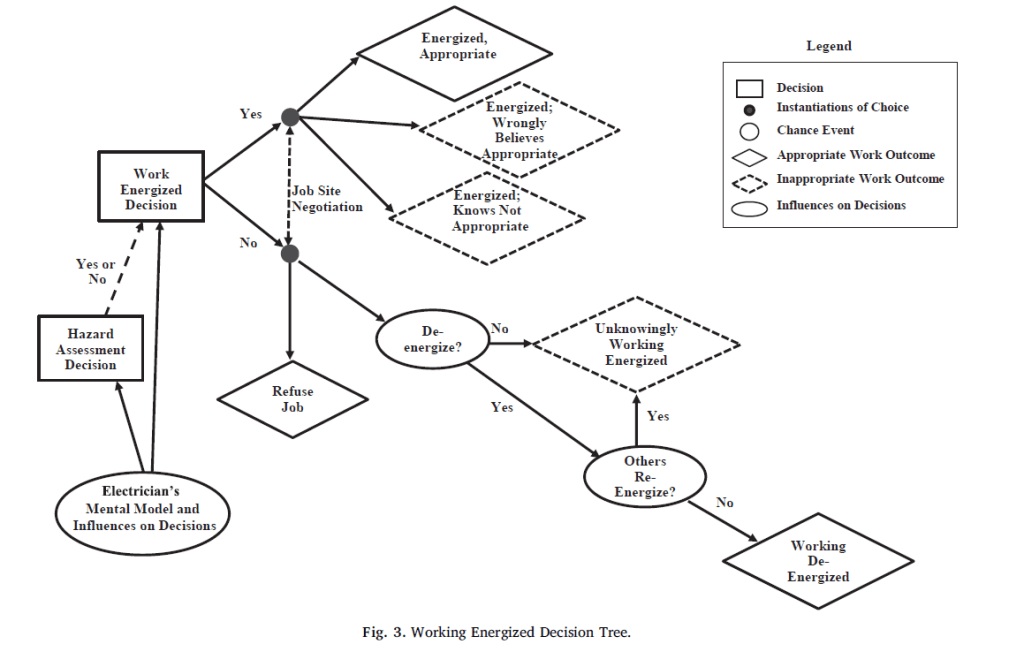
Data indicated that electrical work is cognitively demanding and working energised is not a simple yes/no choice, but rather strongly influenced by a range of factors. Including: the belief that certain tasks need to be energised, pressures from clients or customers (requiring trade-offs), environmental factors, or unknowingly working energised.
Electricians’ mental models influence their perception or risk. Electricians’ are aware of the dangers of live work, and said that their key priority is to get home safely (indicating that safety is more complex than just caring more, since they clearly do not want to die at work). While live work was the main risk, electricians also cited working at heights and some other factors.
20-25% of responses indicated that sometimes live work is necessary. This involved troubleshooting or testing, particularly in critical areas like hospitals or roadways, where safety would be compromised.
Overt pressures was another reason for working live, including from clients and customers. Some electricians believe that they need “a good reason” to refuse working energised. Moreover, if they refuse, a belief is that another electrician will do the job instead if that’s what the customer or client demands. Some said they need to negotiate safety, such as night work, to avoid shutting down critical systems. Problematically, electricians don’t necessarily find it easy to negotiate safety or convince customers – and this skillset isn’t covered in their electrical apprenticeships.
Sometimes working energised happens unexpectedly – 45% gave instances where they were working under the belief of deenergisation, but the asset was live. Factors included being wrongly told it wasn’t live, somebody re-energising the asset, the wrong thing being de-energised and more.
While they were aware of the risks, many didn’t undertake hazard assessments. When asked how they decide to do live work, many said they consider the situation and the risks, availability of PPE etc. For those that said they did “formal” hazard assessments, interestingly their perception of what a formal assessment entailed differed. For some it was a written checklist or assessment, to others it was a 5-minute talk and other methods.
Regarding the safety steps they take for live work, PPE was cited in ~95% of cases, compared to only half respondents indicating the use of testers or LOTO.
Overall, electricians’ decisions to work live is influenced by a range of contextual factors such that “we see the complexity of these seemingly simple decisions and the physical and cognitive demands electricians routinely work under” (p11).
I think the recognition that behaviour operates often within work environments where local rationality, constraints, trade-offs and other factors operate, is important for our capacity to learn, engage and systematically improve.
A decision tree based on the data was produced:
Authors: Laurel C.Austinab Daniel C.Kovacs bSarahThorne bJoel R.K.Moody, 2020, Safety Science
Study Link: https://doi.org/10.1016/j.ssci.2020.104826
Link to the LinkedIn post: https://www.linkedin.com/pulse/using-grounded-theory-mental-modeling-understand-why-ben-hutchinson


