I just summarised a really interesting paper exploring the role of “no blame” (if that’s ever truly a thing…) in construction investigations.
Summary posted in the next week or two, but it’s open access so you can read the full paper yourself.
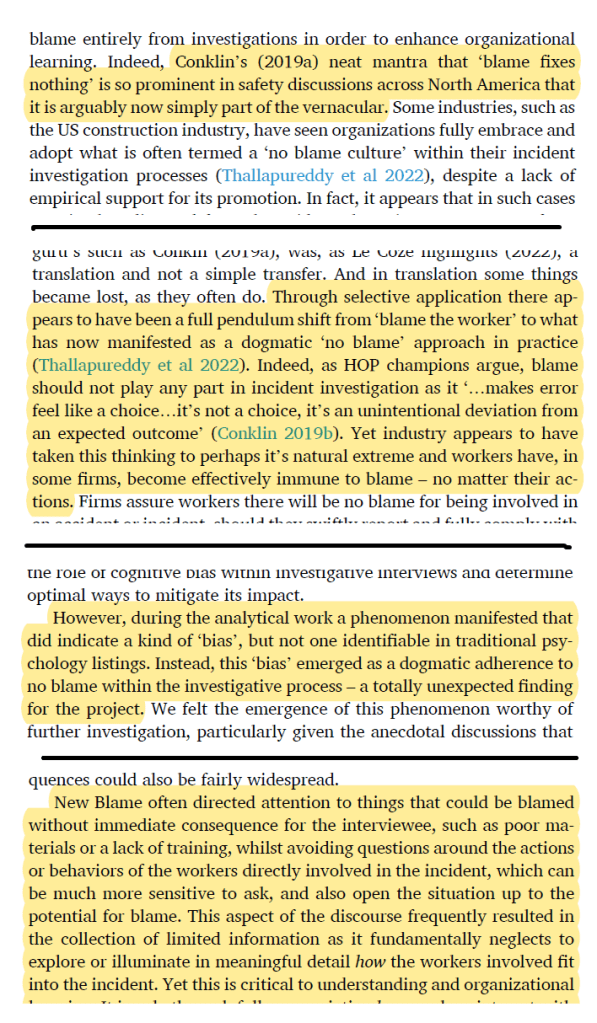
Interestingly, they observed a phenomenon which they called ‘New blame’.
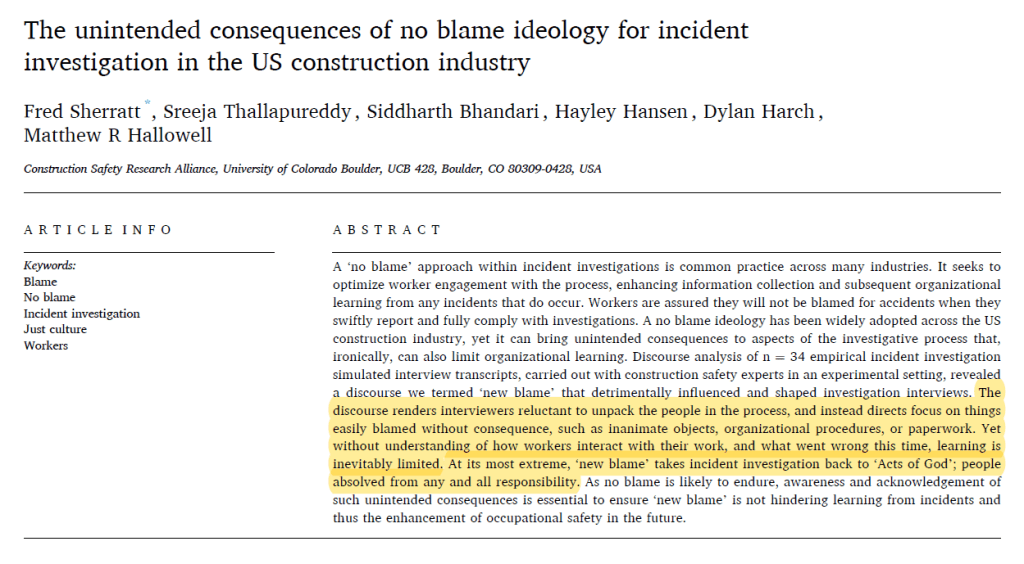
New blame was a reluctance to focus on human action, behaviour and agency during investigations and towards largely “faceless and blameable” inanimate objects, processes, systems etc.
Moreover, in trying to avoid blame in investigations – investigators frequently introduced the discourse of blame by mentioning it within the very first sentence; placing it front and centre.
At the extreme, they conject whether new blame may have reintroduced the saliency of ‘Acts of God’ –largely intangible things which can be readily blamed—but of which without considering how people are affected by them or how the workers fit into the work and influenced by these factors “are as practically useless as once again ascribing [responsibility] to an ethereal deity in the sky” (p10).
Whatever spectrum of safety camp you sit (if any), it’s certainly an interesting read.
Source: Sherratt, F., Thallapureddy, S., Bhandari, S., Hansen, H., Harch, D., & Hallowell, M. R. (2023). Safety Science, 166, 106247.
Study link: https://doi.org/10.1016/j.ssci.2023.106247

 SafetyInsights.org
One thought on “No blame ideology in investigations and ‘New blame’ (and the potential influence of HOP)”