What are the applications and shortcomings of JSAs across industry? An upcoming summary reviewed the literature to explore these questions.
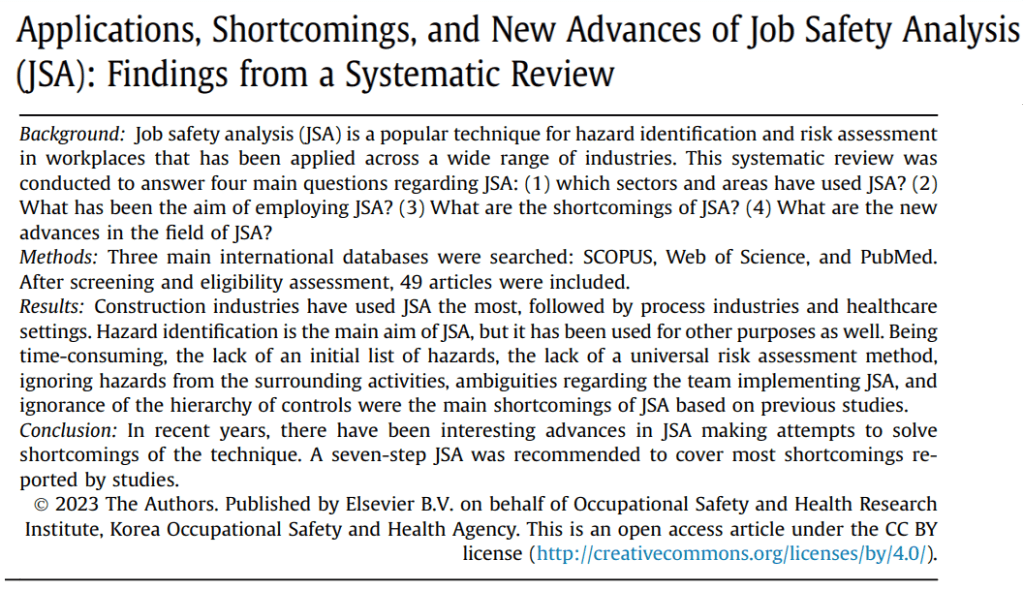
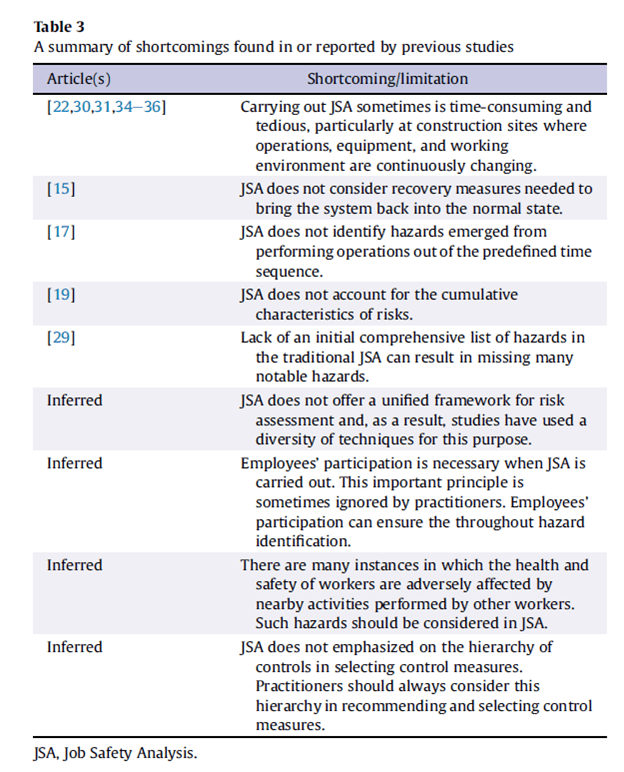
Unexpectedly, JSAs being “tedious and time-consuming to perform was the most frequent drawback mentioned by studies”.
Other expected shortcomings:
· Lack of a universally accepted risk assessment framework to accompany JSAs
· Lack of worker participation in the process, since many studies didn’t explicitly mention the degree of worker participation
· Only 37% of the 49 articles mentioned that the JSA was completed by a team
· Inability of JSA to assess the effect of hazards posed by nearby activities
· On this, they argue “JSA is carried out based on the general working environment and ignores nonroutine/routine conditions in which the health and safety of workers are threatened by surrounding activities”
They also argue that it’s not clear how effective the control measures specified in JSAs are managing operational risks, because of wide inconsistencies in risk assessment methods.
Discussing the findings, they conclude that “JSA suffers from a number of serious shortcomings” which makes “supervisors and employees reluctant to conduct the method and use its benefits before starting the work”.
Ref: Ghasemi, F., Doosti-Irani, A., & Aghaei, H. (2023). Safety and Health at Work.
Study link: https://doi.org/10.1016/j.shaw.2023.03.006


One thought on “Shortcomings of JSAs”