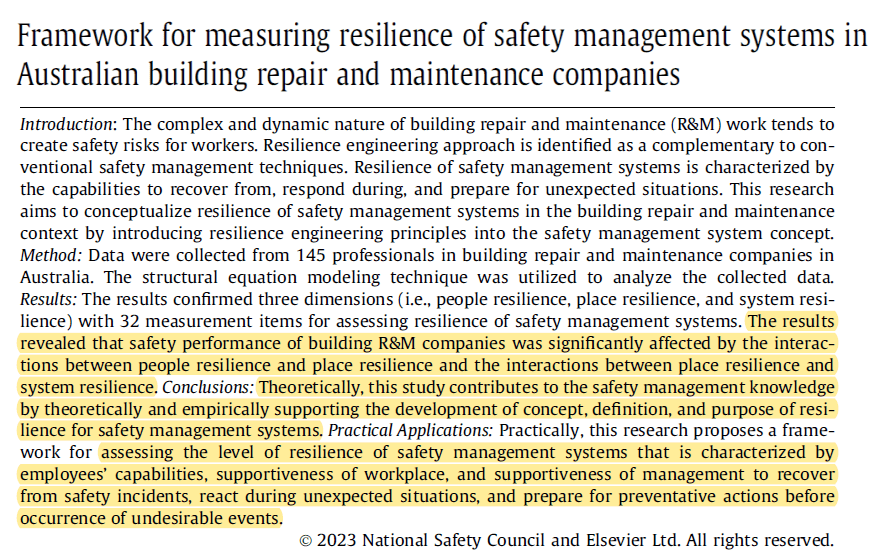
An upcoming summary is a paper that evaluated the role of resilience engineering principles in managing safety in building repair and maintenance.
Multiple definitions of resilience exist, as do resilient capacities. However, a common thread is the ability to make adjustments under varying conditions.
These adjustments are described as:
1) reactive, where adjustments are needed in the post disruption phase and to rebound from disruptions to the original state,
2) concurrent, where rapid reactions take place during the disruption phase and,
3) proactive, where adjustments are made to transform normal operational functions into a state of enhanced preparedness prior to disruptions.
Key findings included:
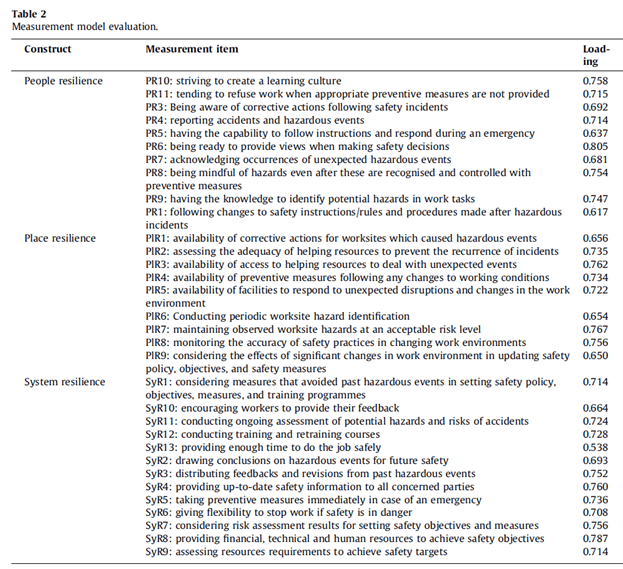
· Three dimensions of resilient capacity were confirmed in this sample: people resilience, place resilience and system resilience.
· Safety performance of building repair and maintenance was “significantly affected by the interactions between people resilience and place resilience and the interactions between place resilience and system resilience”.
· Interesting (for a Resilience Engineering paper), they also evaluated the relationship between resilience capacities and LTIFR – finding a significant negative correlation (as one goes up, the other goes down).
Authors: Pilanawithana, N. M., Feng, Y., London, K., & Zhang, P. (2023). Journal of safety research.
Study link: https://doi.org/10.1016/j.jsr.2023.04.008

 SafetyInsights.org
One thought on “Resilience Engineering in building repair and maintenance”