I found this an interesting study that systematically reviewed the evidence on the physical and psychological hazards in the gig economy system.
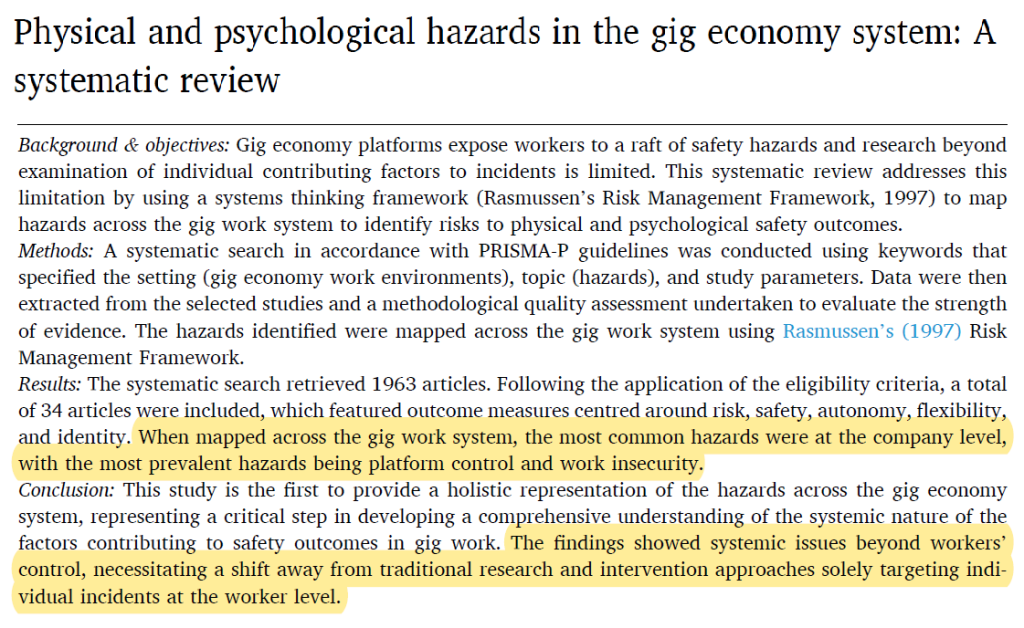
Findings were framed via Rasmussen’s risk framework.
It’s open access, so you can freely read the full paper.
The gig economy is an economic model “where companies temporarily hire individuals as independent contractors to complete ‘gigs’ as demand, via digital applications, dictates”.
Challenges of gig economy situations is that workers are “exposed to asymmetric power and has little to no control over the commission and performance expectations associated with their work”.
And further, “unregulated competition for work combine to encourage improperly classifying workers as independent contractors, which is particularly rife in the cleaning, courier and passenger transport, task-based work, and food delivery industries”.
Working arrangements, misclassification of workers, lack of bargaining power, psychosocial risks and insufficient safety management and training are common hazards.
Evaluating the research, they found:
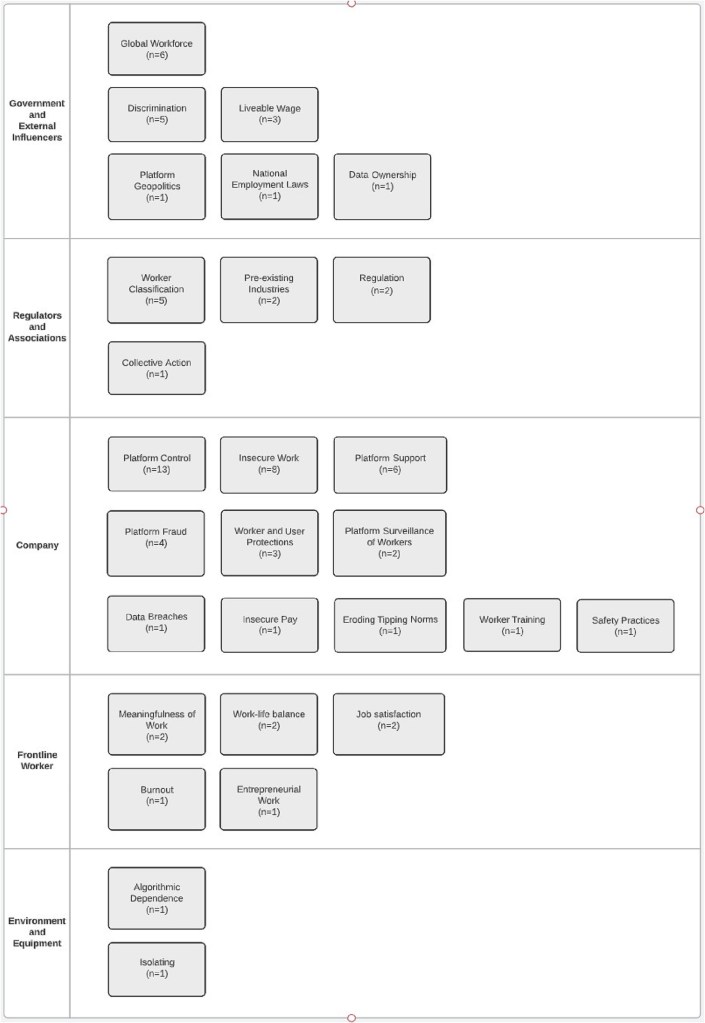
· A large number of hazards were at the government / external level, including unregulated global competition and discrimination
· Next was the regulation level, including threat of worker classification. Liveable wages, job security and working conditions; gig economy companies “utilise self-employment classifications to transfer risk onto individuals, who through this classification, are unprotected by traditional employment entitlements”
· At the company level – large power imbalances were found. Platform features like price fixing, worker surveillance and instantaneous termination “controlled and micro-managed gig economy workers to the extent that their job security and meaningfulness of work was compromised”
· For frontline factors, job dissatisfaction and lack of meaningfulness of work were two factors of many found
· Finally at the environmental level, algorithmic dependence was a hazard and isolating work environments
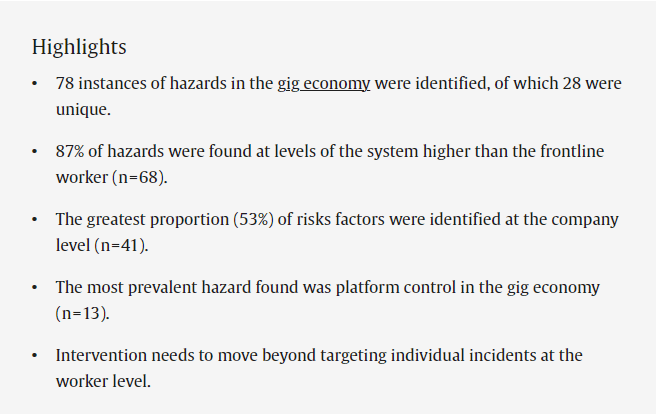
Overall, they say that the “vast majority of hazards are found at levels of the system higher than the frontline worker level”, e.g. company and higher.
Hence, “intervention should not be solely targeted at the worker level. Actors at higher levels of the system need to take responsibility for worker safety and intervention strategies”.
Authors: Taylor, K., Van Dijk, P., Newnam, S., & Sheppard, D. (2023). Safety science, 166, 106234.
Study link: https://doi.org/10.1016/j.ssci.2023.106234

 SafetyInsights.org
One thought on “Physical and psychological hazards in the gig economy system: A systematic review”