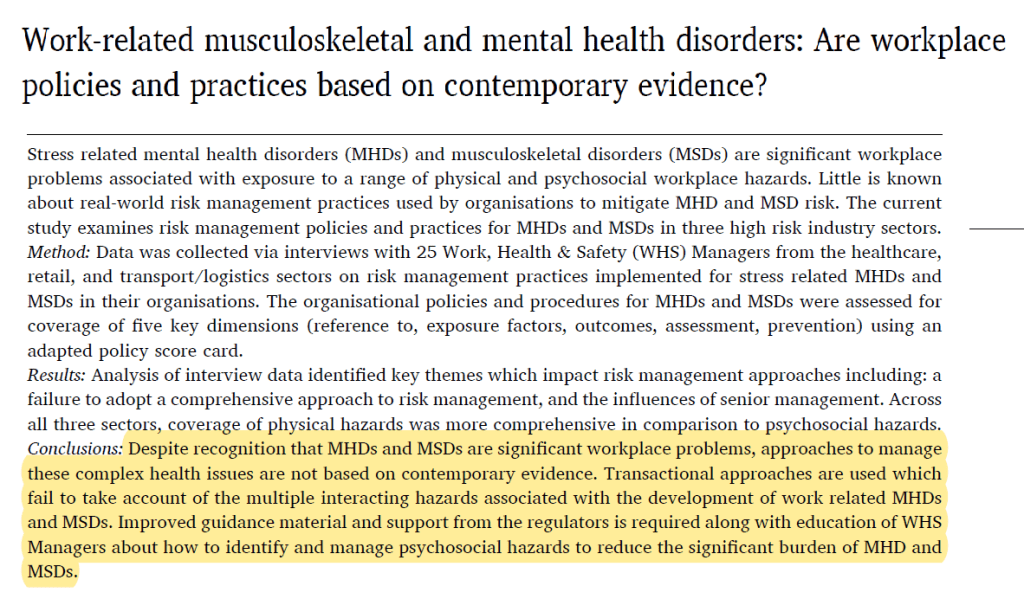
This studied the extent to which psychosocial hazards (categorised under mental health disorders, MHD) and physical hazards (under musculoskeletal disorders, MSD) are covered under work-related MHD & MSD risk management practices across 3 industries and the extent of a disparity towards physical hazards.
Procedures from 3 high risk industry sectors along with interviews with 25 people (healthcare, retail & transport/logistics) were included.
Results
Results indicated that, expectedly, company procedures coverage of psychosocial hazards was limited to physical hazards. The focus on psychosocial hazards narrowly focused on behaviours such as bullying, harassment, aggression & violence with only five organisations providing policies that covered more comprehensive psychosocial hazards like workload, support & job control.
Physical hazards in contrast were comprehensively canvassed across the 3 sectors.
The results suggest that psychosocial hazards may be seen to be “of secondary importance in comparison to other hazards” (p6).
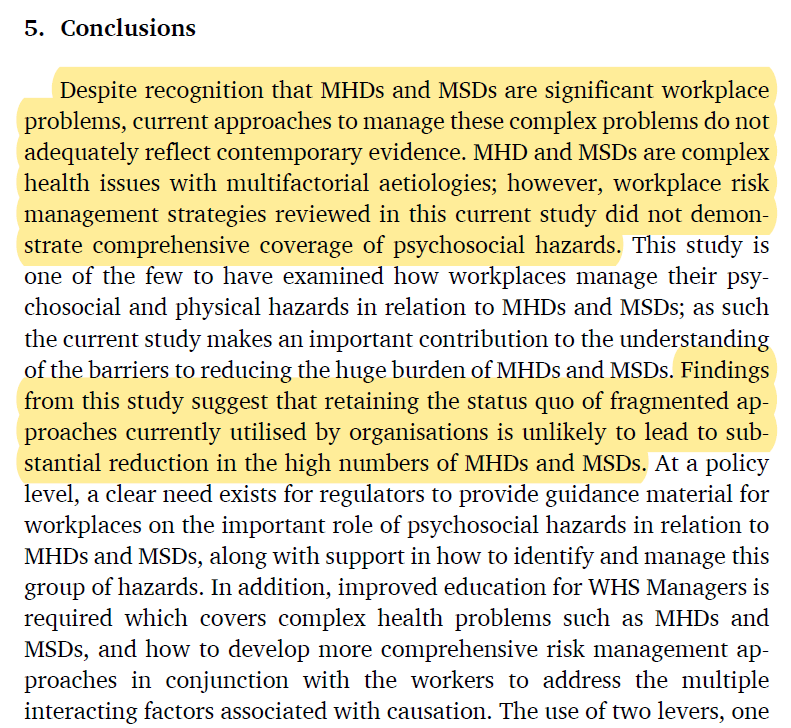
Authors note that despite recognition that MHDs & MSDs are significant workplace problems, “current approaches to manage these complex problems do not adequately reflect contemporary evidence”, with both being complex multifactorial health issues but not having systematic risk management approaches.
Interviewees revealed failures to adopt comprehensive approaches to managing psychosocial issues. Many indicated that their policies lacked clarity around how to manage these issues, and WHS Managers indicated lack of knowledge about how to manage psychosocial hazards.
Lack of knowledge about these issues was said to result in “risk management approaches that were focused on reactive hazard identification and on individual worker behaviour” (p5). On the latter, approaches focusing on workers led to initiatives being focused on worker training & EAPs but not systematic risk management.
Another issue is that the existing policies didn’t translate well into developing effective risk management practices compared to physical hazards, which were more well-defined. Further, current approaches were stacked towards reactive rather than proactive management of issues with an over-reliance on injury & claims data.
Numerous tools for identifying & addressing physical hazards were noted but not many for psychosocial hazards. This was seen as a barrier for people to report psychosocial hazard incidents, and
Noted was there existed too much policy directives, too many guidelines and too much roles & responsibilities in documents and not enough clear direction on what management want them to do.
Another limitation was a perception that policies were “often written to address legal obligations and audit requirements rather than support the process of risk management in MHDs and MSDs” (p5).
Concerningly, some WHS Managers indicated reluctance to include psychosocial hazards in their organisations’ WHS risk management strategies, worried that they may wake a sleeping giant.
To quote the participant, “… if we start teaching people about mental health too much then it all of a sudden becomes a problem. You know, a bit like a repetitive strain injury, and all those things, as soon as you start one thing off then all of a sudden everyone seems to have it” (p5).
In concluding, authors argue that risk management that focuses on hazard ID of individual components rather than the whole system are prone to fail because the core issues won’t be addressed. Focusing on reactive & isolated cases of psychosocial hazards doesn’t reflect current evidence where they should be treated together.
Authors: Robertson, J., Jayne, C., & Oakman, J. (2021). Safety science, 138, 105098.
Study link: https://doi.org/10.1016/j.ssci.2020.105098
LinkedIn post: https://www.linkedin.com/pulse/work-related-musculoskeletal-mental-health-disorders-based-ben-fsjme


One thought on “Work-related musculoskeletal and mental health disorders: Are workplace policies and practices based on contemporary evidence?”