What is the relationship between the magnitude and intensity of energy in workplace sources on fatal and non-fatal accidents? A 2017 study to be posted soon explored these links based on 500 injury reports.
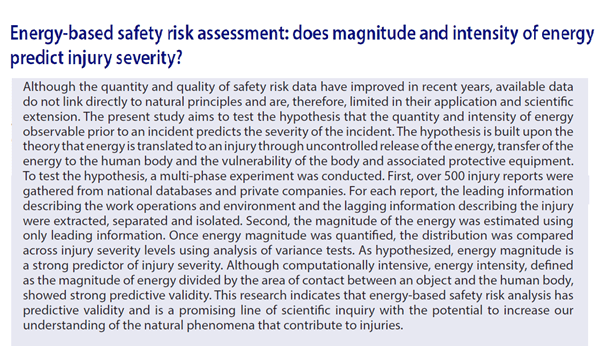
Various energy sources exist in workplaces, e.g. gravitational, kinetic, radiation, chemical etc., hence different means are needed to calculate energy magnitudes.
This study focused on only motion and gravitational energy, hence simple potential energy calculations could be undertaken for energy magnitude. Energy intensity was calculated via energy magnitude and energy transfer area (which incorporates surface area/pressure).
Overall:
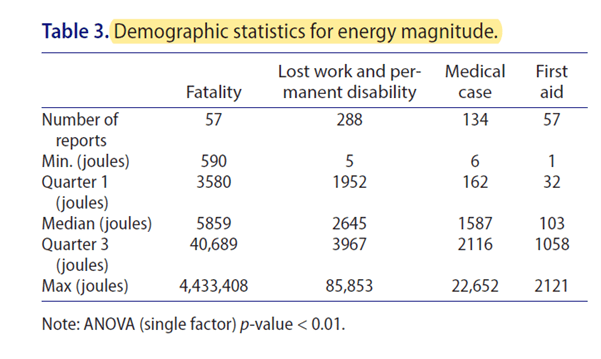
· Energy magnitude is a strong predictor of injury severity – higher energy is more likely to result in fatal outcomes compared to lower energy (see the two attached tables)
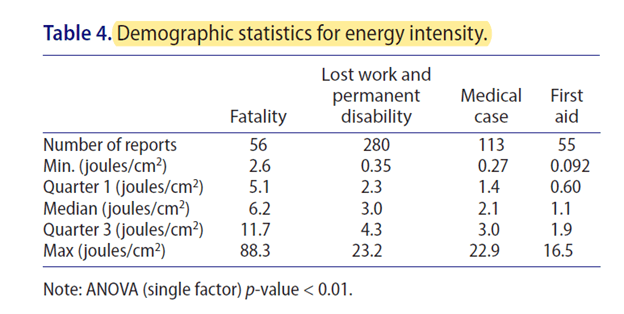
· Energy intensity, although more computationally intensive to calculate, showed strong predictive validity and was a better predictor than magnitude
· Statistically significant differences were found between the energies involved in different injury severities, with estimations possible to demarcate fatal versus non-fatal accidents
· Based on their estimations, a rule of thumb of fatal events having an energy magnitude of 2000 j and energy intensity of 2.56 joules/cm2
Energy intensity couldn’t necessary accurately account for mechanical energy sources (such as from saws, grinders etc.); these energy sources tended to result in higher injury severity than the energy calculations would predict.
This inconsistency is explained largely via body vulnerability (e.g. injuries to the head, neck etc.).
Nevertheless, these types of energy assessments may be useful heuristics for differentiating SIF potential interactions, and the authors have continued this line of research elsewhere in energy-thinking approaches, e.g. the HECA (High-Energy Control Assessments, which proposed 1500 j as a delineation between high vs low energy).
Authors: Matthew R. Hallowell, Dillon Alexander & John A. Gambatese (2017). Construction Management and Economics, 35:1-2, 64-77
Study link: https://doi.org/10.1080/01446193.2016.1274418

 SafetyInsights.org
One thought on “Relationships between workplace hazardous energy and fatal vs non-fatal injury”