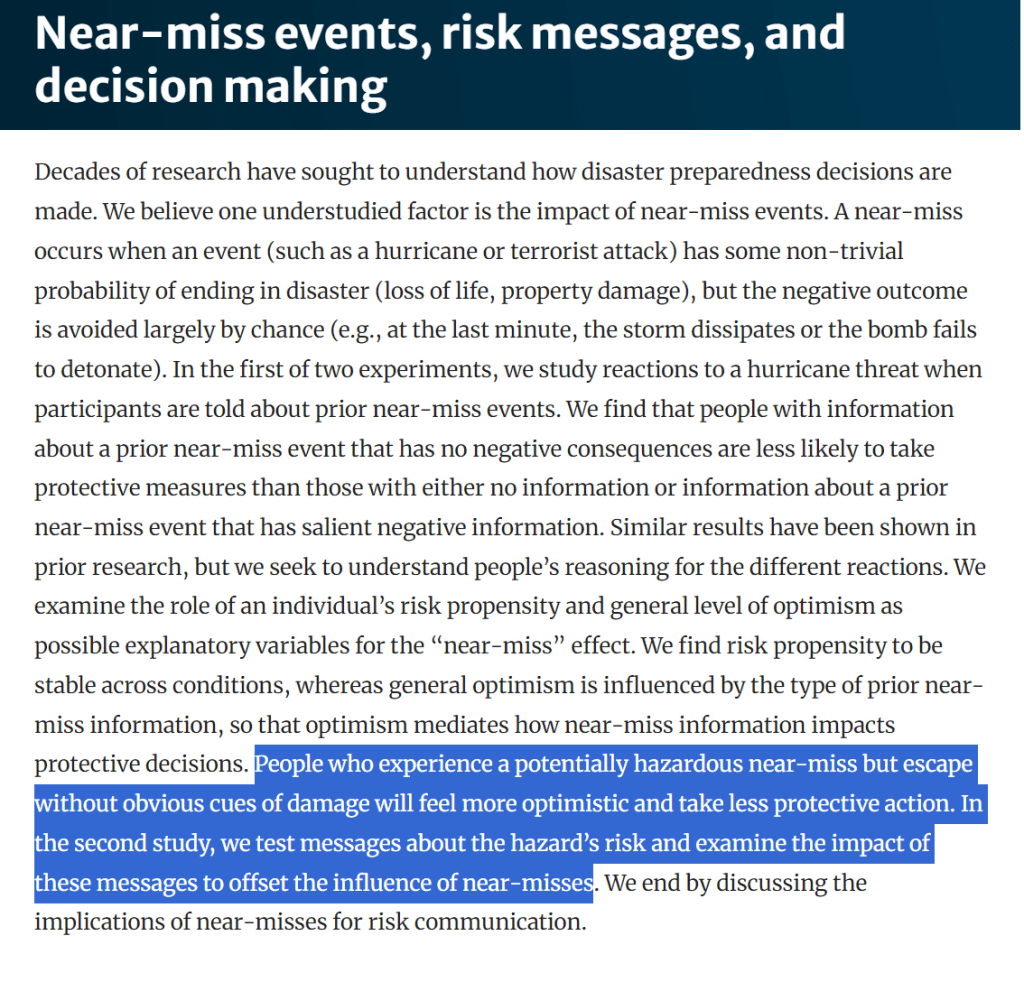
Another study from Dillon & Tinsley which looked at how near-miss events & reporting may increase our exposure to risk rather than improve learning and safety. Again, I’ve done a terrible job summarising this…
This used 2 experiments with participants. In ex.1, participants read a vignette about a planned cruise that could be impacted by a forecasted hurricane and were randomly allocated to 1 of 3 versions.
v1 was a control version indicating that cruises can be diverted by bad weather but no info about past hurricanes was provided.
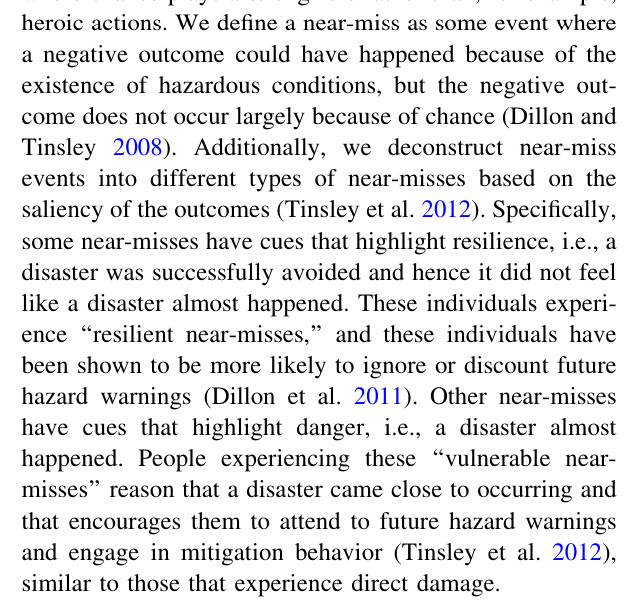
v2 was resilient near-miss version where they were told about hurricanes but the last 3 trips they took were not diverted due to bad weather. Resilient near-misses is where it’s perceived that disaster was successfully avoided. These people are more likely to avoid or discount future hazard warnings.
v3 was a vulnerable near-miss condition where as above but a close friend had their cruise diverted due to a storm. This is where it’s perceived that a disaster came close to occurring and encourages people to seek future hazard warnings and mitigative behaviours.
Results
When participants had info about a prior near-miss (cruise being diverted due to bad weather) but with no salient info about problems that almost occurred, they chose the riskier option to continue the cruise as planned, compared to people with no info about past near-misses or people with salient info about vulnerabilities in past near-misses (the close friend’s experience).
In each condition, people who thought the likelihood of problems was lower stated greater intentions to go on the cruise, but the perception of the likelihood wasn’t influenced by the condition. Further, those who identified as more risk seeking were more likely to choose riskier options but this was independent to the condition.
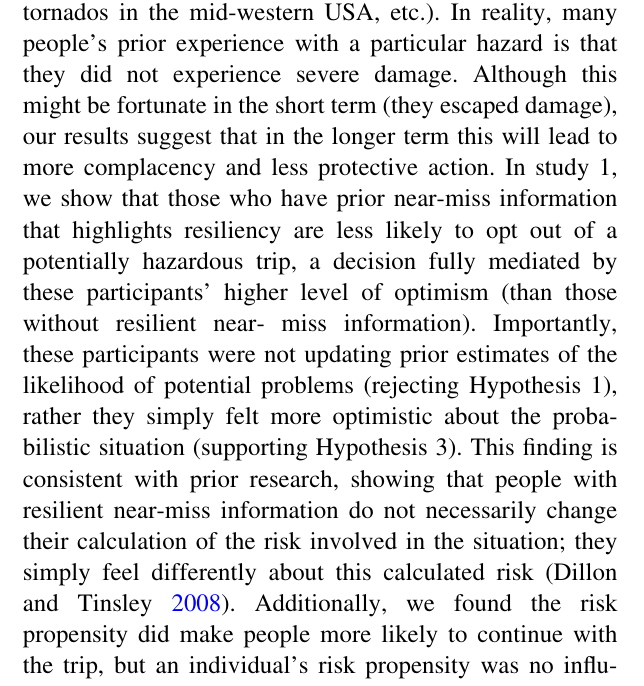
The type of near-miss info provided impacted general optimism of participants, where those with info about a resilient near-miss (seeing near-misses as a positive example of how well disaster was avoided) were more optimistic and more likely to continue with the cruise.
Experiment 2 expanded on the resilient near-miss condition. It found that how the uncertainty or danger of hurricanes was presented to participants influenced their decisions. When near-miss info highlighted the likelihood of a negative event occurring or the associated consequences people were more likely to plan mitigation actions compared to people with no risk messaging.
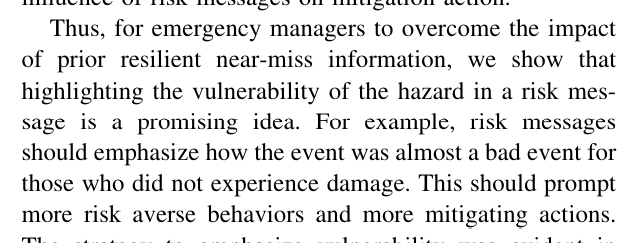
They suggest that for emergency managers and the like to overcome the negative impact of some types of near miss events, they could highlight how the event “was almost a bad event for those who did not experience damage”; a near failure rather than a near success.
Further, people with prior near-miss info that highlights the averted disaster as success are less likely to opt out of a potentially hazardous trip. However, people don’t necessarily update their prior estimates of the likelihood of potential problems (e.g. no evidence for a Bayesian approach) but they rather feel differently about the statistical risk.
These series of studies strongly suggest that near-miss events & reporting may contribute to a state of heightened risk, where decisions drift towards the margins of safety over time and how some near misses dampen our feelings of vulnerability to harm rather than sensitise us to them.
Authors: Robin L. Dillon & Catherine H. Tinsley 2015, Environment Systems and Decisions
Link to the study: https://doi.org/10.1007/s10669-015-9578-x
Link to the review on LinkedIn: https://www.linkedin.com/pulse/near-miss-events-risk-messages-decision-making-ben-hutchinson

 SafetyInsights.org