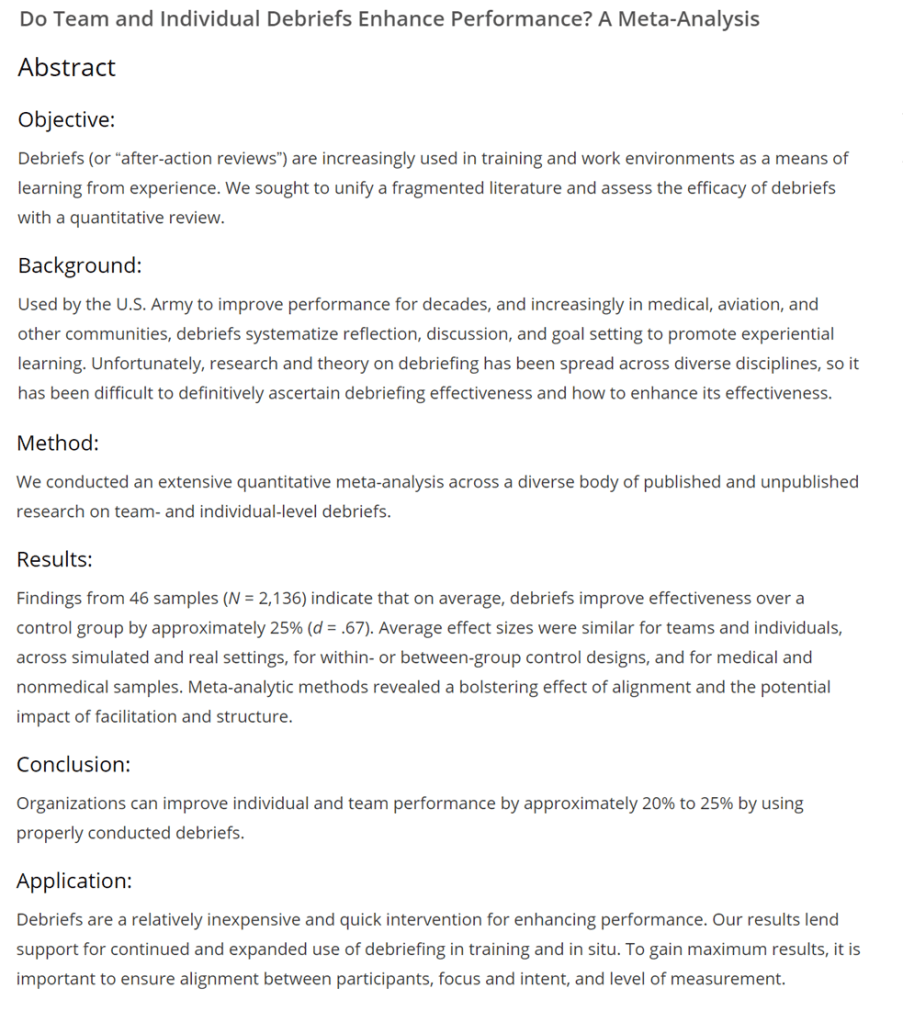
This meta-analysis evaluated the evidence on the effectiveness of individual and team debriefs on improving performance – for instance after-action reviews (AARs).
46 studies met inclusion.
Providing background:
· The US military has used AAR, also called debriefs, for decades. Used to facilitate improvements in learning and performance
· Debriefs facilitate individuals through a series of questions, allowing people to reflect on recent experience, “construct their own meaning from their actions, and uncover lessons learned in a nonpunitive environment”
· Debriefs are a form of “emergent learning”, where “individuals use an iterative process of reflection and planning to improve performance”
· Personal and active engagement produces “a different type of insight than do more passive experiences”, where “Self-discovery has been shown to be a key factor in effective developmental experiences”
· Active learning are said to push learners to engage in experimentation with ideas and actions, which reinforces cycles of learning
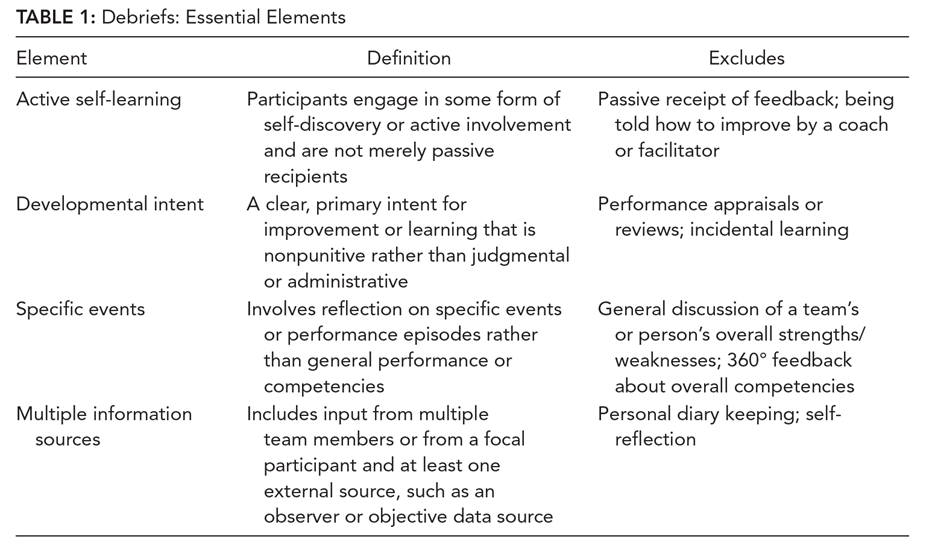
· To be considered a true debrief, some active self-learning and self-discovery by participants must occur
Some essential elements are shown below
Results
Key findings:
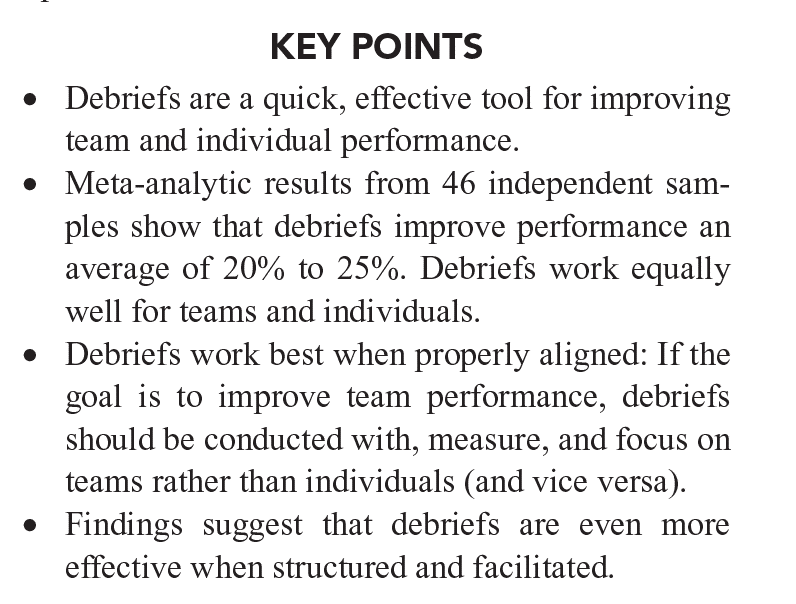
· On average, debriefs improved effectiveness over a control group by ~25%
· Average effect sizes were similar for teams and individuals across simulated and real settings
· There was a bolstering effect where alignment between participants, focus and intent, and the potential impact of debrief facilitation and structure (e.g. facilitated and structured debriefs)
· Debriefs are said to be “a relatively inexpensive and quick intervention for enhancing performance”
Debriefs were found to be a “potentially powerful yet simple tool to improve the effectiveness of teams and individuals”.
On average performance was improved by 25% by use of debriefs, and even after excluding the three largest effect sizes of a debrief intervention, performance still improved by an average of 21%.
They say that an improvement of even 20% seems like an encouraging and potentially inexpensive cost for the benefits, based on the little time required; average debriefs were found to last ~18 mins).
Aligning participants, intent and measurement yielded the strongest effect sizes. When the goal is to improve team performance, then it makes sense for the team to debrief as a while, with the goal of improving team performance.
Debriefs studied specifically in the context of team performance could improve group performance by up to 38%. Nevertheless, individual effectiveness was also improved by focusing on individual performance.
Moreover, while alignment should be the goal, “even “misaligned” debriefs demonstrated a reasonable level of efficacy, suggesting a broad range of acceptable applications”.
They also examined how facilitation, structure and multimedia affected the quality of performance improvements following debriefs.
While they can’t reach strong conclusions here due to the study limitations, the general pattern was that structure enhances debrief effectiveness (e.g. moderate structure vs unstructured debriefs), but noting limitations.
Use of multimedia aids didn’t show any meaningful improvement in debrief effectiveness. This doesn’t mean they aren’t useful, but that the evidence didn’t support them (also likely due to the study limitations).
They say that similar to web-based training, the design of the intervention may be more important compared to the media employed.
They say that overall the efficacy of debriefs was robust. No observable relationship between effect size and publication year, gender mix, time spent debriefing or team size were found.
Quoting the paper, “Organizations are looking for ways to promote on-the-job learning”, hence, “There is a clear opportunity to use debriefing as a way to promote team and individual learning from “real,” in situ experiences more frequently”.
Authors: Tannenbaum, S. I., & Cerasoli, C. P. (2013). Do team and individual debriefs enhance performance? A meta-analysis. Human factors, 55(1), 231-245.
Study link: https://doi.org/10.1177/0018720812448394
My site with more reviews: https://safety177496371.wordpress.com
LinkedIn post: https://www.linkedin.com/pulse/do-team-individual-debriefs-enhance-performance-ben-hutchinson-59sdc

 SafetyInsights.org
One thought on “Do Team and Individual Debriefs Enhance Performance? A Meta-Analysis”