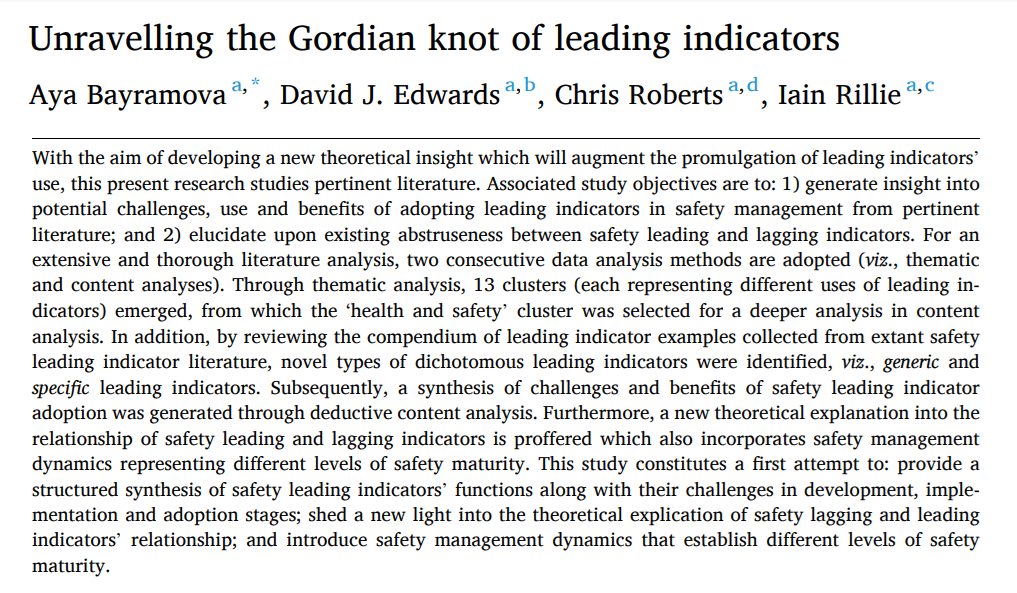
This new study systematically reviewed the literature on safety indicators and thematically analysed their descriptions, aiming to:
- identify potential challenges, use and benefits of adopting Leading Indicators (Lis) in safety management
- clarify any existing abstruseness between leading and lagging indicators
- provide some guidance on how Lis can be adapted for use
Not a summary – but the paper is open access so you can read it yourself.
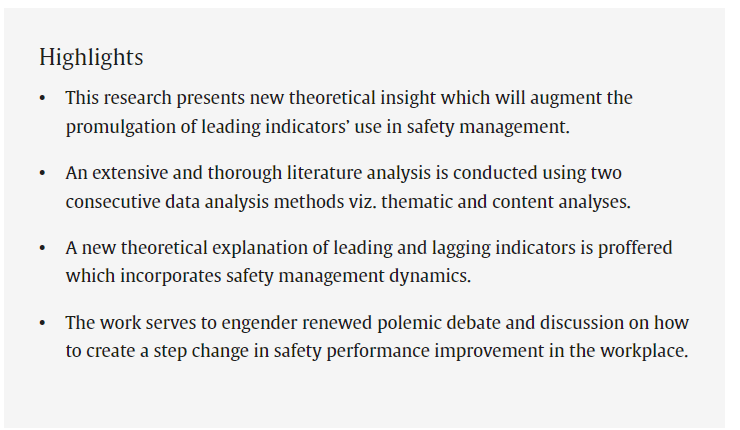
From the paper:
- They discuss the origins of Lis from economics, where “in economics where a measured object is of quantitative and explicit nature is different from using LIs to measure an incorporeal object such as safety”
- Challenges in measuring facets of performance include “the length of time between the action or influence taken and their consequences is long and difficult to correlate … 2) the object being measured occurs by the impact of multigranular, multilevel and multifarious elements (Leveson, 2015); 3) manifestation (or otherwise) of those measured objects are not easily controlled/influenced or tracked … and 4) the object being measured requires continuous monitoring, since the measurement (or the state of the object) is dynamic over time”
- Importantly, “Measurement of safety falls under all these four categories, since safety is dynamic over time …, not easily discernible or sampleable …, the impact of steps taken to improve safety takes longer time to measure … Moreover, safety occurs or fails to occur due to multifaceted and nuanced interplay of multifarious elements”
- Others “cite the paradox associated with safety which states that the success or return from efforts put to maintain safety is not visible or measurable, since the outcome from enhancing safety is indiscernible”
- Hence, organisations often “tend to opt for a more solid measurement of safety, i.e. lagging indicators (which reflect the outcome or past performance of safety”
- However, “safety is not a binary state of its presence and absence; rather there is a ‘grey area’ or period between those two, where the condition might not be safe but an accident has not yet manifested (Guo and Yiu, 2015). This ‘grey area’ is also referred to as ‘drifting to danger or disaster’ (Zwetsloot et al., 2014) ‘slow deterioration of the process’ … or ‘false comfort zone”
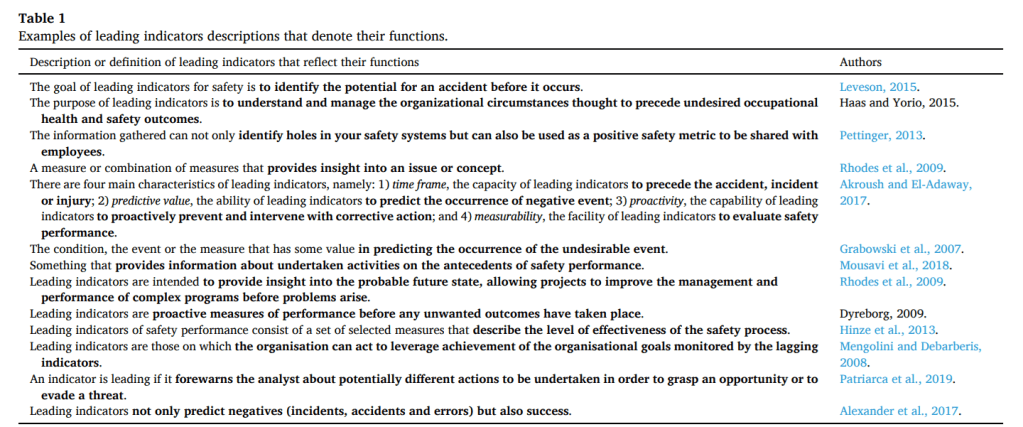
- Multiple descriptions and functions of Lis exist in the literature. Some relate the functioning to “measure and predict positives (i.e. success in maintaining safety, resilient capacity and continuous learning) rather than solely concentrating on negatives (i.e. incidents, accidents and errors)”
- Others relate Lis as feedback about process compliance, as a predictor of future process problems
- Others still highlight feedback nature of Lis, “calling for development of real-time outcome LIs instead of activity LIs such as number of safety audits conducted, number of workers trained or number of risk assessments completed”
- The authors identified two themes of Lis – generic Lis and specific Lis
- “Generic LIs are abstract and do not specify any activity or task to be followed or counted. Examples of generic LIs are ‘safety auditing’ (Xu et al., 2021), ‘workload’ (Sun et al., 2019), ‘cramped spaces’ (Jemai et al., 2021) or ‘employee involvement’ (Almost et al., 2019)”
- Generic Lis “serve the function of indicating to an aspect of safety that need to be considered but do not provide a specific step/task/activity to act upon” and reflect facets not easily quantified, or perception-based elements like ‘audit compliance’
- Specific Lis “specify a required condition, situation or activity (refers to specific LI function) to achieve a certain goal (e.g. avoidance of unfavourable events or maintenance of safety status)”
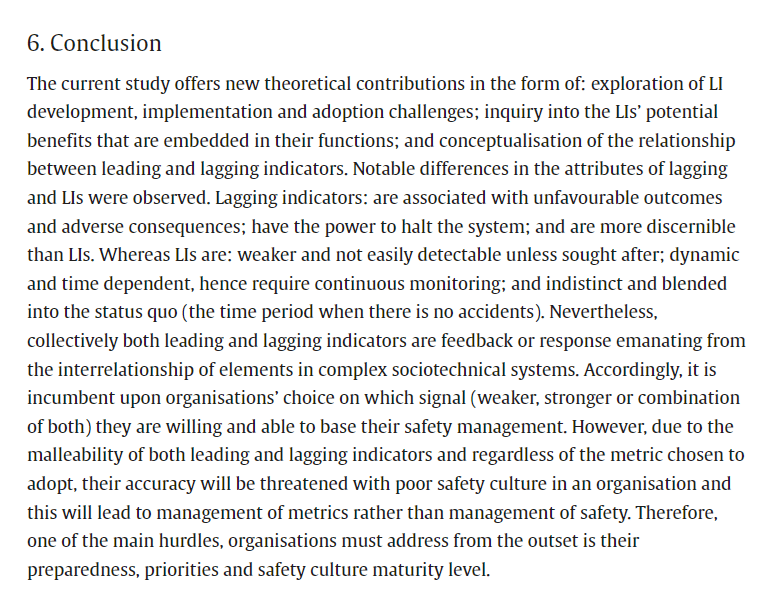
- They then list out a range of challenges associated with stages of developing, implementing and adopting Lis – see attached image for a small selection but there’s lots more
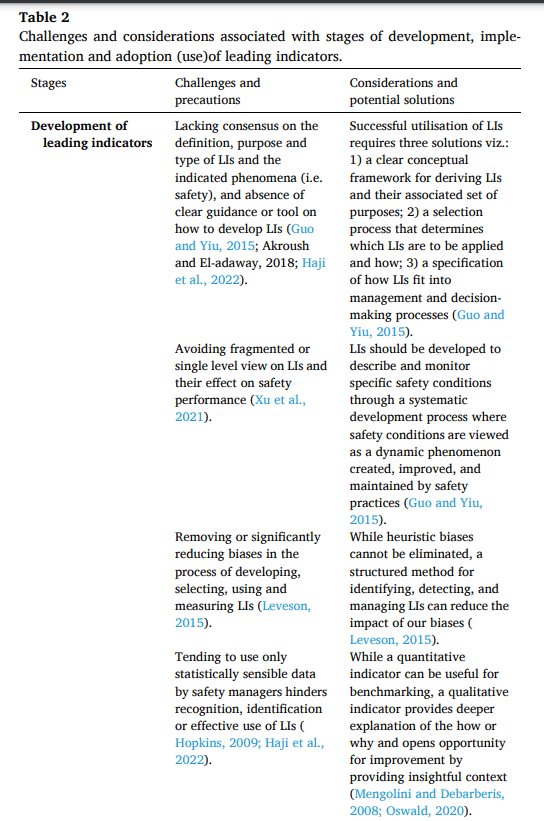
- Some include lacking consensus on the definition or purpose of LIs, being fragmented or focused on a single level of performance
- “Tending to use only statistically sensible data by safety managers hinders recognition, identification or effective use of Lis”, noting that while quantitative LIs can be useful a “qualitative indicator provides deeper explanation of the how or why”
- And a bunch more stuff
Ref: Bayramova, A., Edwards, D. J., Roberts, C., & Rillie, I. (2024). Unravelling the Gordian knot of leading indicators. Safety Science, 177, 106603.
Study link: https://doi.org/10.1016/j.ssci.2024.106603
My site with more reviews: https://safety177496371.wordpress.com


One thought on “Unravelling the Gordian knot of leading indicators”