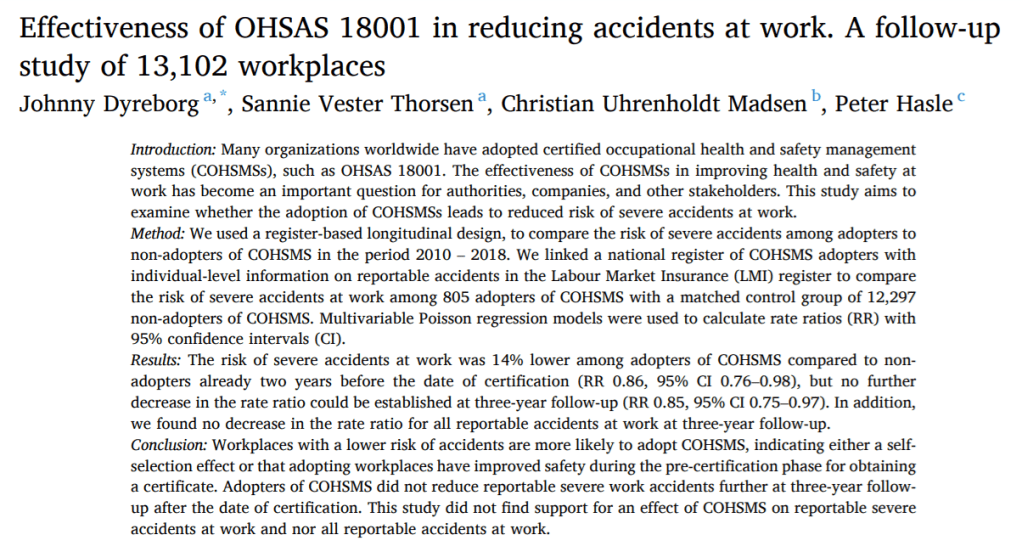
This study evaluated the effectiveness of adopting certified OHSAS 18001 systems among 805 adopters versus 12k matched controls (non-adopters).
Providing background:
· Some research has highlighted a positive difference for organisations adopting certification, like adopters “more likely to enforce OHS rules and procedures than non-adopters were, and that the level of safety training was also higher among adopters”
· Another study found that adopters “fared better than non-adopters in terms of the relative number of safety violations identified by the Occupational Safety and Health Administration”
· Other work suggested that adopters seemed to have a higher overall level of OHS efforts, but cross-sectional research designs ruled out causal direction
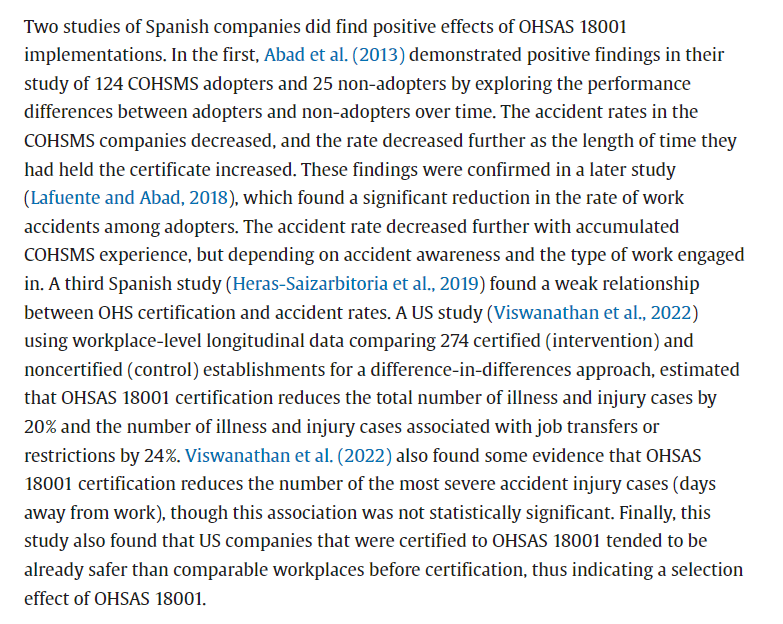
· One Spanish study found positive effects of adopting a certified system where accident rates seemed to decrease
· Another Spanish study found “a weak relationship between OHS certification and accident rates”
· For mechanisms why certified systems may work – one perspective is that implementation “entails an operational focus where the intervention is intended to improve the safety management of a workplace by providing systematic tools, such as plan-do-check-act procedures, continuous improvement”
· One driver of certification might be legitimation, e.g. “implementation might be more focused on increased legitimacy among important stakeholders and an improved public image as the primary driver for being certified”
· And, “Where COHSMS workplaces have a strong focus on the institutional effects of the COHSMS implementation, this might counter or limit the effect of an operational focus”
· [** Other work has called the legitimacy motive “window dressing”, that is, being seen to care enough about safety by becoming certified; other work still may call this symbolic safety or demonstrated safety]
Results
Key findings were:
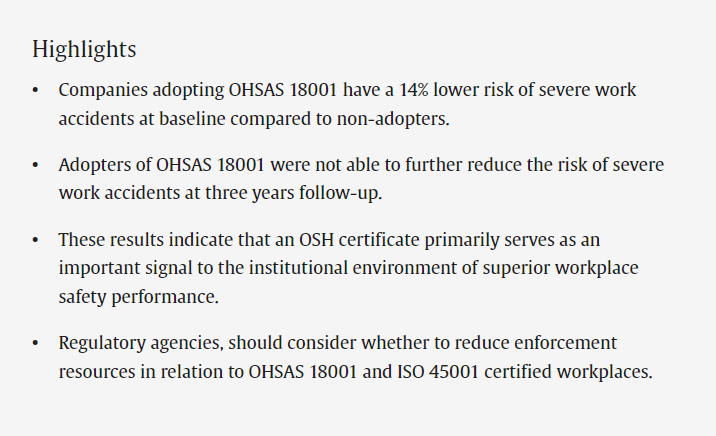
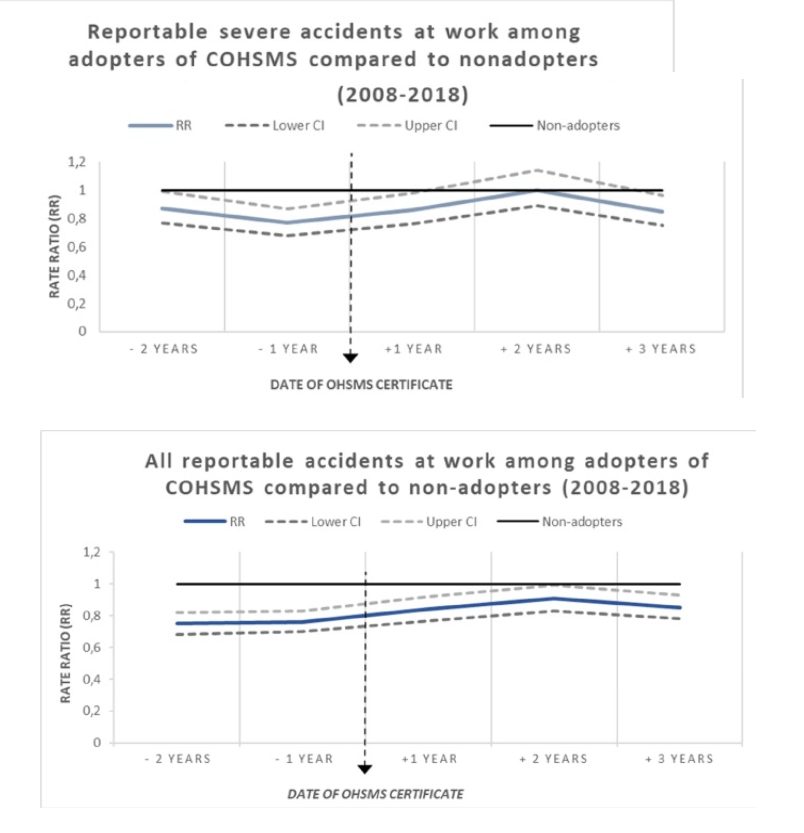
· “The risk of severe accidents at work was 14% lower among adopters of COHSMS compared to non-adopters already two years before the date of certification (RR 0.86, 95% CI 0.76–0.98), but no further decrease in the rate ratio could be established at three-year follow-up”
· “These results indicate that companies with an above-average pre-certification OHS performance constitute the ones who obtained an OHSMS certificate, and thus constitute a pre-certification selection effect”
· They “found no decrease in the rate ratio for all reportable accidents at work at three-year follow-up”
· They say that these findings support some other findings (but not entirely) that, for instance, US certified companies to 18001 “tended to be safer than comparable workplaces before their certification”.
· Moreover, they note that “The results are also in line with the findings of Uhrenholdt Madsen et al. (2022) that adopters of COHSMS perform better than non-adopters, with regard to both process-related OHS efforts and content-related OHS efforts like accident prevention measures. The results could not support the hypothesis that adopters after the introduction of COHSMS reduce the risk of severe accidents at work in the three-year follow-up”.
· They observe some evidence that “there is a tendency (see Table 3 and Fig. 4) suggesting that the introduction of COHSMS does improve companies’ procedures relating to the reporting of less severe accidents”, but this tendency wasn’t significant for severe accidents.
· Interestingly, they discuss input received from the Danish national accreditation body, standards and other certification representatives who confirm that “some companies might wait until they have a good safety record before seeking certification, i.e., they make the (not insignificant) investment in the certificate when they are sure that they will pass the audit and therefore initiate safety improvements before they start to work with certification agencies”.
· They also discussed feedback about large companies having pre-certification audits with a certification agency, who provides feedback on what needs to be changed prior to certification [** My peers will smile knowing how common this practice is.]
In concluding, they highlight that:
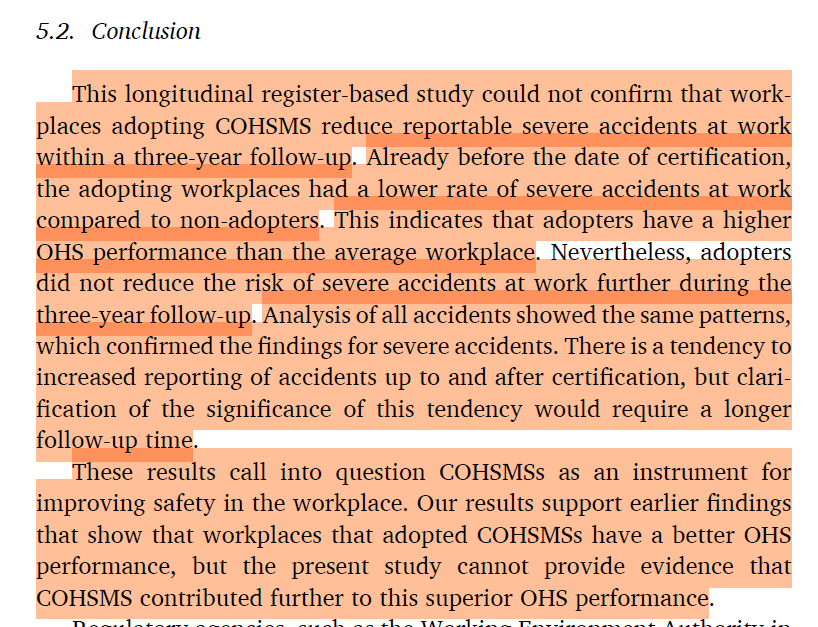
· “This longitudinal register-based study could not confirm that workplaces adopting COHSMS reduce reportable severe accidents at work within a three-year follow-up”
· “Already before the date of certification, the adopting workplaces had a lower rate of severe accidents at work compared to non-adopters. This indicates that adopters have a higher OHS performance than the average workplace”
· Nevertheless, “adopters did not reduce the risk of severe accidents at work further during the three-year follow-up. A’
· “These results call into question COHSMSs as an instrument for improving safety in the workplace”
· “Our results support earlier findings that show that workplaces that adopted COHSMSs have a better OHS performance, but the present study cannot provide evidence that COHSMS contributed further to this superior OHS performance”
Authors: Dyreborg, J., Thorsen, S. V., Madsen, C. U., & Hasle, P. (2024). Effectiveness of OHSAS 18001 in reducing accidents at work. A follow-up study of 13,102 workplaces. Safety Science, 177, 106573.
Study link: https://doi.org/10.1016/j.ssci.2024.106573
My site with more reviews: https://safety177496371.wordpress.com
LinkedIn post: https://www.linkedin.com/posts/benhutchinson2_activity-7216531559095443456-3FOS?utm_source=share&utm_medium=member_desktop

 SafetyInsights.org
Kudos on the the discipline of putting this info out into the world, even when the thought of looking at another paper doesn’t seem feasible. Keep on trucking.
LikeLike
Appreciated, thanks
LikeLike