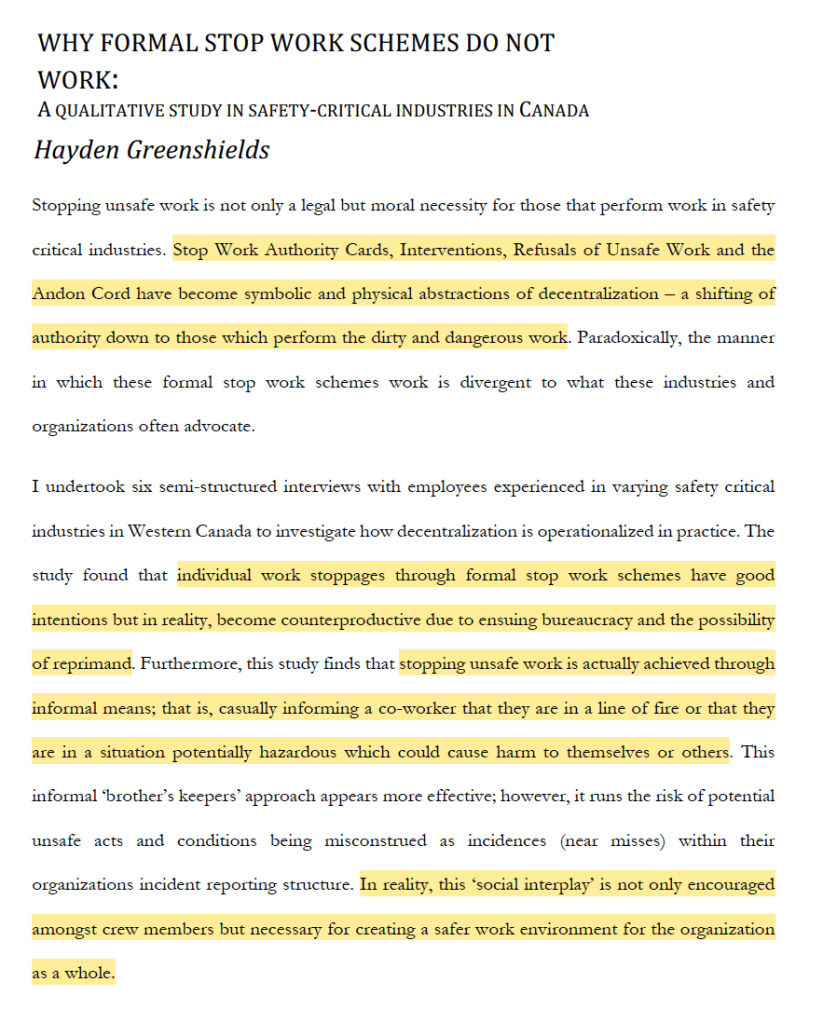
An interesting Masters thesis from Hayden Greenshields at Lund Uni, exploring the nature of Stop Work Authorities and how they play out, or are constrained, in reality.
Just a few findings here – but I suggest you check out the whole thesis:
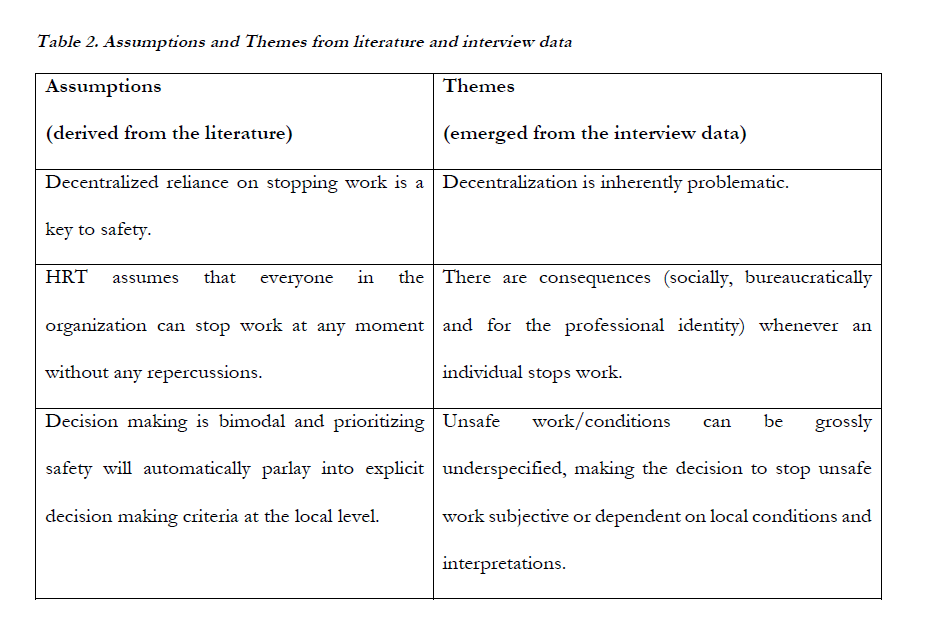
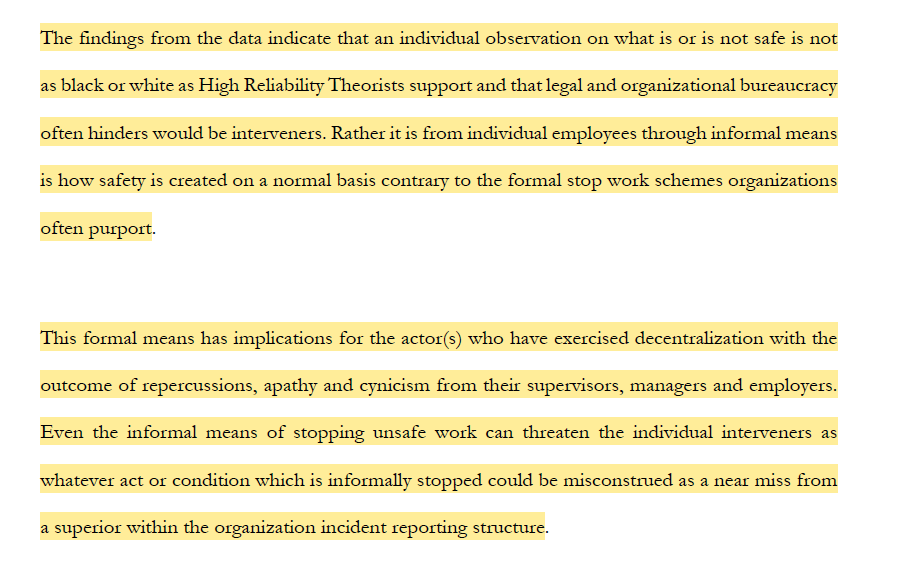
- Three main themes emerged via interviews which conflict with traditional formal stop work schemes:
- Decentralization is inherently problematic
- Stopping work has consequences
- Unsafe work conditions are grossly underspecified
- It’s said that while “formal stop work schemes are meant to empower individuals to cease hazardous work but if they chose not to stop unsafe work because the hazard was not ‘clear’ than they can be judged negatively”
- Further, if “something goes wrong because they did not intervene they might be blamed for failing to stop unsafe work (rather than assigning responsibility on the individual performing the unsafe act or the environment which created the unsafe conditions”
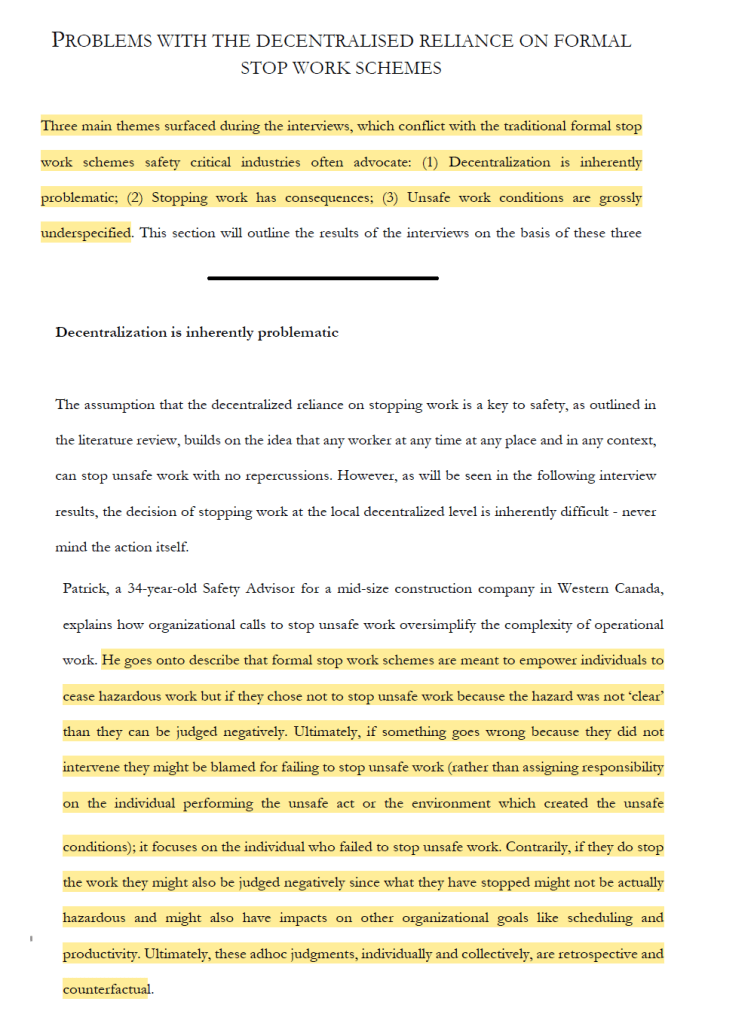
- Hence, formal stop work schemes run the risk of focusing “on the individual who failed to stop unsafe work”, whereas contrarily, “if they do stop the work they might also be judged negatively since what they have stopped might not be actually hazardous”
- It’s argued that the “notion of stopping work is challenging and the wording itself immediately puts the worker in a defensive mode. Consequently, the action of stopping work can also be daunting and challenging”
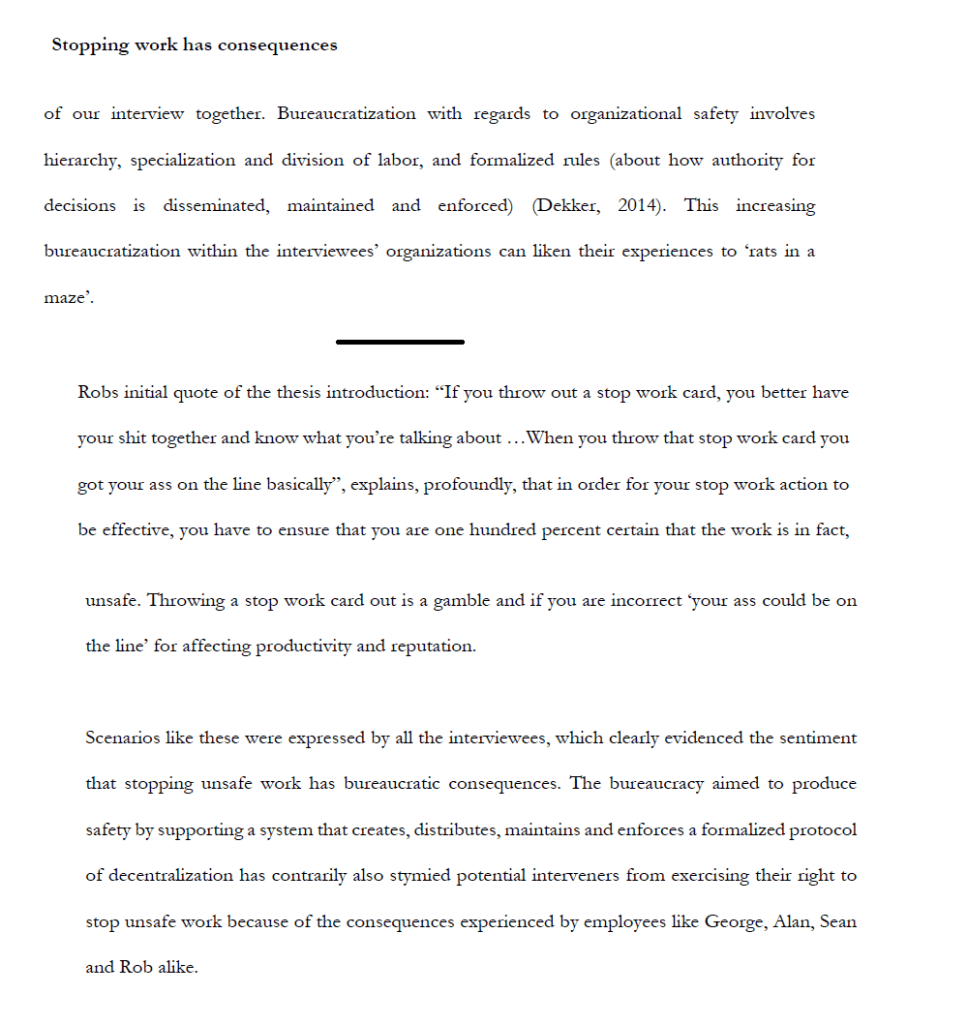
- Data suggested that “stop work schemes are not as straightforward as they seem – that is, as ‘a key to safety’ – but can have very negative sentiments attached to them, especially if they are not properly backed up by leadership”
- Moreover, “the decentralized reliance on stopping work as a key to safety has great intentions, but intentions only”
- In support, interviewees expressed a view that “stopping work is a judgement call and that you will be judged whether you made the ‘correct’ call or not; that the vernacular, work refusals, reduces one to defensiveness and the perspective that they are immediately wrong for stopping work”
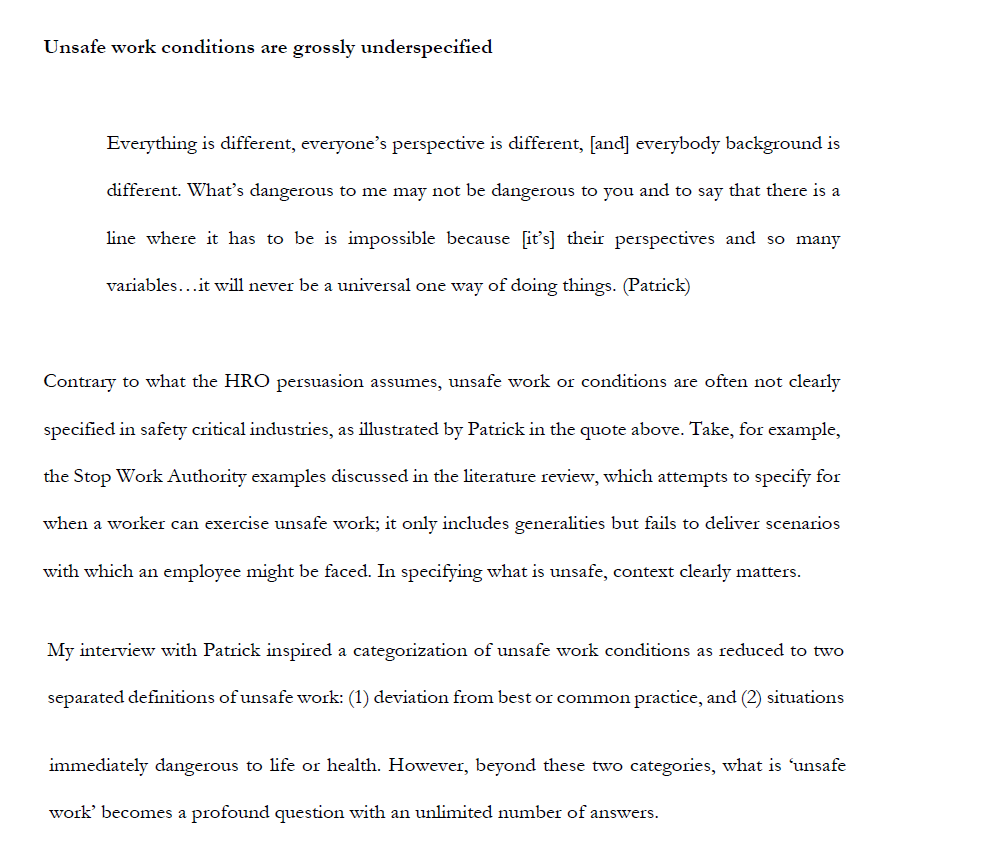
- And hence, “stopping unsafe work is not that simple as there are hierarchical interpretations about whether the unsafe work stoppage was ‘justified’”
- These schemes may, therefore, leave “workers with impossible goal conflicts as these formal stop work schemes are not inherently easy and in fact deeply problematic”
- The “bureaucratic consequences that ensue when stopping unsafe work resulted in interviewees with a vocabulary of alienation, victimization, discrimination, mockery, blame and essentially the last ‘soft control’ in creating safety”
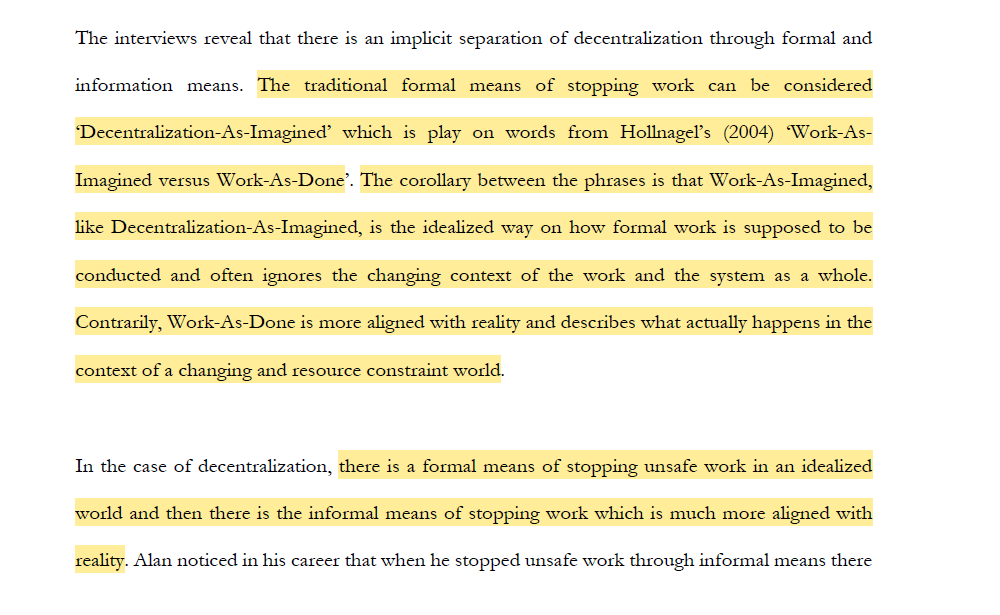
- There’s a “separation of decentralization through formal and information means. The traditional formal means of stopping work can be considered ‘Decentralization-As-Imagined’ which is play on words from Hollnagel’s (2004) ‘Work-As- Imagined versus Work-As-Done’”
- And the “corollary between the phrases is that Work-As-Imagined, like Decentralization-As-Imagined, is the idealized way on how formal work is supposed to be conducted and often ignores the changing context of the work and the system as a whole”
- “Contrarily, Work-As-Done is more aligned with reality and describes what actually happens in the context of a changing and resource constraint world”
Ref: WHY FORMAL STOP WORK SCHEMES DO NOT WORK. A qualitative study in safety-critical industries in Canada. Greenshields, H. (2017). Lund University.
Thesis link: https://lup.lub.lu.se/luur/download?func=downloadFile&recordOId=8928294&fileOId=8928295
My site with more reviews: https://safety177496371.wordpress.com

 SafetyInsights.org
Thank you for bring this article. This debate sounds good. I’ve been using SW as one of a proactive tool as a few others, and recognize the world isn’t perfect, but each SW is rapidly analyzed by a senior safety specialist and validated or not, without witch hunting, or blame, etc. So, I suppose the mentioned problem can be consequence of a weak environment in terms of maturity of leadership and poor communication with the team.
LikeLiked by 1 person