
This 2001 from Hollnagel & Amalberti discusses several arguments on how the concept of ‘human error’ (HE) exists only in the imagination of people.
That is, rather than being an objectively observable phenomena, is more a “false impression” based in “the seductiveness that some concepts or ideas seem to have”.
Parts 2 & 3 in comments.
Some points:
- HE as a term has “been part of the daily language for thousands of years”, and many researchers have taken it at face value
- “There is considerable face validity to this approach since human action (and inaction) undoubtedly plays a major role in a large number of spectacular incidents and accidents – and in an even larger number of seemingly mundane events”
- Some argue that HE “is ill defined, that the use of it is bound to be misleading” and “corresponds to an oversimplified conception of how events occur”
- Defining HE is challenging – and has at least three denotations: “the cause of something, the event itself (the action), or the outcome of the action”
- Each are discussed – in the context of HE as consequence, use of latent human error “implies, wrongly, that one or more “human errors” are hidden somewhere in the system and that they have yet to manifest themselves. The intended meaning is rather that the system hides is one or more latent consequences of a “human error” that already has occurred”
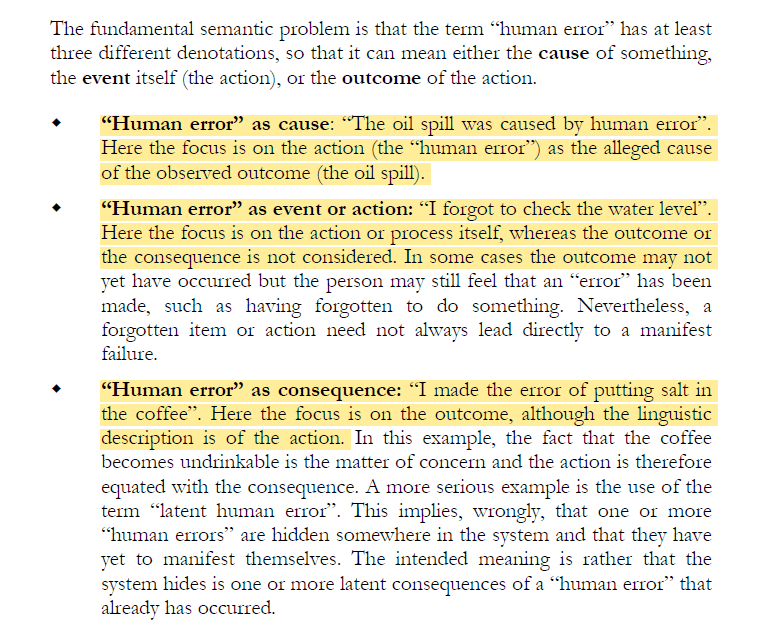
- HE concepts may also allude “to the notion of right and wrong or correct and incorrect, that is, a binary distinction”
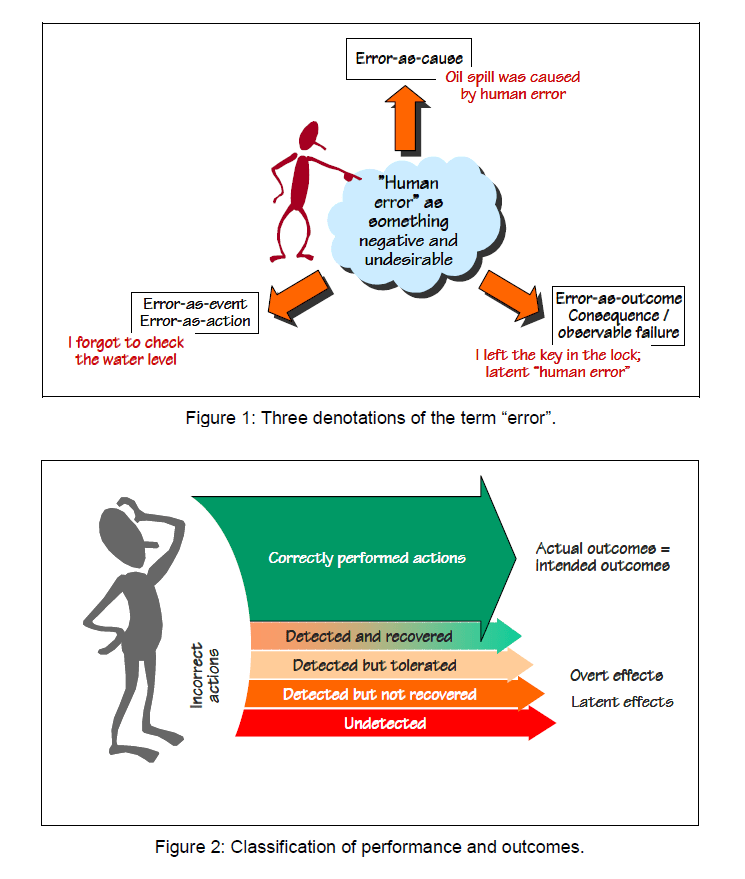
- They discuss five categories of action that “makes it clear, that the binary distinction between correct actions and “errors” is an oversimplification and therefore inappropriate”
- Moreover, for HE, “the issue is even more complicated since it refers to the notion of backward causality, i.e., reasoning from effect to cause”
- And backward causation is aggravated by two mistakes – like where people draw conclusions that aren’t logically valid – e.g. falsely associating a cause with an effect
- The second mistake is that “the sequential relation between events to a considerable extent is an artefact of a description based on time”, like when we construct timelines after incidents, and “it should be realised that in such a description events will always follow each other”
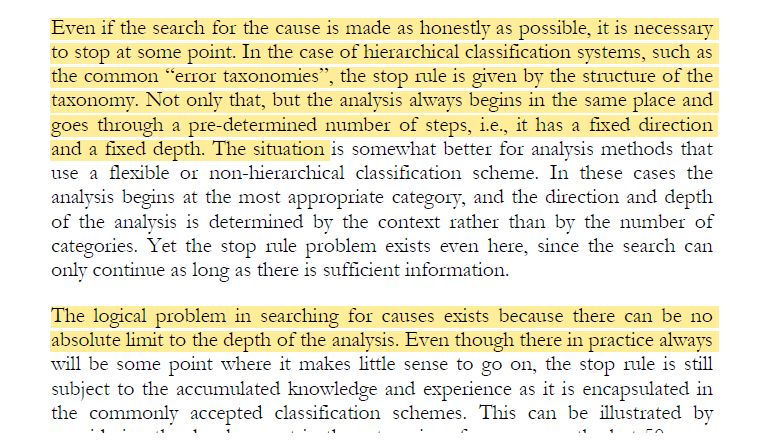
- “Finding a cause is thus a case of expediency as much as of logic. There are always practical constraints that limit the search in terms of, e.g., material resources or time. Any analysis must stop at some time, and the criterion is in many cases set by interests that are quite remote from the accident investigation itself”
- “there is a considerable variability in how a classification scheme is used and that the observers’ background and experience may be at least as important as the categories themselves”
- Further, they discuss the nature of WAI/WAD and performance adjustments. Here “In practice this means that even if there are good reasons for doing something, it may still lead to unwanted consequences, hence in retrospect be seen as an “error”
- “The terminology proposed here thus reinforces the view that an “error” is a judgment in hindsight. At the time of the action it can, in principle, not be known whether the action will succeed or fail”
- “The conclusion is that the term “human error” should be used carefully and sparingly – if it is to be used at all”
- “The consequence of acknowledging the existence of this variability is that many so-called “human errors” can be seen as the outcome of successful performance adjustments”
- “The inherent variability may at times become so large that it leads to unexpected and unwanted consequences, which then are called “errors”. Yet regardless of what the outcome is, the basis for the performance variability is the same, and classifying one case as “error” and the other as not makes little sense. Instead of trying to look for “human errors” as either causes or events, we should try to find where performance may vary, how it may vary, and how the variations may be detected and – eventually – controlled”

Ref: Hollnagel, E., & Amalberti, R. (2001, June). The emperor’s new clothes: Or whatever happened to “human error”. In Proceedings of the 4th international workshop on human error, safety and systems development (pp. 1-18). Linköping University.

Study link:
https://www.academia.edu/22733296/The_emperor_s_new_clothes_Or_whatever_happened_to_human_error_
My site with more reviews: https://safety177496371.wordpress.com

 SafetyInsights.org
The study link fails
Bryan David Grey
bryan.grey@langleyeco.com bryan.grey@langleyeco.com
Health & Safety Officer
Langley Properties Heating & Insulation Limited
134 Leeds Road
Shipley
BD18 1BX
T: 01274 714517
http://www.langleyeco.com http://www.langleyeco.com
The information in this e-mail and any files transmitted with it is confidential and is intended solely for the individual or entity to whom it is addressed. It may be subject to legal privilege. Any unauthorised dissemination or copying of this e-mail and any use or disclosure of any attachments contained in it, is strictly prohibited and may be illegal. Unauthorised recipients are requested to preserve the confidentiality of this e-mail and to advise the sender immediately of any error in transmission and delete it from their system. Any views expressed by an individual within this e-mail which do not constitute or record legal advice do not necessarily reflect the views of the firm. This e-mail (whether you are the sender or the recipient) may be monitored, recorded and retained by Langley Properties Heating & Insulation Limited for the purpose of ascertaining whether the communication complies with the law and internal policies. E-mail monitoring/blocking software may be used and e-mail content may be read at any time. everything we do, if you are anything less than âextremely satisfiedâ with the service you receive please let us know.
LikeLike
Thanks for the heads-up! Hopefully working now.
LikeLike