This discussion paper explored the checklists and false senses of safety.
In healthcare they say that probably the best known version of the checklist is the WHO surgical safety checklist. Prior work has generally shown positive effects, like reduced care complications and 30-day mortality rate.
Interesting though, studies on compliance rates of the WHO checklist across its three main parts “could at best be considered as moderate”. For instance, some data indicated 54% completion of the timeout part of the checklist, and other similar data for different parts.
Based on this data they ask “do safety checklists used with this level of compliance really make practice safer? Could it even be that the lack of compliance actually introduces new risks not present before?”.
The checklist as a defence against failure
In answering these questions, they first cover the perspective of a checklist as a ‘defence against failure’. This perspective suggests that the checklist serves as a defence or barrier between the danger or hazard, and the patient. [** Noting it wouldn’t meet the definition of a barrier in the O&G / process fields]
The checklist may introduce some redundancy into checking processes, like the right patient and correct surgery site.
If viewed as a defence, then “the WHO checklist could at best be defined as what Hollnagel calls a symbolic barrier”, if the checklist is physically present in the operating room, like posted on the wall or included within surgical paperwork.
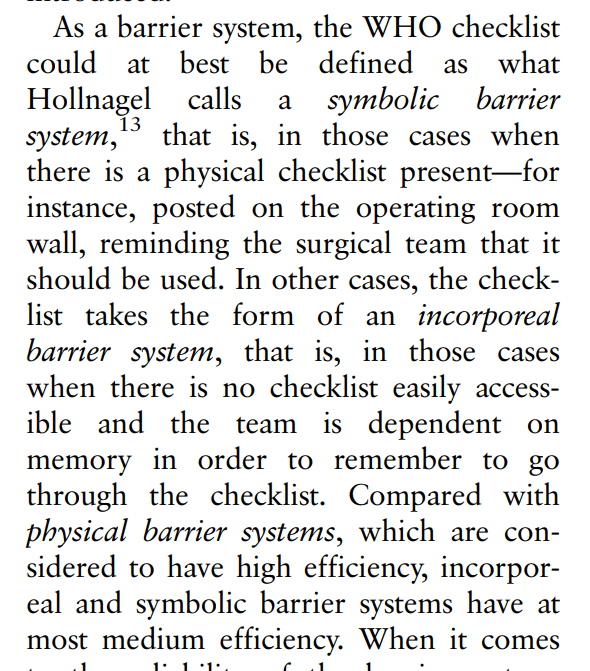
If it isn’t physically present, then “the checklist takes the form of an incorporeal barrier system, that is, in those cases when there is no checklist easily accessible and the team is dependent on memory in order to remember to go through the checklist”.
Whereas physical barrier systems are said to have high efficiency, “incorporeal and symbolic barrier systems have at most medium efficiency”; specifically, incorporeal may often have low reliability, and symbolic medium to low.
Hence, “symbolic and incorporeal barrier systems such as the WHO checklist are vulnerable and quite easily put out of function”.
This paper from herein views the checklist as a type of barrier, but the authors recognise that checklists can have often purposes beyond a barrier, like information and awareness or enhancing elements of the climate or teamwork.
The dynamic aspects of safety
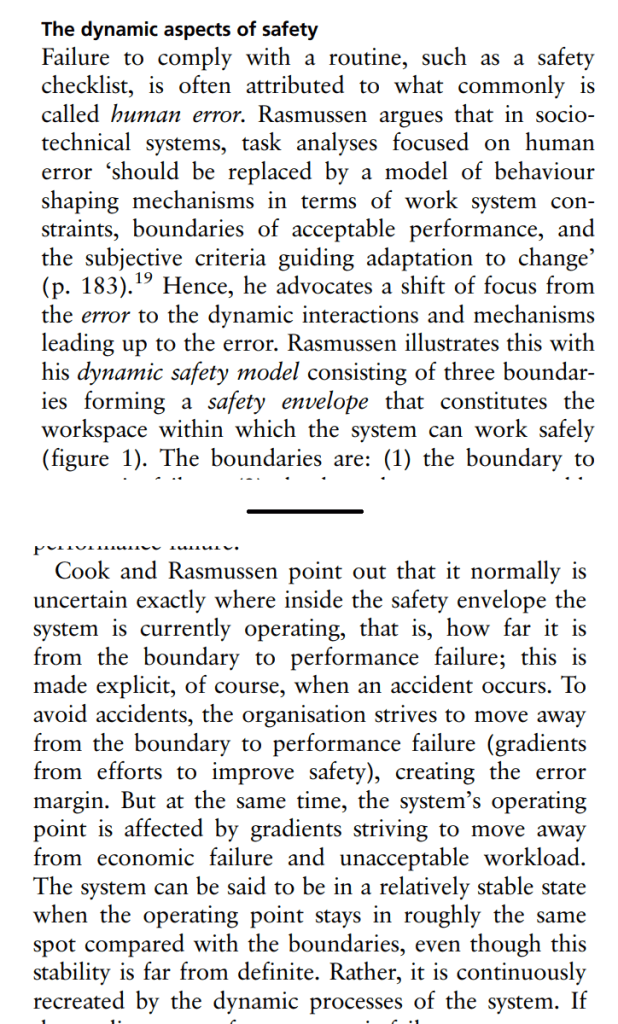
They first argue that failure to comply with a recognised routine, like a checklist, is “often attributed to what commonly is called human error”.
Contrastingly, Rasmussen argued that “in sociotechnical systems, task analyses focused on human
error ‘should be replaced by a model of behaviour shaping mechanisms in terms of work system constraints, boundaries of acceptable performance, and the subjective criteria guiding adaptation to change”. That is, in part, focusing more on the dynamic interactions and mechanisms leading up to the error.
Next they discuss Rasmussen’s dynamic risk model, which I’ve largely skipped (I’ve covered it heaps elsewhere). But in short, performance is constrained within three competing boundaries – workload, economics/resources, and functionally acceptable performance; but is constantly shifting within the space of acceptable performance… until it’s finally not and breached into unacceptable performance.
They note “Cook and Rasmussen point out that it normally is uncertain exactly where inside the safety envelope the system is currently operating, that is, how far it is from the boundary to performance failure; this is made explicit, of course, when an accident occurs”
When striving for efficiency, the economic demands or workload can be too much for the work system to cope with – which people respond to in kind with workaround strategies to increase efficiency.
When workarounds happen to accomplish higher efficiency, “one should not be surprised that ‘every system moves to the limit of its capability’ as Cook and Rasmussen ( p. 133)20 point out”.
They further argue that “Reason states that the gains in defences ‘… are often converted into productive, rather than protective, advantage, thus rendering the system less safe than it was before”.
Drawing on Hollnagel’s concept of ETTO, they observe that people are continually adjusting between efficiency and thoroughness goals, but “appears as if a system always strives to be as efficient as possible”.
The paper next discusses the relevance of Vaughan’s Normalisation of Deviance concept, but I’ve skipped this.
Implications for patient safety
They restate the prior discussion as two central premises, which I’ve directly quoted:
“1. The checklist is a weak type of safety barrier that is easily put out of function and is vulnerable to normalisation of deviance, especially those parts that are not perceived as important to all users”
2. The checklist provides gains in safety but those gains are threatened from demands for efficiency, resulting in safety gains being transformed into production gains”.
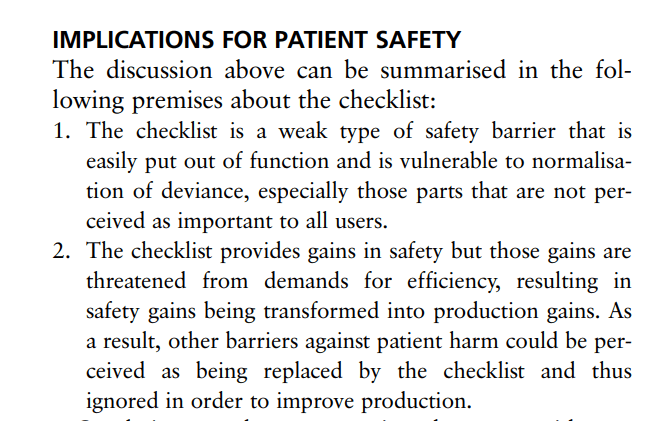
And, resultingly, “other barriers against patient harm could be perceived as being replaced by the checklist and thus ignored in order to improve production”.
They state that either of these issues on their own aren’t generally major threats to patient safety, but rather in combination they can be. For instance, if certain parts of a checklist aren’t completed as per item 1, then completion of the rest of the checklist as intended probably won’t intend in a situation worse than no checklist at all.
It’s said “As pointed out by Amalberti et al,26 violations, that is, non-compliance, does not have to be a sign of decreased safety, but rather the contrary as additional safety rules and routines create additional opportunities for violations to occur”. That is, you can’t depart from a procedure if the procedure doesn’t exist, and hence, the more procedures we have then naturally the more departures we’ll have.
If both premises are true at the same time and interacting, though, then “compliance with the checklist is flawed and other safety checks are omitted because they are thought of as being handled by the checklist—then we have a new safety threat because we have induced a false sense of safety into the healthcare system” (emphasis added).
They then discuss some concluding thoughts, which I’ve skipped.
Authors: Rydenfält, C., Ek, Å., & Larsson, P. A. (2014). Safety checklist compliance and a false sense of safety: new directions for research. BMJ Quality & Safety, 23(3), 183-186.
Study link: https://citeseerx.ist.psu.edu/document?repid=rep1&type=pdf&doi=9b19f3a71a5ec9a8192f4771ad552c6f8cb778e0
My site with more reviews: https://safety177496371.wordpress.com
LinkedIn post: https://www.linkedin.com/pulse/safety-checklist-compliance-false-sense-new-research-ben-hutchinson-6m8yc

 SafetyInsights.org