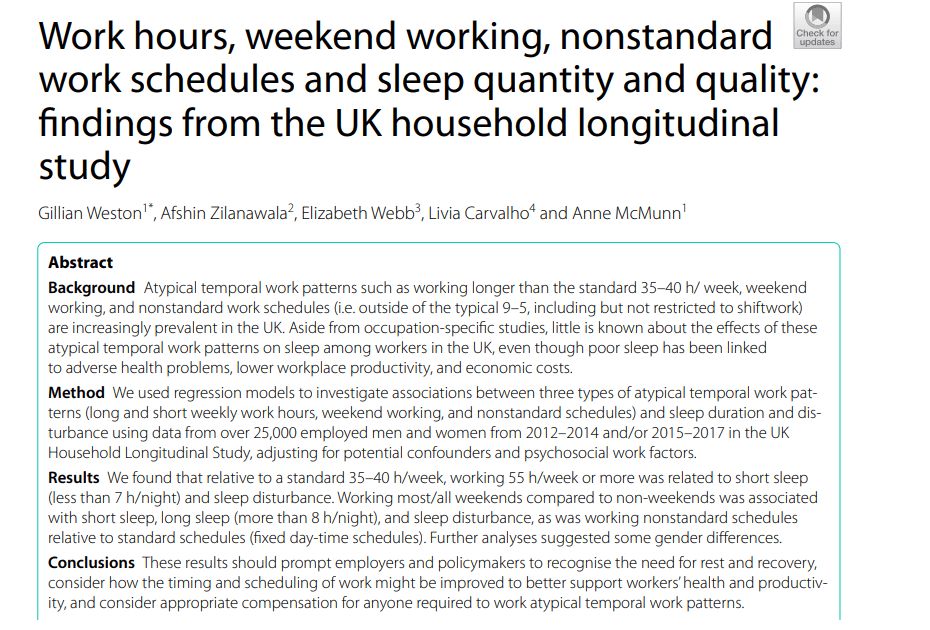
This explored the links between work hours, weekend working and atypical work schedules on sleep quantity and quality in a UK longitudinal sample.
Data came from 25,000 employed men and women – but noting a limitation of self-reported data.
For background:
· Atypical work patterns, like working >35-40h weeks, weekend working and nonstandard schedules (outside of usual 9/5 M-F schedules) are prevalent in the UK
· Adults are recommend to sleep at least 7h/night, fall asleep within ~30 mins, wake no more than 5 mins once per night, and feel satisfied with their sleep
· A u-shaped association between sleep duration and poor health has been established, with short and long sleep associated with mental, cognitive and chronic diseases
· Poor sleep is linked to work-related injuries and atypical work patterns and long hours are also linked with poor health outcomes
· “long and irregular schedules were associated with sleep reductions, and every hour increase in working time was associated with up to 14-min less sleep”
· It’s said many studies have omitted women, yet their experiences of work can differ: “women are less likely than men to work overtime, but more likely to have flexible work arrangements (such as reduced hours, term-time working and job-sharing), and to combine paid work with unpaid domestic activities”
· There are gender differences in sleep where women tend to sleep longer, but experience more problematic sleep
· “There are also gender differences in job types, with women less likely than men to have high quality jobs and high-paying professional and managerial occupations”
Results
· “relative to a standard 35–40 h/week, working 55 h/week or more was related to short sleep (less than 7 h/night) and sleep disturbance”
· “Sleep duration was inversely related to working hours, with long and extralong hours associated with short sleep, and part-time hours associated with long sleep”
· “Working most/all weekends compared to non-weekends was associated with short sleep, long sleep .. and sleep disturbance, as was working nonstandard schedules relative to standard schedules”
· They found these effects were stronger for women than men
· They can’t identify precisely why the effects are stronger for women, but provide some insights. One is that “the more time allocated for work, the more truncated sleep could be [23]. This may be especially pertinent to women, who tend to provide more informal caregiving and domestic labour than their partners [66, 67], thus increasing their total (paid plus unpaid) working hours”
· Atypical working “and early morning work (particularly among later chronotypes ‘night owls’) have also been associated with depressive symptoms, and depressive symptoms with sleep interference”
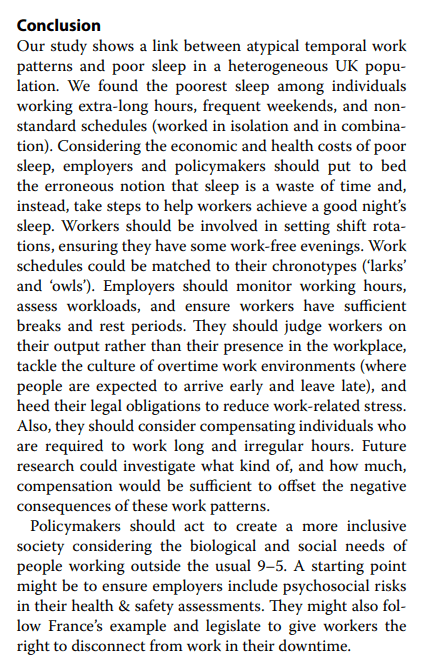
Ref: Weston, G., Zilanawala, A., Webb, E., Carvalho, L., & McMunn, A. (2024). BMC Public Health, 24(1), 309.
Study link: https://link.springer.com/content/pdf/10.1186/s12889-024-17762-0.pdf
My site with more reviews: https://safety177496371.wordpress.com

 SafetyInsights.org