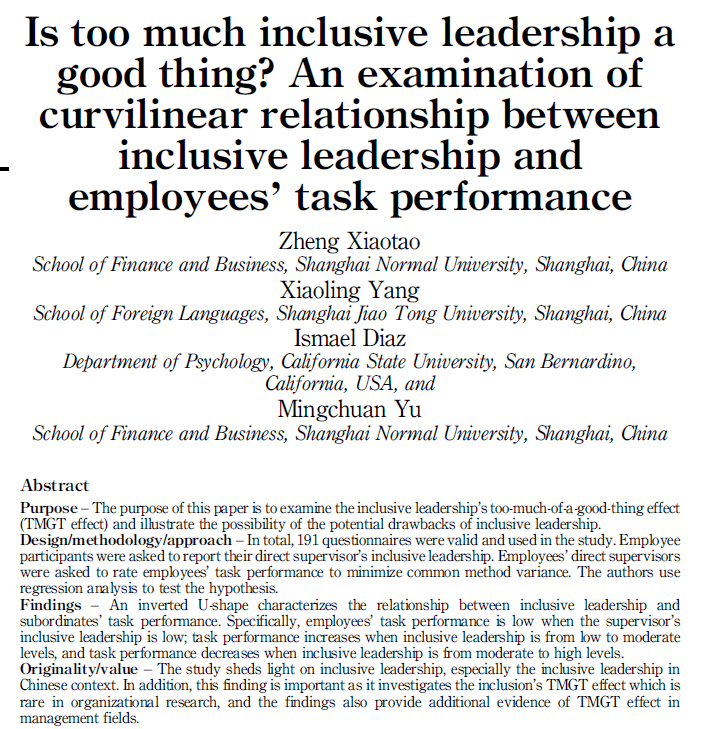
“well-intended … inclusive leadership can lead to unanticipated negative effect on employees’ task performance when taken too far” Can leaders be too inclusive? This study sought to investigate that question in a Chinese context, via 191 questionnaires asking employees to report on their direct supervisor’s inclusive leadership. PS. Check out my YouTube: https://youtube.com/@safe_as_pod?si=iUaDPJynPemQRZhY Shout a… Continue reading Is too much inclusive leadership a good thing?
Tag: mental-health
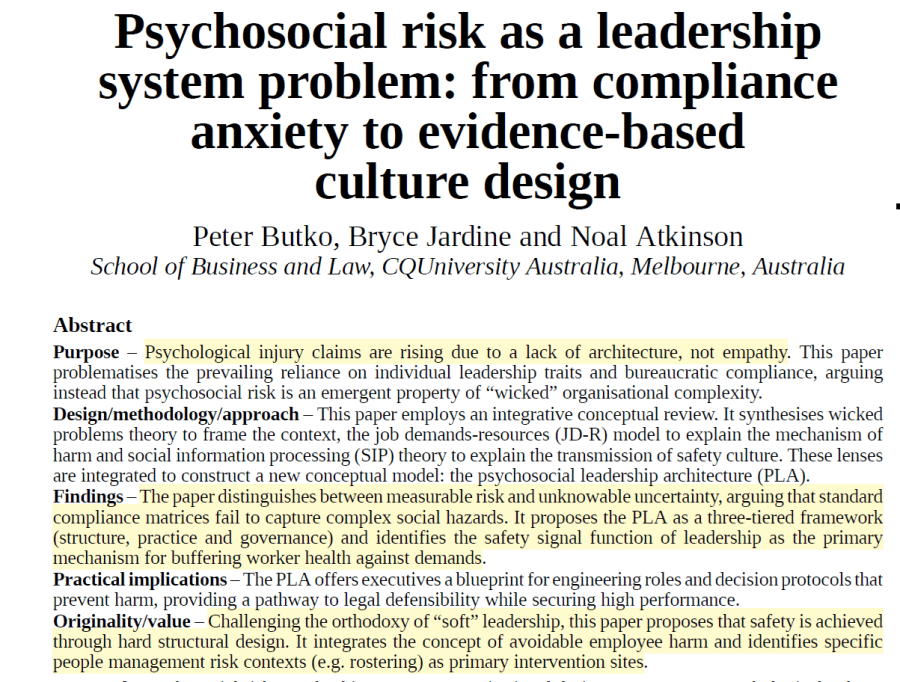
Psychosocial risk as a leadership system problem: from compliance anxiety to evidence-based culture design
“Psychological injury claims are rising due to a lack of architecture, not empathy” An interesting ‘integrative conceptual review’ of the traps of current compliance-driven approaches to psychosocial challenges, and a way forward. They argue that the current approach places “reliance on individual leadership traits and bureaucratic compliance” over recognising the emergent/wicked nature of psychosocial risk.… Continue reading Psychosocial risk as a leadership system problem: from compliance anxiety to evidence-based culture design
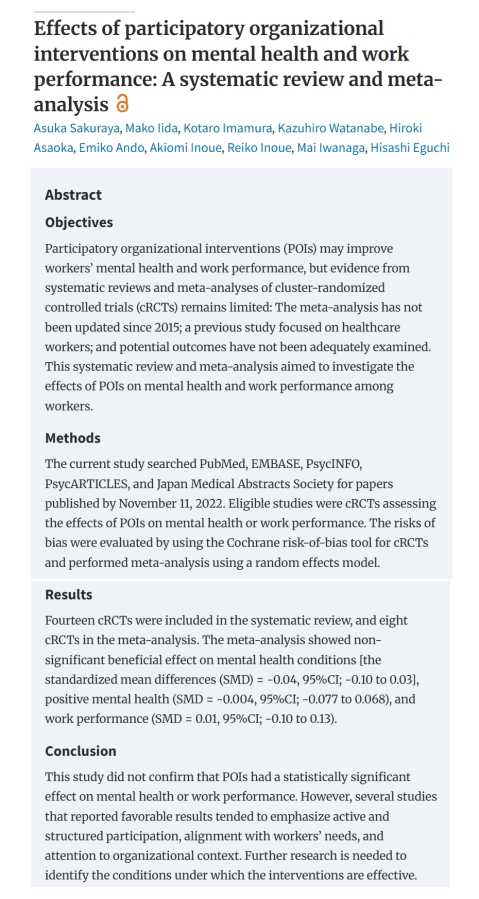
Effects of participatory organizational interventions on mental health and work performance: A systematic review and meta-analysis
Are Participatory Organizational Interventions (POIs) to improve working conditions effective at improving workers’ mental health and work performance? This systematic review & meta-analysis explored just 14 studies that met inclusion to find out. Evaluated outcome measures were negative mental health (burnout, depression, anxiety), positive mental health (job satisfaction, well-being, work engagement) & work performance (work… Continue reading Effects of participatory organizational interventions on mental health and work performance: A systematic review and meta-analysis
The effects of different types of organisational workplace mental health interventions on mental health and wellbeing in healthcare workers: a systematic review
This systematic review unpacked 22 studies to understand the effects of organisational mental health interventions on healthcare workers’ mental health and wellbeing. Shared under an Open Access licence. PS. Check out my YouTube channel: https://www.youtube.com/@safe_as_pod Extracts: · Interventions included flexible and better designed schedules, redesigned work processes and competency training, team-building and civility initiatives, participatory workplace-change… Continue reading The effects of different types of organisational workplace mental health interventions on mental health and wellbeing in healthcare workers: a systematic review
Role overload and safety incidents: An examination of the individual-and team-level buffering effects of psychological safety
This study explored the buffering effects of psychological safety on role overload and safety incidents. Data from online survey of 841 employees. Shared under an open access licence. PS. Check out my YouTube: https://www.youtube.com/@safe_as_pod Extracts: · “Role overload is a form of work-related stress … Qualitative role overload occurs when an individual lacks the skills required… Continue reading Role overload and safety incidents: An examination of the individual-and team-level buffering effects of psychological safety
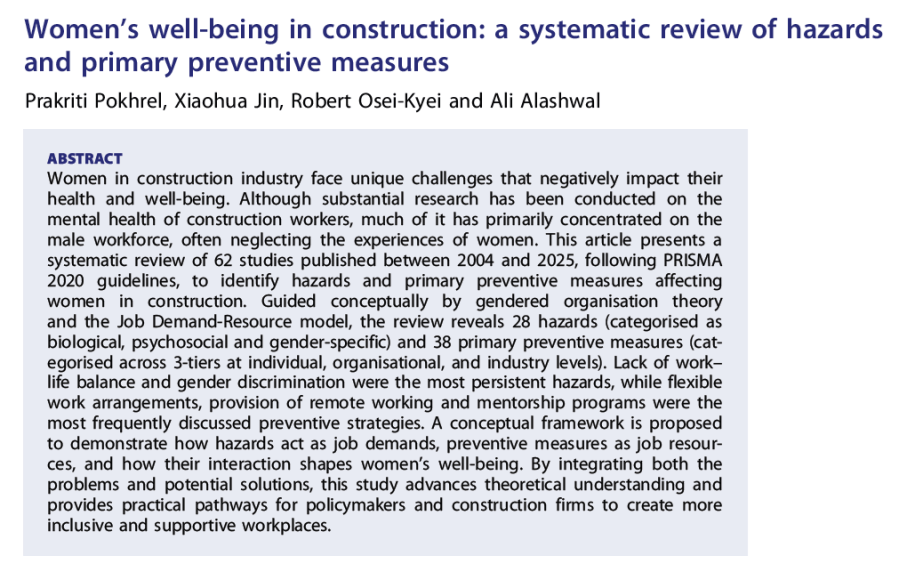
Women’s well-being in construction: a systematic review of hazards and primary preventive measures
This systematic review unpacked 62 studies looking at women’s well-being in construction, and key hazards and prevention measures. ** Check out my YouTube channel: https://www.youtube.com/@safe_as_pod Background: · “construction industry is often shaped by a macho work culture marked by aggression, bullying, and job insecurity due to the nomadic and cyclical nature of projects” · “women face not… Continue reading Women’s well-being in construction: a systematic review of hazards and primary preventive measures
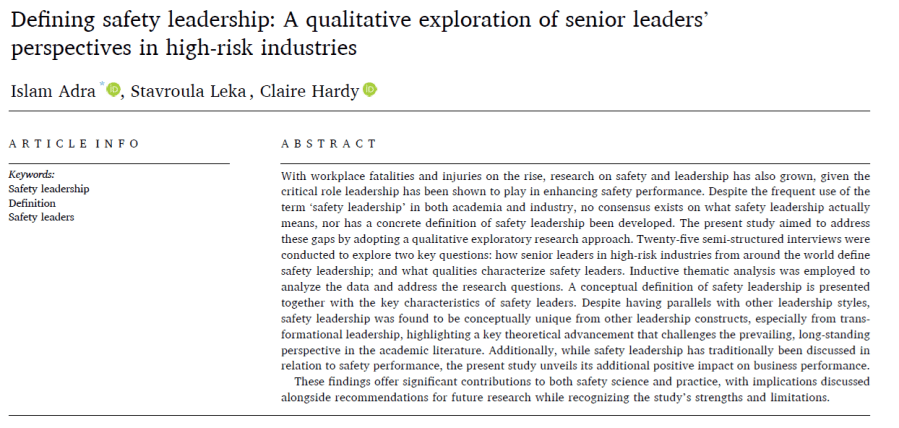
Defining safety leadership: A qualitative exploration of senior leaders’ perspectives in high-risk industries
How do senior leaders in high-risk industries define safety leadership? And what qualities characterise them? This interview study of 25 leaders unpack these questions. Note. Those cynics which moan about why safety needs to take concepts like leadership or culture and whack ‘safety’ on the front should read this. Once again, another study highlighting domain-specificity.… Continue reading Defining safety leadership: A qualitative exploration of senior leaders’ perspectives in high-risk industries
There is nothing authentic about authentic leadership: Forbes article
This article about authentic leadership may be of interest – in part arguing it may perpetuate a “childish, romantic, and ultimately toxic idea”. They argue: · Authentic leadership is said to be a popular but is rather conceptually vague · It’s said to stem from “self-awareness, internalized moral perspective, balanced processing of information, and relational transparency — in short, being “true… Continue reading There is nothing authentic about authentic leadership: Forbes article
The Critical Role of Psychological Risk and Safety in Eliciting Worker Well-Being
This explored the links between psychosocial risk and psychological safety on worker well-being. Survey responses from >800 workers in Malaysian were obtained. Usefully, it’s another study that slightly challenges the claim that you ‘can’t have too much psychological safety’. We need far more targeted evidence to make that claim. Extracts: · “our results revealed a significant… Continue reading The Critical Role of Psychological Risk and Safety in Eliciting Worker Well-Being
Psychological Distress and Post-Traumatic Symptoms Following Occupational Accidents
What are the psychological consequences of physical work incidents? 38 occupationally injured persons matched against 38 none injured. Background: · Prior work “reported that 34.7% of injured workers with chronic pain achieved full criteria for PTSD, and 18.2% had partial PTSD” · “victims of work-related accidents showed clinically relevant psychopathological symptoms, including post-traumatic symptoms, anxiety, depression, anger, and… Continue reading Psychological Distress and Post-Traumatic Symptoms Following Occupational Accidents
 SafetyInsights.org