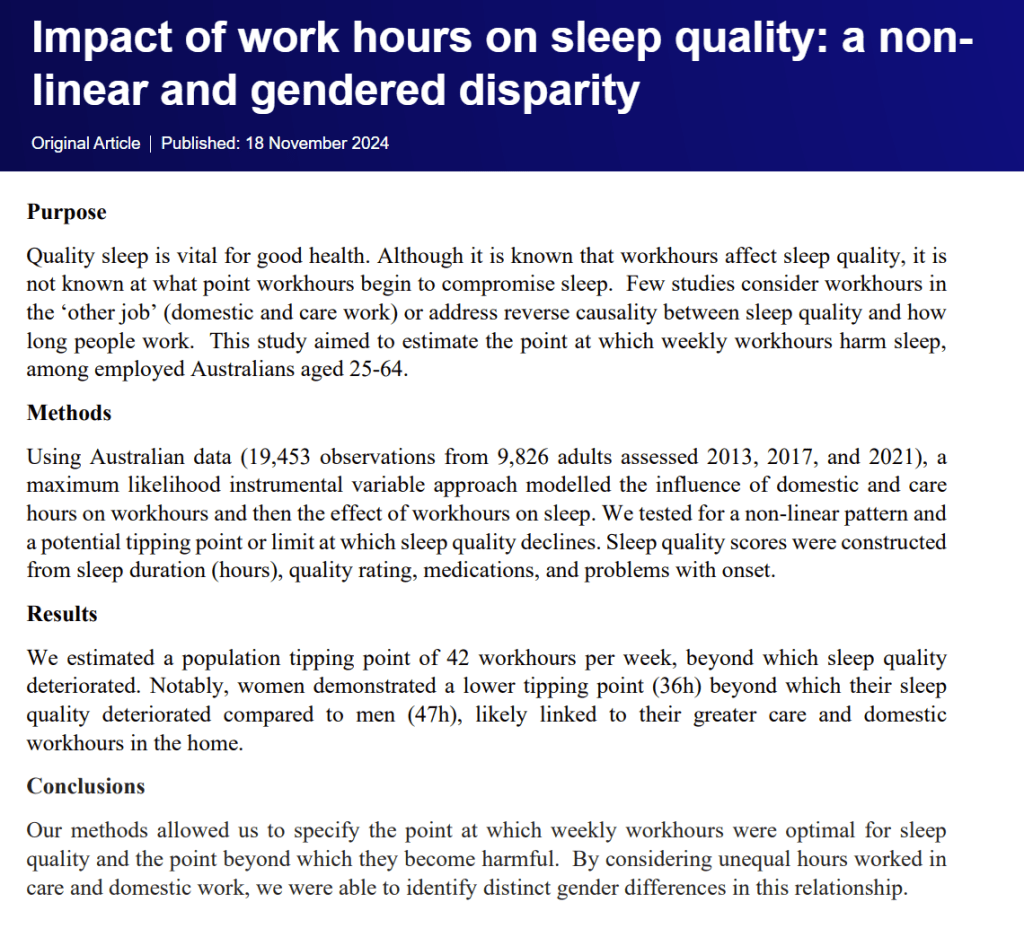
This study explored the tipping point at which weekly workhours harm sleep in Australian adults – 25 to 64.
Data was drawn from >9k people.
Providing background they say:
- Long workhours are one of the main work-related factors affecting sleepiness, short sleep and sleep disturbances
- Long workhours, in addition to stress, reduce the time available for sleep, impairing sleep quality, and increasing fatigue and potentially injuries
- Prior work often assumes the effect of workhours on sleep quality is linear, or the effect is uniform across different work hour groups above or below a threshold
- E.g. some studies pool 41 to 55h into one group, treating the effects synonymously
- Also, there are likely gender-related differences in sleep and working hour effects
- An example is via paid and unpaid domestic workhours – they argue “In almost all countries where it is measured, men work more hours for pay than women do, and dominate in long-hour jobs”
- However, “women spend more hours on unpaid care and domestic work and predominate in jobs with hours below the full-time standard (OECD 2021). Women’s workdays are usually a combination of hours spent managing the household, cooking, cleaning”
Results
Key findings:
- They found the working hour tipping point that disrupts sleep to be 42 workhours per week
- Beyond this point, sleep quality deteriorated
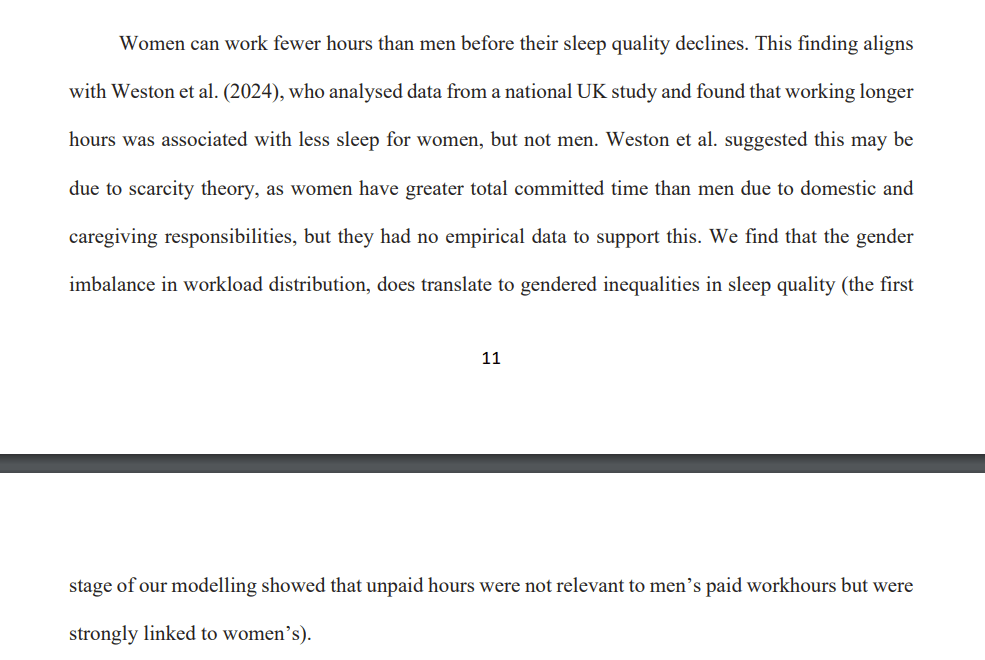
- “Notably, women demonstrated a lower tipping point (36h) beyond which their sleep quality deteriorated compared to men (47h), likely linked to their greater care and domestic workhours in the home”
- “By considering unequal hours worked in care and domestic work, we were able to identify distinct gender differences in this relationship”
- They found a “non-linear relationship between workhours and sleep quality, with an identifiable weekly workhour tipping point (confirming Hypothesis H1). For the average employed Australian, exceeding 42h a week led to a decline with each additional hour worked worsening sleep quality”
- “the non-linear relationships discovered show that both long and shorter workhours can detrimentally impact sleep quality”
- “Short-hour employment may be poorer quality and poorly paid (Burgess and Campbell 1998; Charlesworth et al. 2011). Short hour jobs may also reflect ‘underemployment’ – where people are involuntarily working fewer hours than they would like to”
- “findings confirm that working women, who on average devote 10 more hours … to unpaid domestic work than men, have a lower workhour tipping point compared to their male counterparts”

Ref: Doan, T., Leach, L., & Strazdins, L. (2024). Impact of work hours on sleep quality: a non-linear and gendered disparity. Archives of Women’s Mental Health, 1-8.
My site with more reviews: https://safety177496371.wordpress.com

 SafetyInsights.org
One thought on “Impact of work hours on sleep quality: a non-linear and gendered disparity”