
This brief conference paper from Patrick Hudson and colleague from 1998 describes a Go – No Go decision tool called the ‘Rule of Three’.
This tool was used in Shell, although at the time of this paper was in its infancy and had yet “to be turned into an effective and working tool”.
For background:
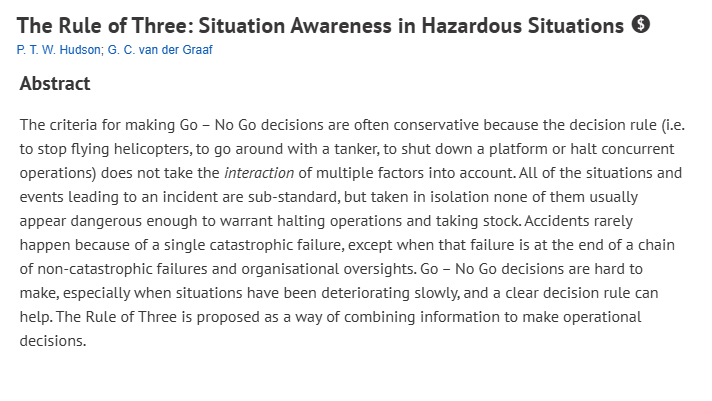
· “The criteria for making Go – No Go decisions are often conservative because the decision rule (i.e. to stop flying helicopters, to go around with a tanker, to shut down a platform or halt concurrent operations) does not take the interaction of multiple factors into account”
· Hence, many of the factors and events leading to an incident are ‘sub-standard’ but “taken in isolation none of them usually appear dangerous enough to warrant halting operations and taking stock”
· Incidents often involve a range of factors (quoted in the paper as often exceeding 50 factors), and their interactions
· While removing one potential factor may avert an incident, there are 49 others which may interact in expected, or unexpected ways – hence “we may find ourselves in a state of permanent near-miss, what we might call Living on the Edge”
· The Rule of Three is said to be a way of finding out “just how close we are to the edge” and assisting decisions on what to do
· One constraint people often have on their relationships within complex failures is “they often fail to understand how small problems, that no one would regard as particularly dangerous, may interact to become big ones”
They provide an example of a helicopter accident where there were no advance factors that would have reasonably prompted the pilots to stop flying. The weather was marginal but within acceptable limits, pilots were currently within their allowable flying hours (but would have exceeded hours on the final leg), and operational requirements were not impossible, but underwent several changes in the course of the mission.
They ask the question: How can we acquire the benefits of hindsight, and prevent such accidents, without unnecessarily curtailing operations by excessive caution?
They argue the issue is less about individual limits on permissible operations (which may include golden rules and the like), but rather the way marginal conditions accumulate and interact.
The Rule of Three
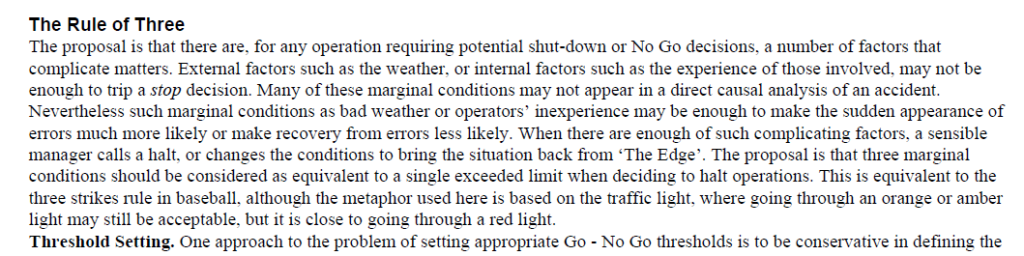
In response, they propose the Rule of Three tool. For any operation requiring potential shut-downs (ships berthing, helicopters taking off or flying a mission etc.), there will be several factors that complicate the situation – like external factors (e.g. weather) and internal factors (staff experience).
Any of these factors in isolation may not be enough to trigger a stop decision and may not be a direct proximal factor in an accident. Nevertheless, such “marginal conditions”, like bad weather or operator inexperience, “may be enough to make the sudden appearance of errors much more likely or make recovery from errors less likely”.

Once enough of these factors accumulate, a manager or other stakeholder “calls a halt, or changes the conditions to bring the situation back from ‘The Edge’”.
They propose that three marginal conditions should be considered as equivalent to a single exceeded limit when deciding to halt operations. [** It looks like 3 was selected mostly as a familiar concept for people, e.g. three strikes in baseball, or 3 colours in traffic lights, rather than as an empirical basis).
Thresholds
They talk about the challenge, and perhaps art, of setting appropriate Go – No thresholds; I won’t cover all of this, but they say one approach is to be conservative in defining the point at which operations have to be halted.
They relate the thresholds to traffic lights approaches. Values exceeding an absolute safety threshold can be represented as red, marginal situations as orange, and ideal operating situations as green. Red, absolute, thresholds may be related to legislation, unacceptable or intolerable risks, or laws of aerodynamics (like a helicopter’s permissible wind-speed for take-off), for example.
Orange thresholds may be factors to proceed at caution; experienced operators and managers may be able to discuss and set the orange thresholds, drawing on their experience. Further, “Orange thresholds can continue to be reviewed and altered as more experience is gained, whereas red thresholds are much more likely to remain fixed”. In short, all greens = work can progress, three oranges = halt work and reassess (equal to a red), and a single red = halt work. For variations, e.g. 2 oranges and a green, the decision to halt is judged in relation to the critical dimensions and the number of oranges.
They argue that “Too many factors in the ‘orange’ distract and influence decision makers and stress the system’s defensive barriers”. The rule of three is said to use both red-orange and green-orange thresholds, with “a summation rule that three orange factors is equivalent to a single red”. When this happens, the operations should be stopped or delayed until a number of the factors in orange have been managed back to green.
A range of sub-dimensions can be added to the factors to further calibrate the use of the tool.

[***As an aside, Andrew Hopkins briefly discussed this tool in a 2011 paper. He mentioned that, for instance, three oranges don’t necessarily mean that the whole operation has to be terminated, but rather there could be an opportunity to ‘manage’ one of the oranges to green (e.g., eliminating one of the risk factors].
Further, this type of tool is an example where:
“The rule of three provides a mechanism that converts the risk continuum into a dichotomy for the purposes of decision-making. It does not, however, ignore the expertise of operators; it draws on that expertise in identifying relevant risk factors. Put another way, the rule of three structures expert decision-making; it does not replace it” (Hopkins, 2011).]

Authors: Hudson, P. T. W., & Van Der Graaf, G. C. (1998, June). The Rule of Three: Situation awareness in hazardous situations. In SPE International Conference and Exhibition on Health, Safety, Environment, and Sustainability? (pp. SPE-46765). SPE.

Study link: https://doi.org/10.2118/46765-MS
LinkedIn post: https://www.linkedin.com/pulse/rule-three-situation-awareness-hazardous-situations-ben-hutchinson-lc3kc

 SafetyInsights.org