

This study unpacked what investigators look at and how they construct causes in high-speed workboats.
It employed a Safety-II / HOP / HF perspective.
Tl;dr: human factors are poorly evaluated and largely seen as individual-level factors.
Some extracts:
· “Although the analysis focused on negative observations, it also identified HFs that supported the activity”
· “Many pivotal HFs [Human Factors] that affected operations were not evaluated, which meant that the documents had to be interpreted by reading ‘between the lines’”
· “HFs were understood through individuals, as is often the case in the maritime sector”
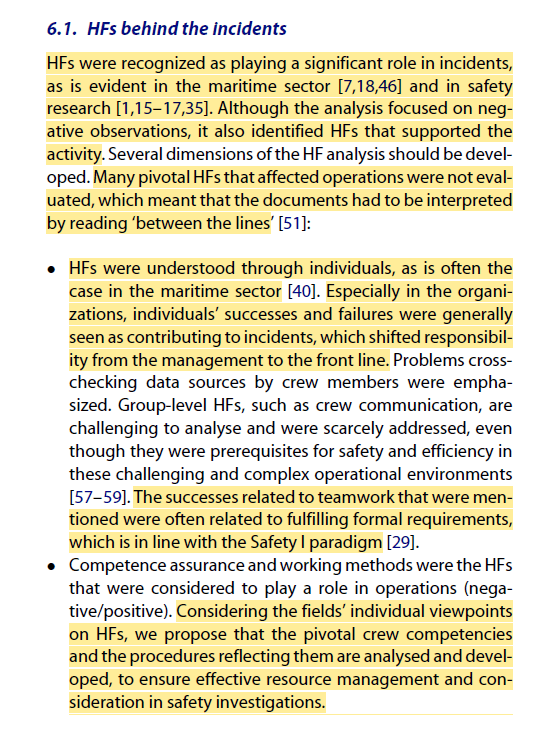
· “individuals’ successes and failures were generally seen as contributing to incidents, which shifted responsibility from the management to the front line”
· “Problems crosschecking data sources by crew members were emphasized. Group-level HFs, such as crew communication, are challenging to analyse and were scarcely addressed, even though they were prerequisites for safety and efficiency in these .. complex operational environments”
· “The successes related to teamwork that were mentioned were often related to fulfilling formal requirements, which is in line with the Safety I paradigm”
· “Multitasking and time pressure were seen as harming operations, but mental workload was not explicitly addressed”

· “HFs related to the technical and information environment were rarely mentioned, despite the role they play in crew performance”
· The Finnish safety investigation authority “more accurately identified organizational HFs, such as crew structuring and work experience, as being behind the operational levels” whereas maritime organisations “seldom mentioned organizational HFs”
· “Many of the HFs identified were related to the human consequences of actions, as situational awareness, e.g., can be both a factor and an effect”
· “The organizations’ recommendations often focused on improving individuals’ performance by developing their professional skills or mastery of their work and following instructions and procedures, reflecting the norm-based emphasis”
· “Many of the recommendations were related to developing and adopting working methods”
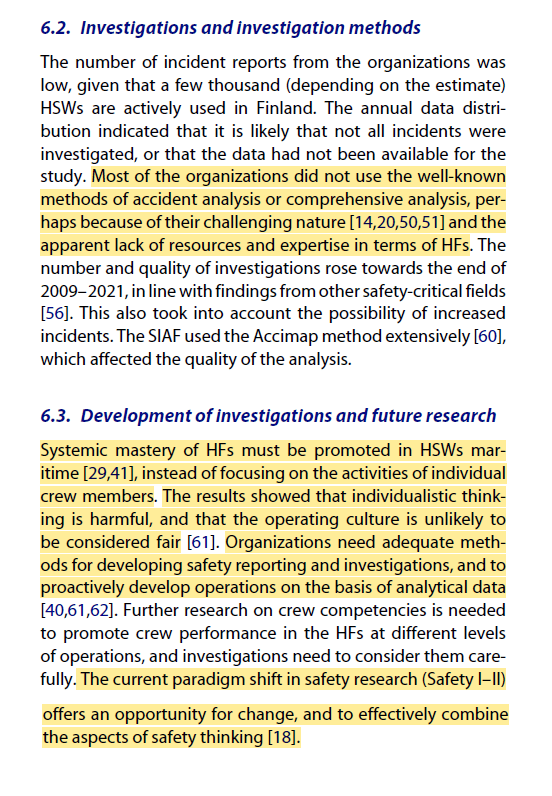
· “Systemic mastery of HFs must be promoted in HSWs maritime [29,41], instead of focusing on the activities of individual crew members”
· “The results showed that individualistic thinking is harmful, and that the operating culture is unlikely to be considered fair”
· of operations, and investigations need to consider them carefully. The current paradigm shift in safety research (Safety I–II)
· “the current paradigm shift in safety research (Safety I–II) offers an opportunity for change, and to effectively combine the aspects of safety thinking”
Ref: Lehtimäki, M., & Teperi, A. M. (2025). International Journal of Occupational Safety and Ergonomics, 1-13.

Study link: https://doi.org/10.1080/10803548.2024.2445979

 SafetyInsights.org