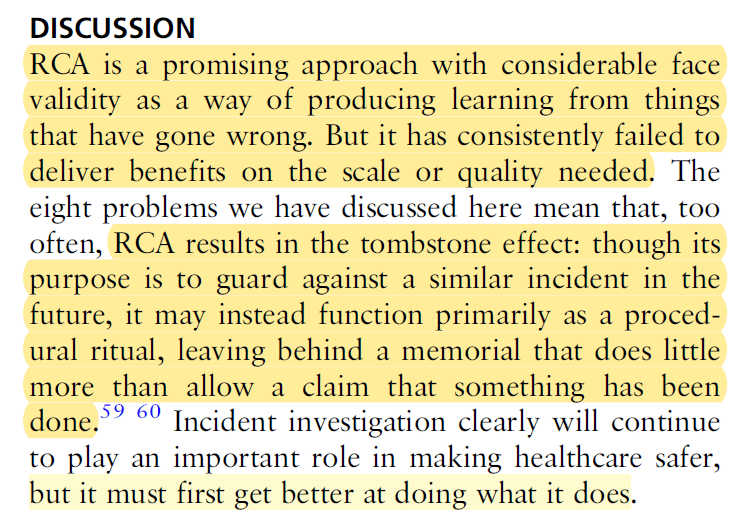
Are your investigations improving control systems or reducing risk, or mostly procedural rituals ‘because we have to do them’? I’m finalising my penultimate PhD study draft (resubmitting based on peer review), and was reminded of this phenomena that I referenced: the tombstone effect. They suggest that too often, incident investigations can fall into the trap… Continue reading Tombstone effect: investigations acting as ‘procedural rituals’ of paper trails
Tag: investigation
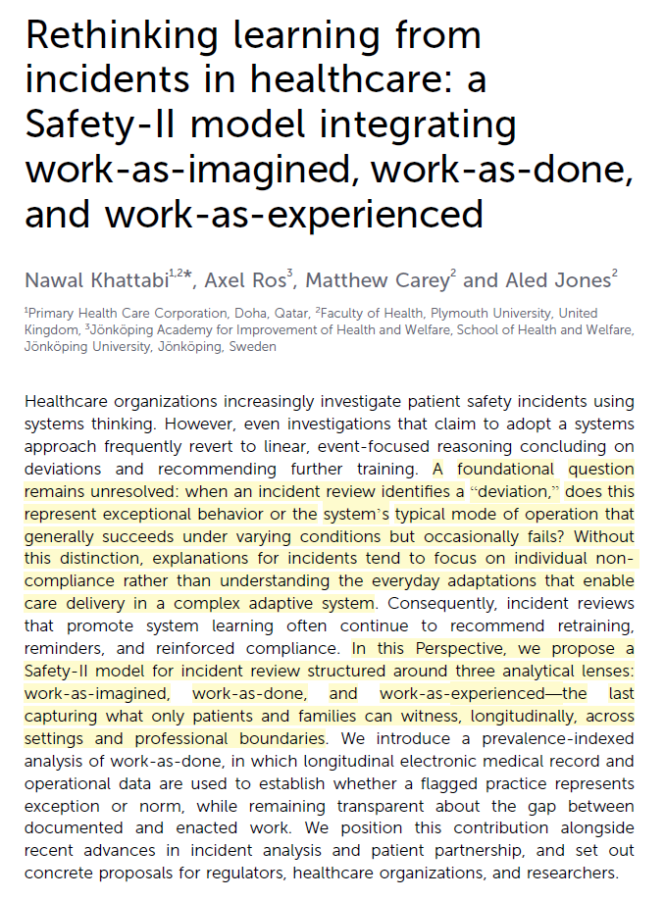
Rethinking learning from incidents in healthcare: a Safety-II model integrating work-as-imagined, work-as-done, and work-as-experienced
Can Safety-II principles expand learning within investigations? This article proposes a Safety-II framed incident review model for healthcare capturing WAI (work-as-imagined), WAD (work-as-done) and WAE (work-as-experienced). Shared under an open access licence. PS. Check out my YouTube and recent Critical Control / barrier vid: https://youtube.com/@safe_as_pod?si=iUaDPJynPemQRZhY Shout a coffee: https://buymeacoffee.com/benhutchinson Extracts: · “A foundational question remains unresolved:… Continue reading Rethinking learning from incidents in healthcare: a Safety-II model integrating work-as-imagined, work-as-done, and work-as-experienced
Pathways to failure: Emeritus Prof Michael Quinlan part 2 interview
What are the repeat failure types across major accidents? In part 2, I continue my discussion with Emeritus Professor michael quinlan, focusing on his Ten Pathways To Failure framework to make sense of how we can avert disaster. He found that these disasters were rarely just simple mechanical failures, but linked to recurring pathways, like:a.… Continue reading Pathways to failure: Emeritus Prof Michael Quinlan part 2 interview

Safe As 39: How biased are incident investigators?
Investigations are reputed to be ‘fact finding’ exercises: objective searches for facts and truth. How what role does investigator bias play in constructing the incident findings? Today’s article is: MacLean, C. L., & Dror, I. E. (2023). Measuring base-rate bias error in workplace safety investigators. Journal of safety research, 84, 108-116. Spotify: https://open.spotify.com/episode/2sd92JGDTL4vq4s9AGJ2ac?si=tWpXuga6RwqmF0r-AiWPnw Apple: https://podcasts.apple.com/us/podcast/e39-how-biased-are-incident-investigators/id1819811788?i=1000728238089 Make sure… Continue reading Safe As 39: How biased are incident investigators?

Safe As podcast ep16: Systems thinking and investigations
Do construction investigations take broader systems perspectives of accident causation, or stuck in the mud focused on local factors, people and behaviour? Further, do investigations help organisations navigate complex, often entangled sociotechnical matters, or hinder progress in safety capacities? Today’s paper is from Woolley, M. J., Goode, N., Read, G. J., & Salmon, P. M.… Continue reading Safe As podcast ep16: Systems thinking and investigations

Safe As podcast ep15: Root Cause Analyses (RCA) and incident prevention – do they ‘work’?
Many organisations rely on their root cause analyses (RCA) to help learn about incidents, and, ideally, prevent incident reoccurrences. So the logic goes. But does the published evidence support RCA approaches as effective means for preventing incident reoccurrences? Today’s paper is Martin-Delgado, J., Martínez-García, A., Aranaz, J. M., Valencia-Martín, J. L., & Mira, J. J.… Continue reading Safe As podcast ep15: Root Cause Analyses (RCA) and incident prevention – do they ‘work’?
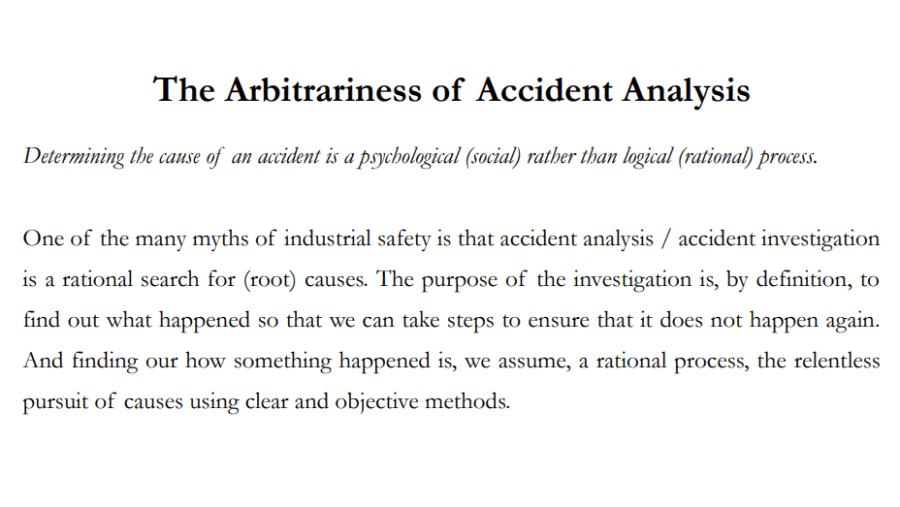
The Arbitrariness of Accident Analysis
A brief article from Hollnagel on the ‘arbitrariness’ of accident analyses. Relying on a lot of direct quotes. First it’s argued that one of the many myths within safety is that accident analysis / investigation “is a rational search for (root) causes”. By this logic, the purpose of an investigation is to found out what… Continue reading The Arbitrariness of Accident Analysis
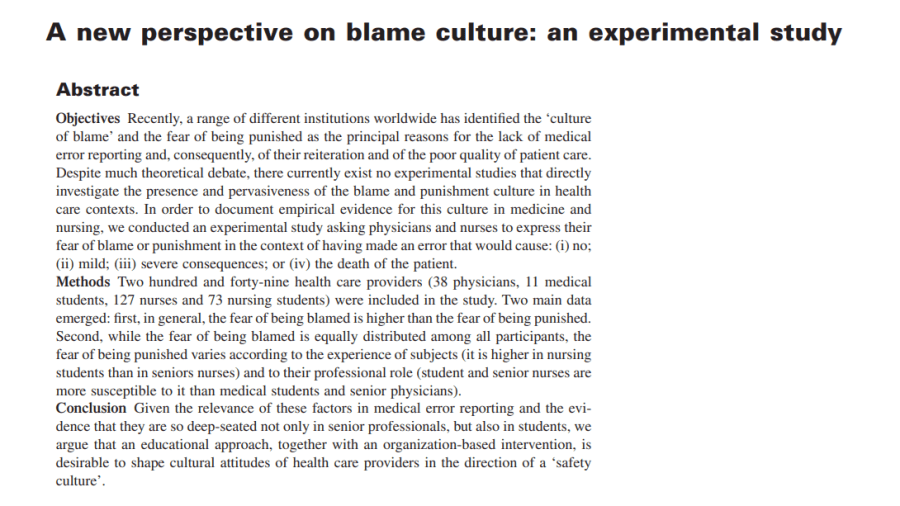
A new perspective on blame culture: an experimental study
This study explored how fear of blame and punishment affects different healthcare professions, experience levels and gender. 249 healthcare practitioners were involved, and were asked how fear of blame or punishment resulting from an error which caused no, mild, severe or death of a patient. Extracts: · “blame culture can be defined as a set of… Continue reading A new perspective on blame culture: an experimental study
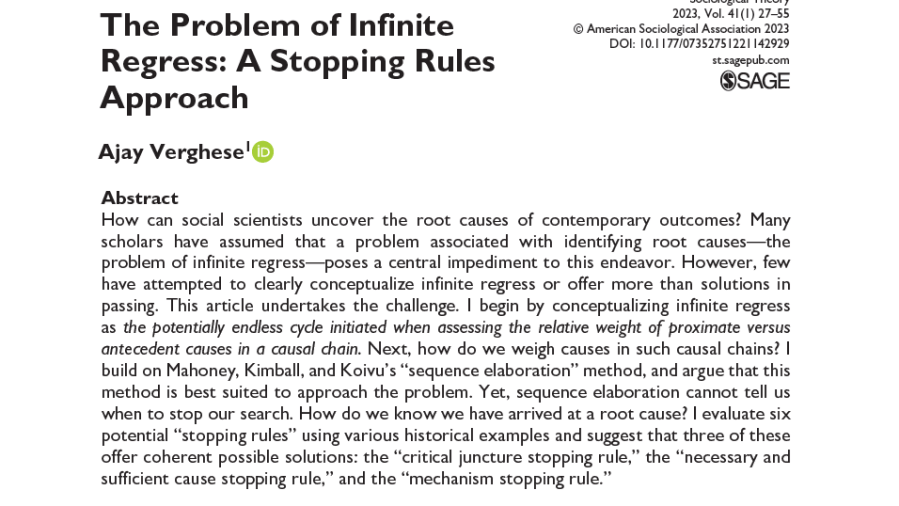
The issues of ‘root causes’ and infinite regression (the endless search for the causes of causes)
A really interesting, but challenging, read about the ontological status of ‘root causes’ and more pointedly, the problem of infinite regression. The author also proposes some stop rules to help navigate infinite regression. I’ve previously posted articles critical of the status of ‘root causes’, who argue it is more a process of implicit or explicit… Continue reading The issues of ‘root causes’ and infinite regression (the endless search for the causes of causes)

Confirmation bias and priming in investigations: ‘Human & Organizational Potential’
Here’s one of (prob) several upcoming posts about Ivan Pupulidy, PhD and Crista Vesel, MSc’s book ‘Human and Organizational Potential’. This part looks at confirmation bias within investigations and uses the US Forest Service’s then current Investigation Guide: · “Confirmation bias is a tendency to search for information that confirms one’s preconceptions. When discussing confirmation bias… Continue reading Confirmation bias and priming in investigations: ‘Human & Organizational Potential’

