

An interesting article from Karl Weick discussing the merits of ‘leadership as the Legitimation of Doubt’.
He argues the strengths of a leader saying ‘I don’t know’.
Some extracts:
· Providing an example, he argues that a leader saying “I don’t know,” … was a strong act of leadership, not a weak one”
· “It was strong because it positioned him for the sensemaking that he needed to do, not for the decision making that would come later as a minor by-product of sensemaking”
· Weick argues that unknowability and unpredictability are expected to become more prominent over time, and we can expect to find more conditions like “Uncertainty will be based less on insufficient facts and more on insufficient questions” (see image 2)

· Starting with I don’t know means “The effective leader is someone who searches for the better question, accepts inexperience, stays in motion, channels decisions to those with the best knowledge of the matter at hand, crafts good stories, is obsessed with updating, encourages improvisation, and is deeply aware of personal ignorance”
· He discusses the saying that the map isn’t the territory, but perhaps neither capture the narrative as well as the compass
· The compass “makes it clearer that we are looking for a direction rather than a location”
· And “While the effective leader may sometimes be able to point to a specific destination that people find compelling, it is more likely that the effectiveness lies in the ability to set in motion a process for direction making”
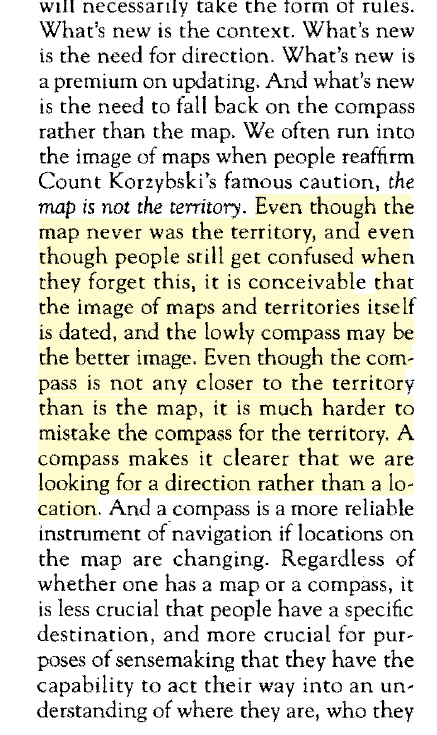
· “Successful sensemaking is more likely when people stay in motion, have a direction, look closely, update often, and converse candidly” and to update stale prior thinking
· Updating previous thinking takes “the form of candid dialogue that mixes together trust, trustworthiness, and self-respect”
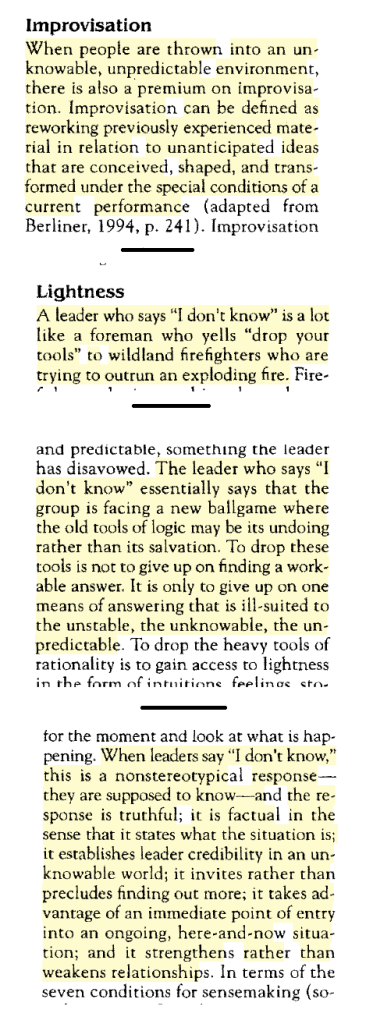
· “When people are thrown into an unknowable, unpredictable environment, there is also a premium on improvisation”
· “A leader who says “I don’t know” is a lot like a foreman who yells “drop your tools” to wildland firefighters who are trying to outrun an exploding fire”
· “The leader who says “I don’t know” essentially says that the group is facing a new ballgame where the old tools of logic may be its undoing rather than its salvation”
· To drop tools isn’t about abandoning an answer but giving up an answer that “is ill-suited to the unstable, the unknowable, the unpredictable”
· When leaders say I don’t know, this is “truthful; it is factual in the sense that it states what the situation is; it establishes leader credibility in an unknowable world”
· “The final and most obvious outcome of leadership acts that begin with not knowing is that they often end with something learned”
Ref: Weick, K. E. (2001). Leadership as the legitimation of doubt. The future of leadership: Today’s top leadership thinkers speak to tomorrow’s leaders, 91-102.

Study link: http://ereserve.library.utah.edu/Annual/POLS/3300/Graham/lead.pdf

 SafetyInsights.org