Just a basic post today – some extracts from a paper exploring chronic unease:
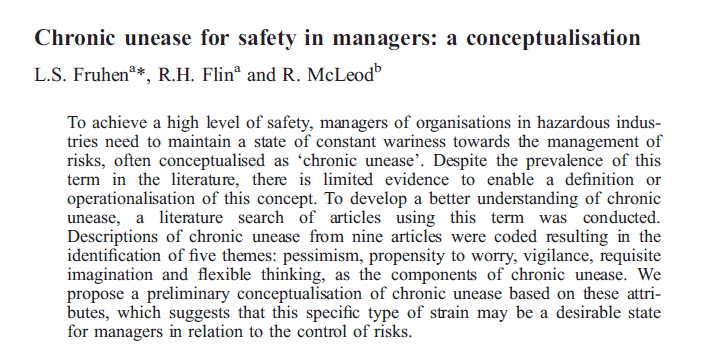
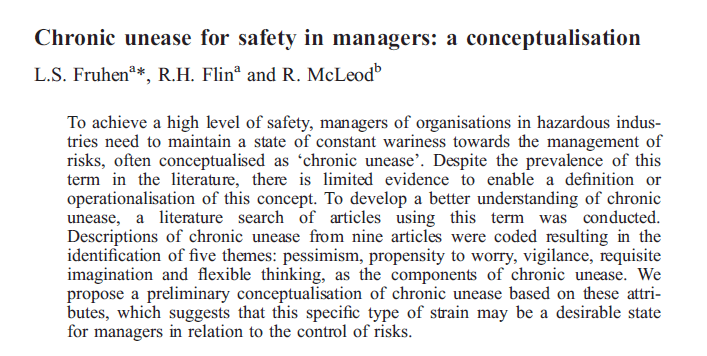
· Drawing on Reason’s concept, chronic unease has gone by various definitions over the years (image 1)

· For Reason, it was the “tendencies of wariness towards risks”
· And as a “contrast to complacency, resulting from the absence of negative events, leading ‘people [to] forget to be afraid”
· It has a general assumption that “everyday will be a bad day”
· Other streams have their own iterations – like mindfulness in HRO
· Mindful organisations in Weick & Sutcliffe’s concept entails:
“(i) dealing with risks by investing substantial resources, both financial and attentional,
(ii) early detection of issues,
(iii) pre-occupation with failure,
(iv) reluctance to simplify, (v) sensitivity to nuances that can lead to failure,
(vi) commitment to resilience and (vii) willingness to defer to experts”
· Other work uses the term “restless mind” to “label awareness that things can go wrong and alertness to weak signals”
· Nick Pidgeon used the term ‘safety imagination’ and another similarish concept is entertaining doubt
Five attributes are said to highlight chronic unease:
· The first is pessimism: “a disposition that drives individuals to anticipate failures and expect negative events”
· Second is vigilance: being “alert to (weak) indicators of risks in the environment”
· Third is requisite imagination: being the “ability to project the development of a situation into future based on its current state”
· Fourth is flexible thinking: being the “ability to approach safety related issues from many angles, to think about them critically and to question assumptions”
· Fifth is propensity to worry: being a “personal attribute reflecting a tendency to worry about risk”
Image 2 is their proposed model of chronic unease, influenced by a model of occupational stress:
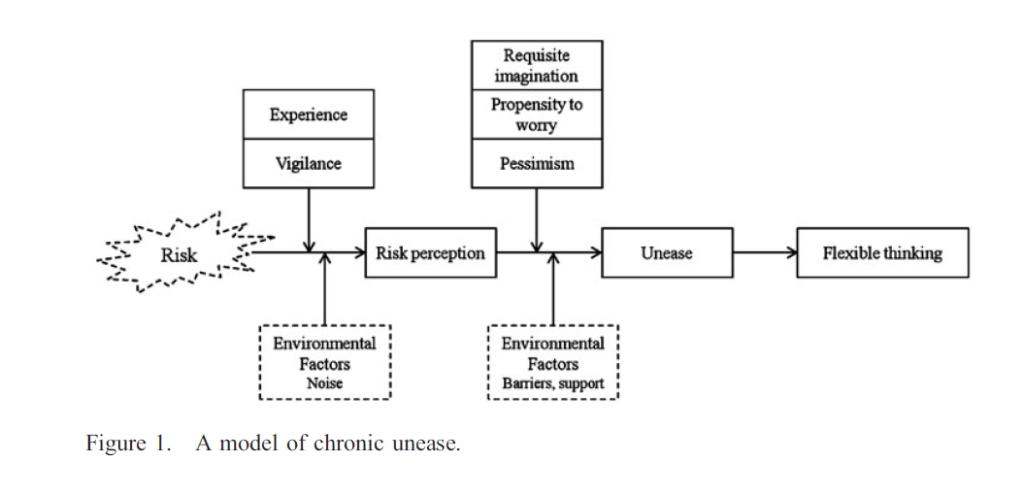
· Chronic unease in their model is a strain reaction to the management of risk
· Hence, “workplace risks function in the same manner as stressors that are perceived by managers”
· “The genesis of unease starts with the manager’s perception of risks, which will be influenced by his or her vigilance and experience”
Note: Other work has been more critical of chronic unease/preoccupation with failure, suggesting it could contribute to significant stress and anxiety if it’s taken literally.
Ref: Fruhen, L. S., Flin, R. H., & McLeod, R. (2014). Chronic unease for safety in managers: a conceptualisation. Journal of Risk Research, 17(8), 969-979.

Study link: https://doi.org/10.1080/13669877.2013.822924

 SafetyInsights.org