“How can I know what I think till I see what I say?”
I’ve always liked this expression from Karl Weick (taken from Graham Wallas), discussing the retrospective justification element of sensemaking.
Pretty heavy for a Sunday morning my time. But here we are.
Sensemaking is argued to entail: (image 1)
· Thoughts justifying earlier words
· Choosing which words to focus on and the thoughts to explain them
· Retrospective sensemaking: Sensemaking is said to emphasise retrospection or looking back and attributing meaning

In Ryan Smerek’s work (image2):
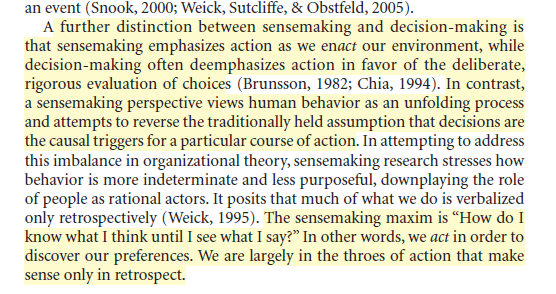
· Smerek draws on Weick’s concept of sensemaking, observing that a distinction “between sensemaking and decision-making is that sensemaking emphasizes action as we enact our environment, while decision-making often deemphasizes action in favor of the deliberate, rigorous evaluation of choices”
· “a sensemaking perspective views human behavior as an unfolding process and attempts to reverse the traditionally held assumption that decisions are the causal triggers for a particular course of action”
· “sensemaking research stresses how behavior is more indeterminate and less purposeful, downplaying the role of people as rational actors. It posits that much of what we do is verbalized only retrospectively (Weick, 1995). The sensemaking maxim is “How do I know what I think until I see what I say?” In other words, we act in order to discover our preferences”
· “We are largely in the throes of action that make sense only in retrospect”
· “sensemaking” is used rather than “decision-making” to move analysis from isolated events to more comprehensive, ongoing flows of experience”
· “A sensemaking perspective shifts us to a more interpretive, ongoing worldview from a rational, static picture that delineates actors from an objective reality”
· “A focus on decision-making, with its assumptions of objectified external environments, is more likely to activate a search for blame about who made a “bad” decision relative to an external environment, rather than focus attention on the flow of subjective experience leading to an event”
· “A further distinction between sensemaking and decision-making is that sensemaking emphasizes action as we enact our environment, while decision-making often deemphasizes action in favor of the deliberate, rigorous evaluation of choices”
· “a sensemaking perspective views human behavior as an unfolding process and attempts to reverse the traditionally held assumption that decisions are the causal triggers for a particular course of action”
Refs:
1) Weick, K. E., & Weick, K. E. (1995). Sensemaking in organizations (Vol. 3, pp. 1-231). Thousand Oaks, CA: Sage publications.
2) Smerek, R. E. (2013). Sensemaking and new college presidents: A conceptual study of the transition process. The Review of Higher Education, 36(3), 371-403.


 SafetyInsights.org