
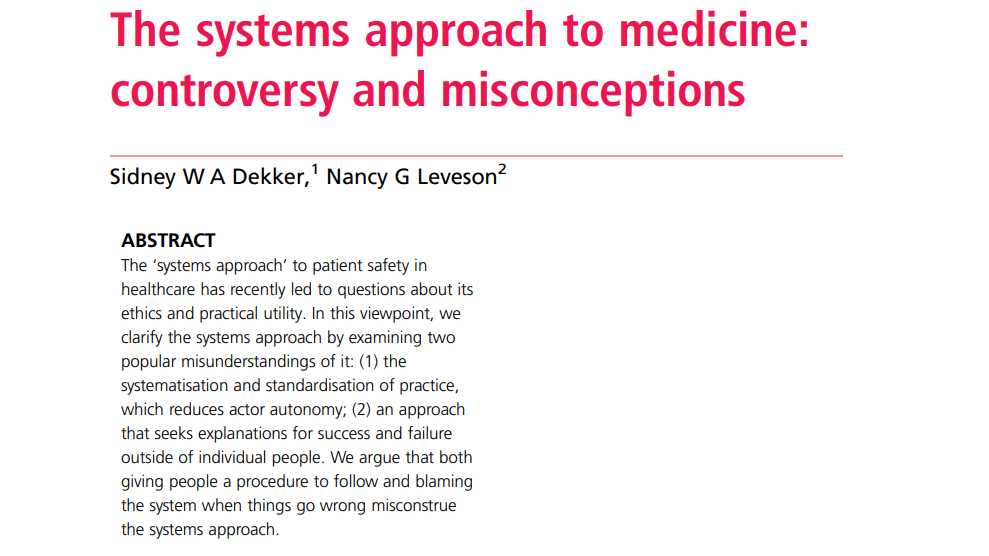
This was a really brief discussion paper from Dekker and Leveson, covering systems thinking in medicine.
Three parts – see comments.
Nothing new for most, but they cover:
· “The ‘systems approach’ to patient safety has recently led to questions about its ethics and practical utility”
· E.g. A recent paper from a retired neurosurgeon questioned systems thinking, stating “the medical profession has put its faith in a systems approach to the problem … [a] so-called solution that doesn’t address the problem’”
· Dekker & Leveson argue that this perspective misunderstands systems approaches, which seems to equate it to “standardising practice and reducing individual autonomy (eg, creating more rules, policies and compliance demands)2 and (2) blaming the system rather than holding people accountable”
· Neither of these are representative of systems approaches
· What are systems? In this context, “A system, such as a hospital, is a dynamic and complex whole, interacting as a structured functional unit to achieve goals”
· Sub-systems are nested within higher-order systems
· “The behaviour of a system reflects the linkages and interactions among the components that make up the entire system”
· All of medicine “is practiced within a system” [** that’s a huge understatement…]
· “Reducing the system approach to following a checklist or standardised procedure trivialises what can be accomplished by careful system design”
· “goal of a systems approach, however, is not to reduce human behaviour to rule-following, but to design a system in which individual responsibility and competence can effectively help create desired outcomes”
· “Procedures or checklists per se do not reduce harm”, and likewise mistakes in using checklists in aviation “do not directly produce catastrophe because of careful engineering”
· “human resilience fills the gap between work-as-imagined and work-as-done: autonomy is maintained for a variety of processes”
· “Thus, standardisation, or giving people a procedure to follow, does not constitute a systems approach”
Next they ask whether a systems approach conflicts with personal accountability?
· “The systems approach argues that a flawed hospital system, rather than flawed individuals, is responsible for patient harm”
· But some people “invert this”, suggesting that “a systems approach entails just blaming the system, not the individual”
· But systems approaches do not “eschew individual responsibility and accountability”
· “First, the rate at which healthcare produces ‘second victims’ compared with other domains shows just how much individual accountability its practitioners assume”
· Second, individuals all have a role in sub-systems, which contribute to overall goal performance
· An example is given of a NZ surgeon who was criminally prosecuted resulting from several deaths, but what received scant attention was “he was forced to operate with help from medical students, because of a lack of available competent assistance”
· “Prosecuting the surgeon, who had little control over the context in which he worked, did not solve the problem”
· “Blame is the enemy of safety” (emphasis added)
They wrap-up with some systems thinking ideas:
· Focusing on blame and punishment “results in hiding errors and eliminates the possibility of learning from them”
· Just Cultures are so called ways to try and counter blame logics, in part by “fairly adjudicate[ing] how to respond to undesired practice”
· This approach is consistent with systems approaches, which sees error “to be reducible through processes, procedures, training, and system design, including the design of the incentive structure around practitioners”
· Management “in(competence) can be seen as a system issue”
· Take aviation, which is said to have structures to oversee and eliminate incompetent practice “instead of leaving its discovery and management only to individual moral valence”
· While “Good doctoring” [* and good healthcare professional practice] is of course critical, and makes the most of what is available, “the systems approach has always been about providing a better hand in order to improve the opportunity to do the right thing”
· “Merely leaving the hand with which one is dealt and banking on personal virtue to do the rest is both practically and ethically irresponsible”
Ref: Dekker, S. W. A., & Leveson, N. G. (2015). The systems approach to medicine: controversy and misconceptions. BMJ Qual Saf 24 (1): 7–9.
[PS. I have another brief article from these authors on ‘bad apples’ coming up next week]

Study link: https://www.academia.edu/29657886/The_systems_approach_to_medicine_controversy_and_misconceptions

 SafetyInsights.org