
Today I chat with Dr Marcin Nazaruk, who shares his practical experience and research on learning from daily work and application on Safety-II and HOP principles to improve learning and risk management. The discussion also explores themes around risk controls, work constraints, risk assessments, and error traps. Check out Part 1 and please help like… Continue reading Dr Marcin Nazaruk Part 1: HOP, New View, Learning from Daily Work
Tag: safety differently
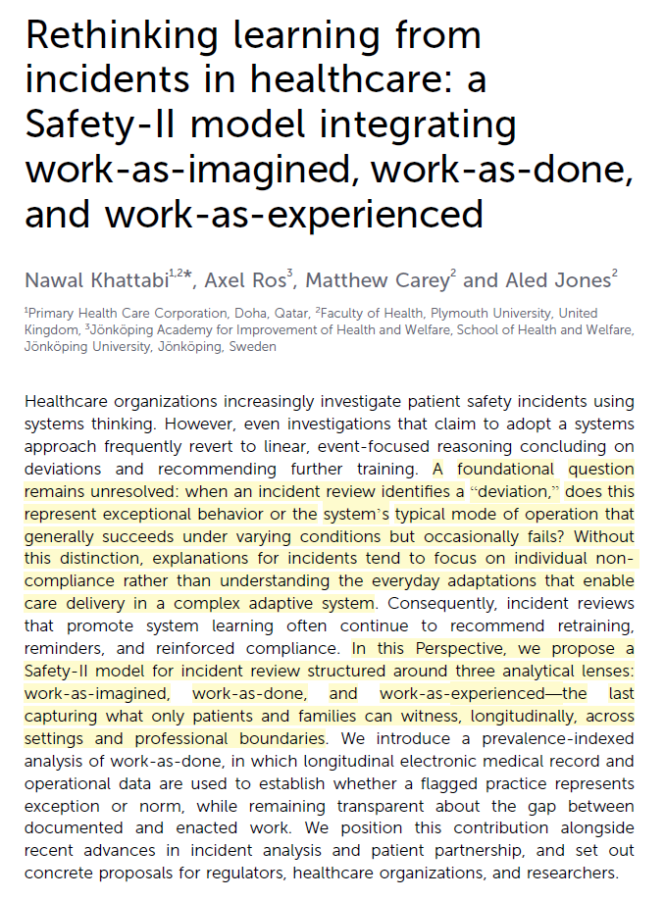
Rethinking learning from incidents in healthcare: a Safety-II model integrating work-as-imagined, work-as-done, and work-as-experienced
Can Safety-II principles expand learning within investigations? This article proposes a Safety-II framed incident review model for healthcare capturing WAI (work-as-imagined), WAD (work-as-done) and WAE (work-as-experienced). Shared under an open access licence. PS. Check out my YouTube and recent Critical Control / barrier vid: https://youtube.com/@safe_as_pod?si=iUaDPJynPemQRZhY Shout a coffee: https://buymeacoffee.com/benhutchinson Extracts: · “A foundational question remains unresolved:… Continue reading Rethinking learning from incidents in healthcare: a Safety-II model integrating work-as-imagined, work-as-done, and work-as-experienced
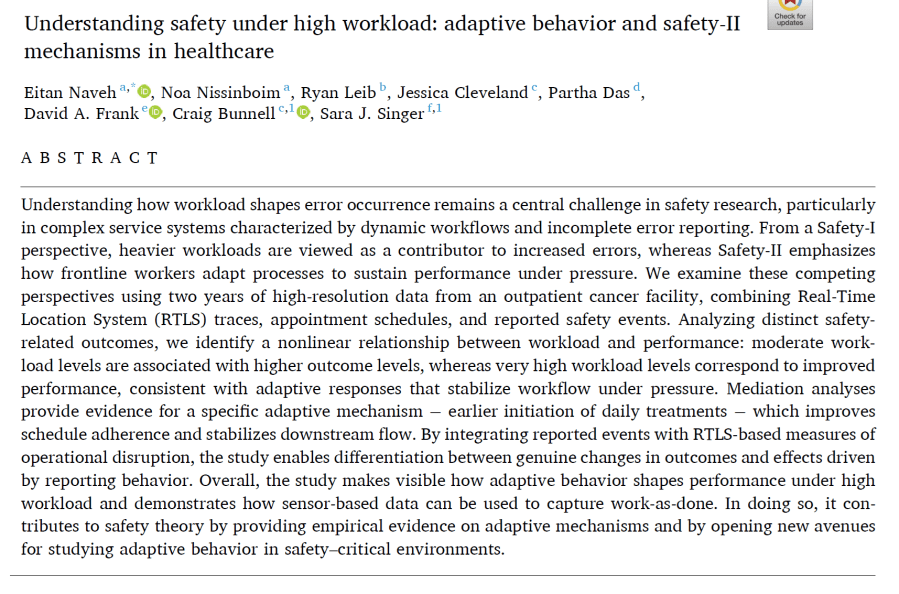
Understanding safety under high workload: adaptive behavior and safety-II mechanisms in healthcare
What does Safety-II tell us about workload, adaptations, and error? This study analysed the effects of workload on error and adaptations across >580 days in 6 hospital departments and 924 reported safety events. PS. Check out my YouTube and recent Critical Control / barrier vid: https://youtube.com/@safe_as_pod?si=iUaDPJynPemQRZhY Shout a coffee: https://buymeacoffee.com/benhutchinson Extracts: · “From a Safety-I perspective,… Continue reading Understanding safety under high workload: adaptive behavior and safety-II mechanisms in healthcare
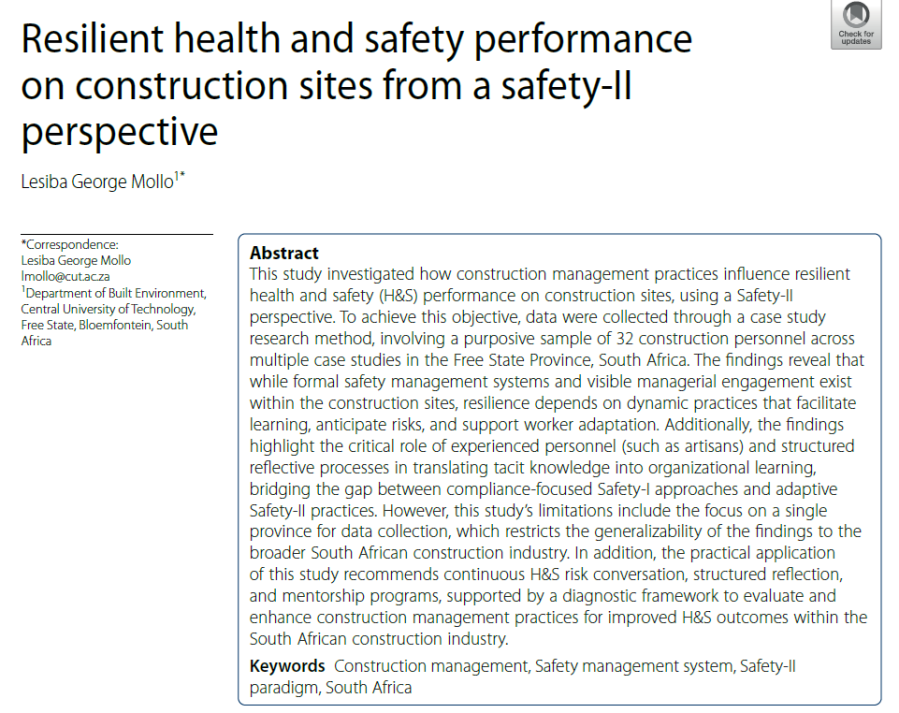
Resilient health and safety performance on construction sites from a safety-II perspective
“These findings .. emphasizes that resilience stems from dynamic, iterative practices that foster adaptive capacity” How do construction management practices influence resilient health and safety performance? Shared under an open access licence. PS. Check out my YouTube: https://youtube.com/@safe_as_pod?si=iUaDPJynPemQRZhY Extracts: · “Instead of implementing proactive interventions that address planning deficiencies, poor coordination, and organizational decision-making under dynamic… Continue reading Resilient health and safety performance on construction sites from a safety-II perspective
Dr Drew Rae: Does the limited New View / HOP / Safety-II empirical evidence challenge its credibility?
Does the limited empirical interventional evidence underpinning New View / HOP / Safety-II approaches challenge their credibility? Here Dr Drew Rae unpacks his perspective on how this is often framed as a confused question. We also discuss the limited evidence behind Risk Matrices, which prompts the foundational question: what are they actually used for?
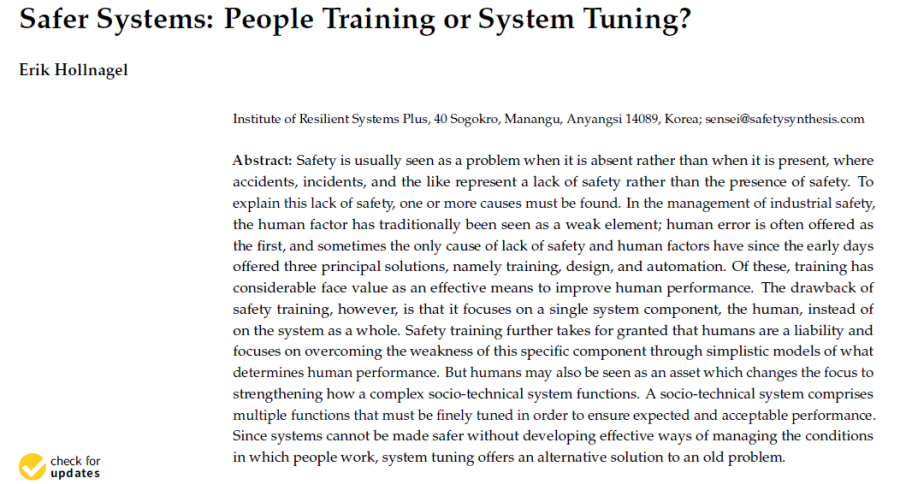
Safer Systems: People Training or System Tuning?
Hollnagel discusses the role of training in complex systems. Shared under open access licence. PS. Check out my YouTube channel: Safe As: A thrifty analysis of safety, AI and risk – YouTube Extracts:· “Safety is usually seen as a problem when it is absent rather than when it is present, where accidents, incidents, and the like… Continue reading Safer Systems: People Training or System Tuning?

Safe As 38: 4Ds – Dumb, Dangerous, Different, Difficult – for learning (quickisode)
This quickisode unpacks the 4D method for learning: Dumb, Dangerous, Different, Difficult. The source is Sutton et al. 2023. 4Ds for HOP and Learning Teams: A practical how-to guide to facilitate learning from everyday work, critical and dynamic risks with the 4Ds. Spotify: https://open.spotify.com/episode/5kVSsQBISQK3vMREbUGExv?si=LOvB1DE1SfCE-8E7uYSK_Q Apple: https://podcasts.apple.com/us/podcast/e38-4ds-dumb-dangerous-different-difficult-for-learning/id1819811788?i=1000727889641 Make sure to subscribe to Safe As on Spotify/Apple,… Continue reading Safe As 38: 4Ds – Dumb, Dangerous, Different, Difficult – for learning (quickisode)

The Folly of Safety-III
Hollnagel’s response to some of the recent (and somewhat bizarre) articles on ‘Safety-III’. Spoiler: It’s not charitable. I’m relying on a lot of direct quotes. Providing context, Hollnagel argues: · Introduction of Safety-I and Safety-II (SI / SII) to characterise two opposite means of safety was “met with surprisingly large interest” and “also with some… Continue reading The Folly of Safety-III

Strategies and tools to learn from work that goes well within healthcare patient safety practices: a mixed methods systematic review
This systematic review covers strategies and tools used in healthcare patient safety for learning from normal work and Safety-II. 22 articles met inclusion. For background: · In healthcare “underreporting is highly prevalent, and is linked to, among other things, shaming and blaming mentality, insufficient visible measures and inadequate communication about errors” · “most reporting systems… Continue reading Strategies and tools to learn from work that goes well within healthcare patient safety practices: a mixed methods systematic review

Open-access healthcare debriefing videos need to incorporate more Safety-II learnings
Are Safety-II concepts used in debriefing? This explored the language and framings used in open access debriefing videos, to ascertain whether the questioning probes deeper into S-I (focus on failure/error) or S-II (focus on normal work, variability, success) questioning. Note: Only 7 videos met inclusion for transcription/evaluation. They note that learning from success isn’t “uncommon… Continue reading Open-access healthcare debriefing videos need to incorporate more Safety-II learnings
 SafetyInsights.org