
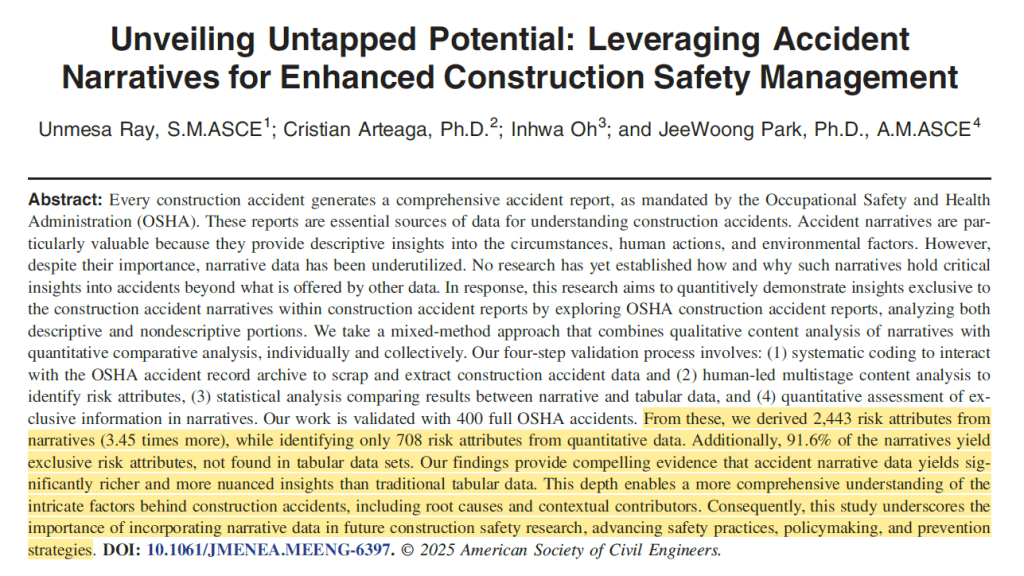
This study explored the value and insights derived from investigation reports, comparing tabulated data vs extracted narratives.
It was interested in what sorts of trends and insights about risk factors could be derived from either data stream.
Their method to extract the info was tested against 400 OSHA reports.
For context:
· Tabular data is “structured information and thus can be easily quantifiable and codifiable”
· “Narrative data is another type of data in an unstructured format and thus cannot be easily quantified and codified, being relatively difficult to be used in analysis “
· Despite the significant value of narrative data, the “interpretation of narrative data poses a challenge due to its qualitative nature”
· “Past research notably favored tabular data over narrative data, leading to disproportionate attention”
· Some limited work has explored narrative data in safety, finding some value of narrative-driven toolboxes compared to non-narrative toolboxes
· “Narratives, compared to other nondescriptive data, are inherently understood to offer more detailed and critical insights into accidents”
I’ve skipped all of their methods and direct statistical results and gone straight to the discussion.
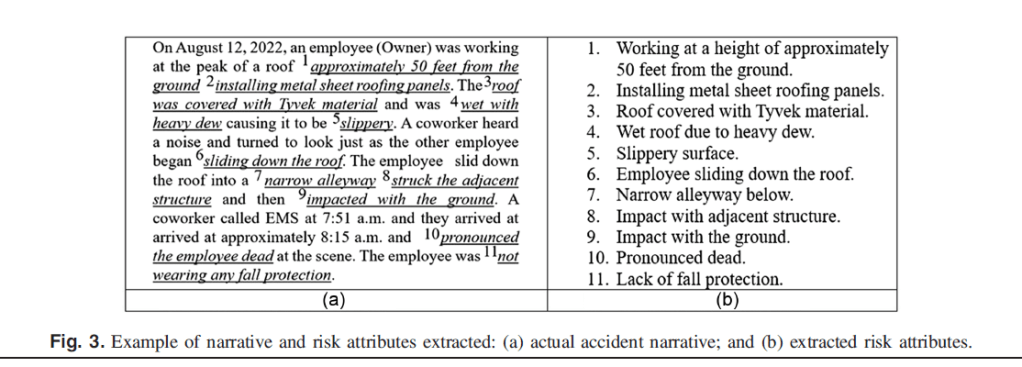
Results
Overall they found:
· 708 risk attributes were extracted from the tabulated data
· In contrast, 2,443 risk attributes (3.45 times more) were extracted from the narrative data
· Further, “91.6% of the narratives yield exclusive risk attributes, not found in tabular data sets”
· “Our findings provide compelling evidence that accident narrative data yields significantly richer and more nuanced insights than traditional tabular data”

Expanding on the above, 1,735 risk attributes were extracted solely from the narratives. Further, most narratives had zero to seven exclusive risk attributes, with an average of 4.44 more risk attributes identified over tabulated data.
Their analysis found just 21 instances where all of the risk attributes from the narrative were identified via the tabulated data alone. This highlights the limitations of incident reporting/investigation with overprioritises tabulated data over narratives.
Their findings “highlights the inadequacies of OSHA accident reporting, showcasing instances where the event abstracts lack sufficient information for our risk attribute extraction process due to the limited content contained within them”
Their findings indicated that tabulated data was more unreliable, with missing fields/data across the sample. This suggests “tabulated data alone is insufficient in capturing the entirety of the information”. And in cases of insufficient reporting/lack of information, “narrative analysis proves to be as effective as tabular analysis “.
In concluding, they argue, unsurprisingly, that “By extracting and integrating both qualitative insights and quantitative measures from narratives, safety managers can achieve a deeper understanding of accident causes and develop more effective prevention strategies”.
And their findings “highlights the importance of detailed narrative data in accident reports, suggesting that organizations should refine their data collection processes to capture richer accounts”.
NB 1. As you may have noticed, they’re not advocating for narrative over tabulated, but suggesting greater focus on narratives. Both can and should co-exist, but narratives provided far richer data and made up for flaws/gaps in tabular data.
NB 2. This could equally apply to any activity that collects and parses data, including facilitated learning groups (Learning Teams, quality circles, pre-mortems) and more.
Ref: Ray, U., Arteaga, C., Oh, I., & Park, J. (2025). Unveiling Untapped Potential: Leveraging Accident Narratives for Enhanced Construction Safety Management. Journal of Management in Engineering, 41(3), 04025012.

Study link: https://doi.org/10.1061/JMENEA.MEENG-6397
LinkedIn post: https://www.linkedin.com/pulse/unveiling-untapped-potential-leveraging-accident-ben-hutchinson-yoqbc

 SafetyInsights.org