
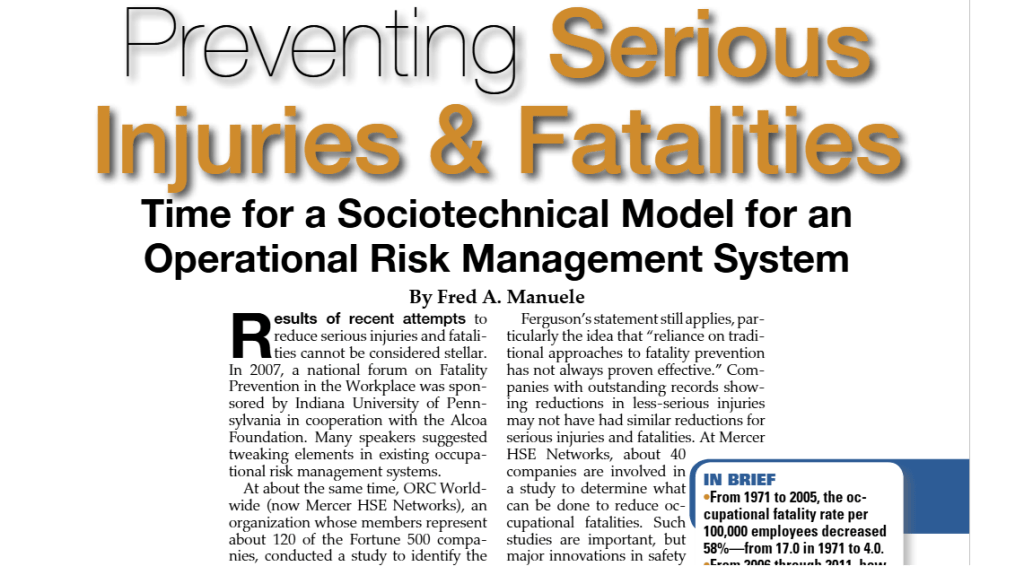
Here’s a 2008 article from Fred Manuele which was included in my SIF compendium (link to compendium & article below).
Fred explores a sociotechnical approach to preventing SIFs.
The fatality rate in the US from 1971 to 2005 decreased from 17 to 4, but remained stable from 06 to 2011 at ~3.5; hence SIF prevention efforts in that time period “have made little progress”.
It’s argued that “reliance on traditional approaches to fatality prevention has not always proven effective”, where reductions in non-SIFs may not carry over to SIF prevention.
Fred argues that some persistent premises (myths) have stuck around in organisations, which affect SIF prevention:

· “The premise that OSHA-related incidence rates are accurate measures of serious injury and fatality potential must be dislodged”
· “broadly held assumption that reducing the frequency of [non-SIFs] will result in an equivalent reduction in [SIFs] must be dislodged”
· “The belief that unsafe acts of workers are the principal causes of occupational incidents must be uprooted and dislodged”
· “Prevention through design concepts must be instituted as an element within an operational risk management system”
· Australian data is cited which found that design factors were ‘definitely or probably’ involved in at least 37% of machinery and equipment fatalities
· Design should reduce human error to a practical minimum, and “The ability of personnel to defeat the work system and prescribed work methods is at a practical minimum”
· Prescribed work processes should adopt HF/E principles to evaluate human capabilities and limits
· Design should also reduce the need of PPE to a practical minimum
· MOC & prejob planning must “be a separate and emphasized element within an operational risk management system”
· Fred’s own review of >1.7k incidents found many incidents to occur during unusual and nonroutine work, during nonproductive activities, during plant modifications or startups, and where high energy sources are present
On error:
· Businesses must shift the focus towards the design of work systems and work methods
· Work systems should be over training and ‘fixing’ individuals – the latter “not be effective if error potential is designed into the work”
· Quoting Dekker, “Human error is not a cause of failure. Human error is the effect, or symptom, of deeper trouble. Human error is . . . systematically connected to features of people’s tools, tasks, and operating systems”
· Sources of error are “structural, not personal”

Fred argues for a sociotechnical/systems view:
· “Taking a macro view of systems as a whole and adopting the sociotechnical concept (Figure 1) will advance the state of the art in the practice of safety”
· “Highly effective operations require a good fit between an organization’s technical subsystems and its social subsystems”

Study link: https://aeasseincludes.assp.org/professionalsafety/pastissues/058/05/F2Manu_0513.pdf
SIF compendium: https://safety177496371.wordpress.com/2025/04/15/compendium-sifs-major-hazards-fatal-traumatic-hazards-risks/

 SafetyInsights.org