Is there a link between fatal and minor hazard exposures? Recent SIF research & campaigns suggest ‘NO’ – what kills people aren’t the same as what hurts them. But is that scientifically accurate? In part 1 of my chat with Dr Linda Bellamy, we discuss how Linda undertook perhaps the largest study of this kind… Continue reading Dr Linda Bellamy part 1: SIFs & the links between minor and major incidents
Tag: sif
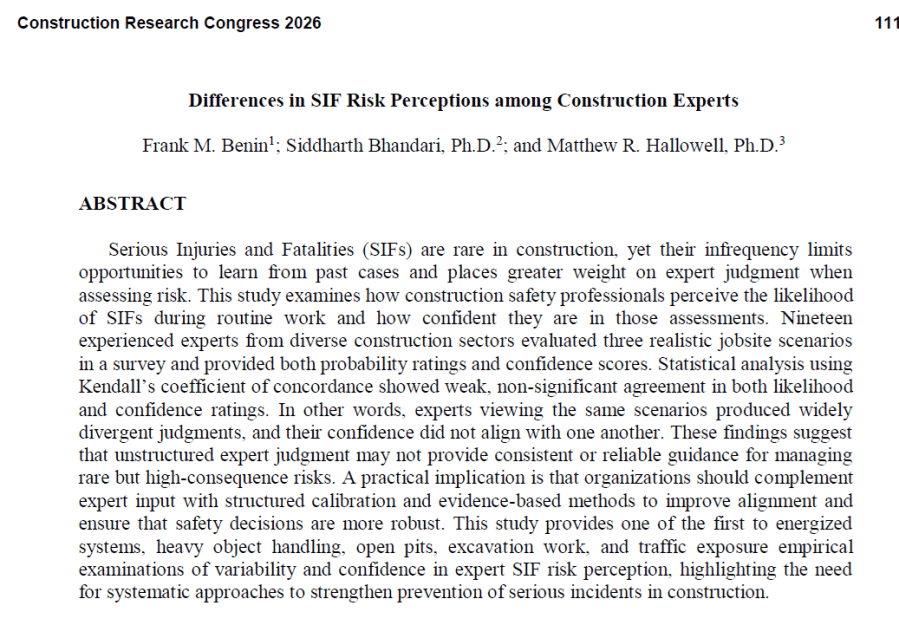
Differences in SIF Risk Perceptions among Construction Experts
Would two construction experts see the same SIF threat on the same site? This study from Frank Benin, Sid Bhandari & Matthew Hallowell evaluated how 19 construction experts perceive the likelihood of SIFs during routine work and how confident they were in those assessments. Assessments were sought via 3 work site scenario photos (so note… Continue reading Differences in SIF Risk Perceptions among Construction Experts
Balanced approach to serious injury and fatality prevention: Exploring empirical relationships between short and long-term measures of safety performance
What tells you more about tomorrow’s fatality risk – last month’s injury rate or today’s control of high-energy hazards? An interesting study Arnaldo Bayona & Matthew Hallowell and colleagues exploring the relationship between assessments of pre-job safety brief (PJSB) quality and HECA (high-energy control assessments) and work conditions, and links with injury and SIFs. Not… Continue reading Balanced approach to serious injury and fatality prevention: Exploring empirical relationships between short and long-term measures of safety performance
“Achieving low … incident rates does not indicate that controls are adequate with respect to [SIFs]”
“Achieving low … incident rates does not indicate that controls are adequate with respect to [SIFs]” Another lazy PowerPoint of quotes, this time from Fred Manuele’s 2013 article ‘Preventing Serious Injuries & Fatalities’. What do you think – do you agree or disagree with Fred’s premises which need to be embedded or dislodged? PS. Check… Continue reading “Achieving low … incident rates does not indicate that controls are adequate with respect to [SIFs]”
Part 2 interview with Dom Cooper: SIFS, BBS, HOP, and can we trust injury outcome measures
Part 2 interview with Dom Cooper on YouTube. Over these 2 eps, we discuss BBS, SIFS, weaknesses of HOP, and a lively debate on whether we can trust injury outcome measures, and more. Please subscribe, like, comment (directly on the YT video), and help share with your network. 🙏 Shout me a coffee: https://buymeacoffee.com/benhutchinsonSafe As… Continue reading Part 2 interview with Dom Cooper: SIFS, BBS, HOP, and can we trust injury outcome measures
Minor injuries may have little to no connection with fatal injuries
Minor injuries may have little to no connection with fatal injuries. No great epiphany or diatribe here – just three readily accessible extracts highlighting that focusing on minor stuff may not give many insights into the stuff that kills. 1. “There is no discernible association between Total Recordable Incident Rate (TRIR) and fatalities” 2. “analysis… Continue reading Minor injuries may have little to no connection with fatal injuries
Safe AF #8: The harm in zero harm
Is Zero Harm a laudable approach or a misdirection–a utopian fantasy–associated with higher fatality rates? Safe AF episode #8 dives into a paper which compares safety injury and fatality performance between zero and non-zero construction company adopters in the UK. From: Sherratt, F., & Dainty, A. R. (2017). UK construction safety: a zero paradox?. Policy and… Continue reading Safe AF #8: The harm in zero harm
Building Resilience into Safety Management Systems: Precursors and Controls to Reduce Serious Injuries and Fatalities (SIFs)
This report, part of creative sentencing research, explored Serious Incidents and Fatalities (SIFs) in mining, and the causes, and the most effective controls for SIFs. Another aim was around the fallibility of people, and when they make mistakes, ensuring there are adequate capacities “so that they ‘fail safely’”, rather than “rather than ‘failing lucky”, or… Continue reading Building Resilience into Safety Management Systems: Precursors and Controls to Reduce Serious Injuries and Fatalities (SIFs)

Safe AF ep #4: Relationship between fatal and non-fatal accidents based on 23k accidents
Is there a connection between fatal and non-fatal accidents, or is it a fallacy to focus on the minor potential events with the hope of managing the major events? Today’s study explores these relationships based on 23k reported serious accidents in the Netherlands. Ref: Bellamy, L. J. (2015). Exploring the relationship between major hazard, fatal… Continue reading Safe AF ep #4: Relationship between fatal and non-fatal accidents based on 23k accidents
Impact of Energy-Based Safety Training on Quality of Prejob Safety Meetings and Control of Hazardous Energy in Construction: Multiple Baseline Experiment
This study explored the role of energy-based safety training on the quality of the prestart meetings. Method was a multiple baseline assessment on 10 construction crews in the US and Canada following the training intervention, then measuring the prejob safety brief quality and HECA (High Energy Control Assessment). Background: · Construction accounts for about 7%… Continue reading Impact of Energy-Based Safety Training on Quality of Prejob Safety Meetings and Control of Hazardous Energy in Construction: Multiple Baseline Experiment
 SafetyInsights.org