
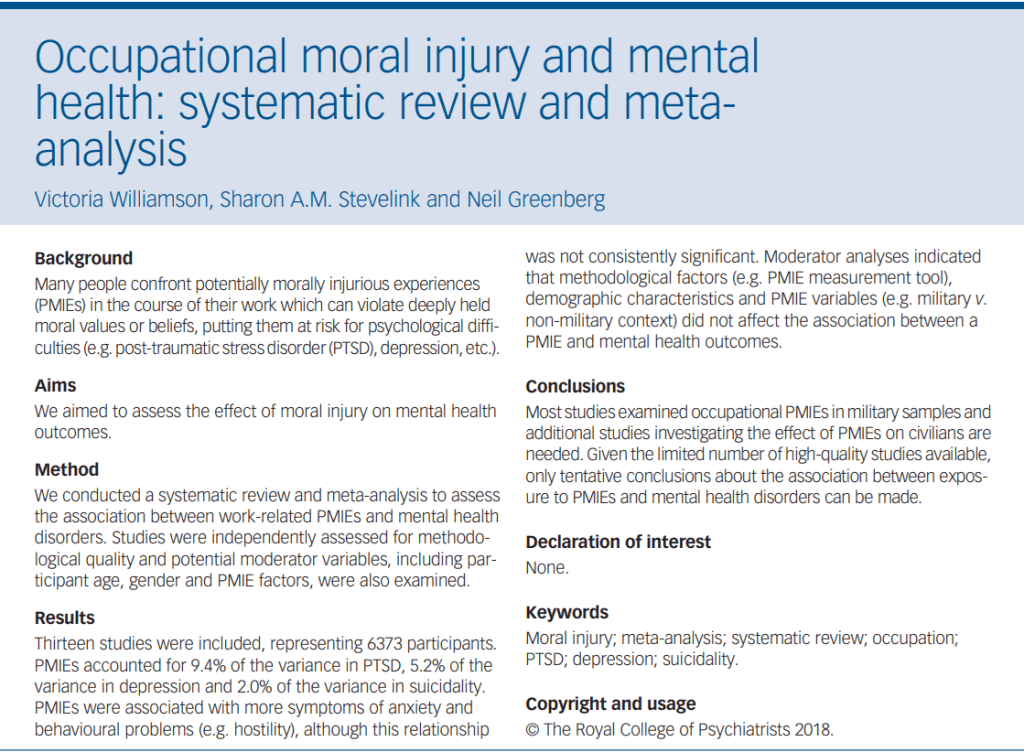
This meta-analysis studied the links between occupational moral injury and mental health.
Two key terms are morally injurious experiences (PMIEs) and post-traumatic stress disorder (PTSD).
PMIEs include “‘perpetrating, failing to prevent, bearing witness to, or learning about acts that transgress deeply help moral beliefs and expectations”.
PMIEs can result in “significant psychological distress or moral injury”. Certain occupational groups are exposed to PMIEs, including military personnel, first responders, journalists and more.
Most research has focused on military personnel (as of 2018), so the effects on other groups were less explored. Just 13 studies met inclusion.
Results:
· “PMIEs accounted for 9.4% of the variance in PTSD, 5.2% of the variance in depression and 2.0% of the variance in suicidality”
· “PMIEs were associated with more symptoms of anxiety and behavioural problems (e.g. hostility), although this relationship was not consistently significant”
· “Most studies examined occupational PMIEs in military samples and additional studies investigating the effect of PMIEs on civilians are needed. Given the limited number of high-quality studies available, only tentative conclusions about the association between exposure to PMIEs and mental health disorders can be made”
· “The strongest relationship was found between PMIEs and PTSD … [reporting] the common symptoms of moral injury are intrusive thoughts, intense negative appraisals (e.g. shame, guilt, disgust, etc.) and reliance on cognitive avoidance”
· “A statistically significant, although small relationship between depression and PMIEs was found in military personnel; however, civilian data on this association was lacking”
· “Characteristic symptoms of depression include social withdrawal, self-depreciating emotions and a loss of meaning,58 all of which have been reported in qualitative studies following military-related moral injury” and similarly in humanitarian aid workers
· “Suicidality was significantly associated with PMIEs in military personnel with a small effect” but with only three studies reporting significant findings
· “Alternatively, it is possible that the relationship between suicidality PMIEs may be an indirect effect caused by other associated risk factors”
· “A modest relationship between PMIEs, anxiety, hostility, poor resilience and less social support was also examined in this review”
· “The relationship between PMIEs and hostility is in keeping with recent research of military-related PMIEs causing anger or hostility that persists for several years post-deployment”
· “the results suggest a negative impact of PMIEs on psychological adjustment, in both a military and non-military occupational context”


Ref: Williamson, V., Stevelink, S. A., & Greenberg, N. (2018). The British Journal of Psychiatry, 212(6), 339-346
Study link: https://doi.org/10.1192/bjp.2018.55

 SafetyInsights.org
One thought on “Occupational moral injury and mental health: systematic review and meta-analysis”