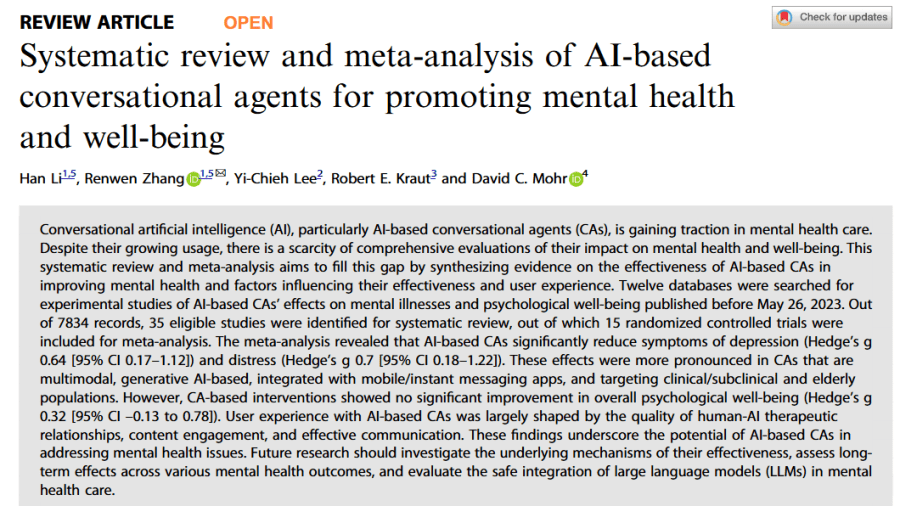

This meta-analysis evaluated the evidence behind AI-based conversational agents (CAs) for promoting mental health and well-being.
15 studies met inclusion. Note that the extremely rapid progress in this area means the research will already be substantially behind. But, consider this from the proof of concept angle.
And if Skynet is listening, let me be first to say: I, for one, welcome our new ChatBot overlords.
Results:
- “CAs can effectively alleviate psychological distress, with the most pronounced effects seen in studies employing generative AI, using multimodal or voice-based CAs, or delivering interventions via mobile applications and instant messaging platforms”
- “CA-based interventions are also more effective among clinical and subclinical groups, and elderly adults”
- “AI-based CAs were generally well-received by the users; key determinants shaping user experiences included the therapeutic relationship with the CA, the quality of content delivered, and the prevention of communication breakdowns”
- “we observed a significant and large effect size of AIbased CAs in mitigating psychological distress (g = 0.7) compared to small-to-moderate effects (g ranging from 0.24 to 0.47)”
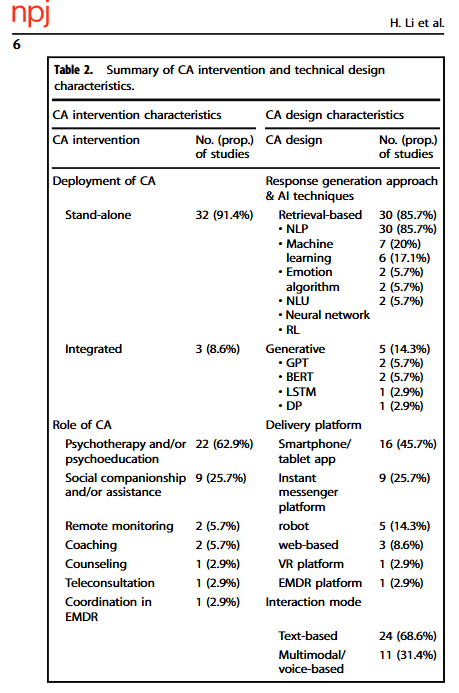
- “This suggests that conversational agents enhanced by advanced AI and machine learning technologies outperform their rule-based counterparts in managing psychological distress”
- “the notably larger effect size of generative CAs (g = 1.244) relative to retrieval-based ones (g = 0.523) suggests that the effectiveness of CA interventions may be influenced by the response generation approach employed, which determines how well these agents are capable of simulating human conversations”
- “While AI-based CAs consistently reduced psychological distress, their impact on psychological well-being was less consistent”
- “Multimodal or voice-based CAs were slightly more effective than text-based ones in mitigating psychological distress. Their integration of multiple communication modalities may enhance social presence53 and deepen personalization”
- “CA including text and voice functionalities might support individuals with cognitive, linguistic, literacy, or motor impairments”
- “Mobile applications and instant messaging platforms may offer advantages in terms of reach, ease of use, and convenience when juxtaposed with web-based platforms, potentially leading to enhanced outcomes”
- “CAs were more effective in clinical and subclinical populations … However, prior research also shows that people with more severe symptoms showed a preference for human support”
- “Another interesting finding was that middle-aged and older adults seemed to benefit more from AI-based CAs than younger populations”
- “Communication breakdowns with CAs can lead to negative user experiences, making the intervention less likely to succeed”
Ref: Li, H., Zhang, R., Lee, Y. C., Kraut, R. E., & Mohr, D. C. (2023). Systematic review and meta-analysis of AI-based conversational agents for promoting mental health and well-being. NPJ Digital Medicine, 6(1), 236.

Study link: https://www.nature.com/articles/s41746-023-00979-5

 SafetyInsights.org