
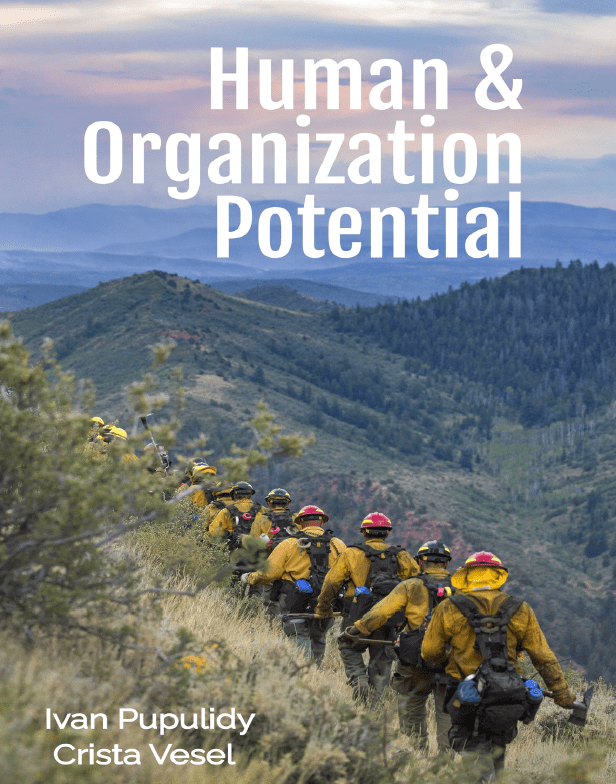
Here’s one of (prob) several upcoming posts about Ivan Pupulidy, PhD and Crista Vesel, MSc’s book ‘Human and Organizational Potential’.
This part looks at confirmation bias within investigations and uses the US Forest Service’s then current Investigation Guide:
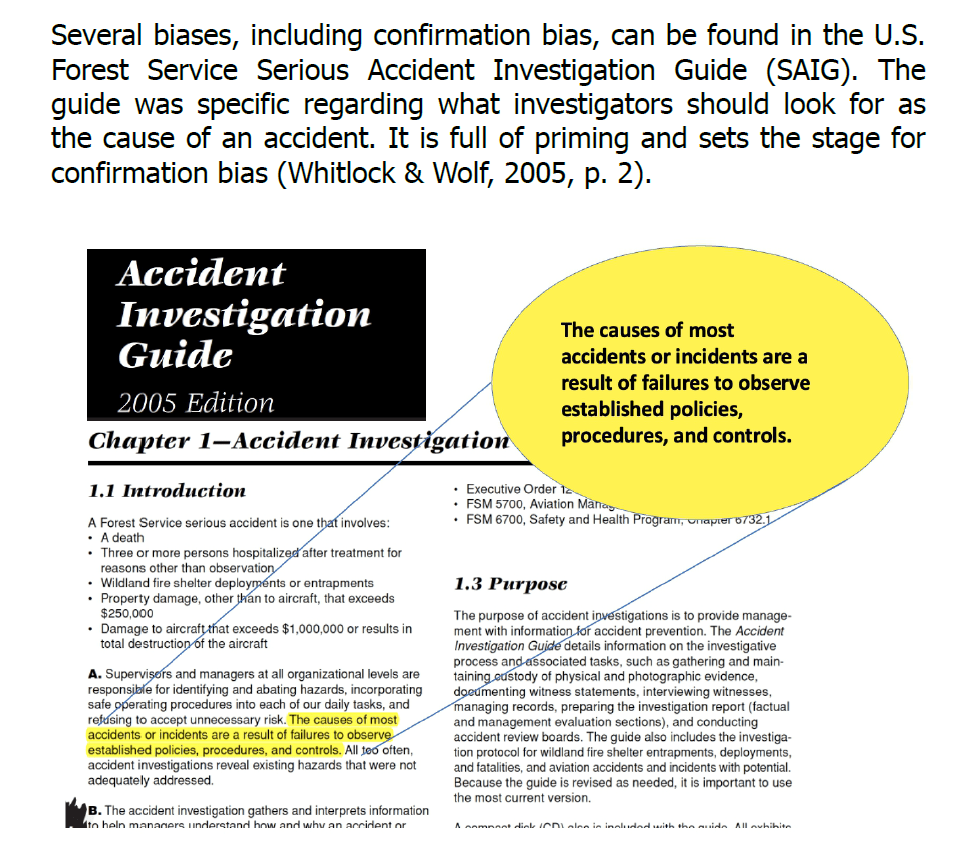
· “Confirmation bias is a tendency to search for information that confirms one’s preconceptions. When discussing confirmation bias in accident investigation, Professor Erik Hollnagel put it this way “What you look for, is what you find””
· The investigation guide “was specific regarding what investigators should look for as the cause of an accident. It is full of priming and sets the stage for confirmation bias”
· “the SAIG establishes a base for understanding how actions and decisions are to be addressed and is a classic example of priming”
· E.g. “The causes of most accidents or incidents are the result of failures to observe established policies, procedures, and controls”
· They say that this approach “is deeply rooted in the illusion of cause-consequence equivalence or the assumption that really bad consequences can only be the result of really bad actions or decisions, most frequently judged as errors”
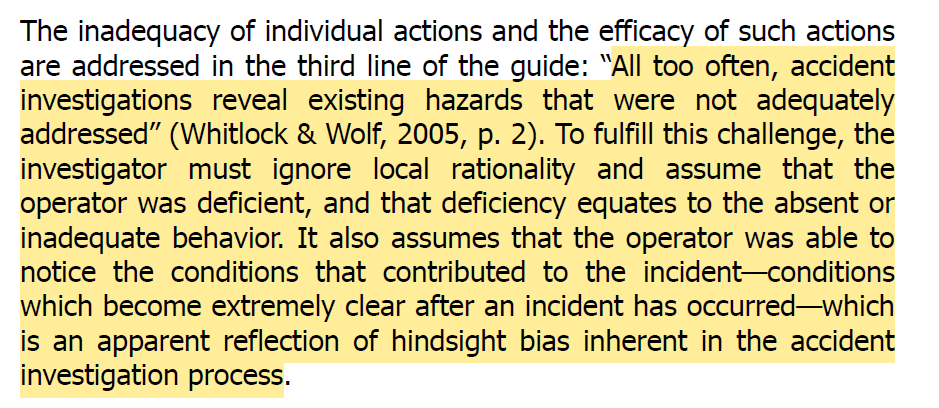
· They point to how the guide primes the investigator to “ignore local rationality and assume that the operator was deficient, and that deficiency equates to the absent or inadequate behavior”
· It also assumes that the operator was able to notice the conditions that contributed to the incident—conditions which become extremely clear after an incident has occurred—which is an apparent reflection of hindsight bias inherent in the accident investigation process”
· They suggest that the guide also “lays the groundwork for recommendations designed to correct and fix the broken person, who willfully engaged in the at-risk behavior, thus eliminating the hazardous practices”
· Finally, based on another real investigation report, which concluded inadequate management oversight, inadequate duties, failure to comply with policies and more – the authors observe that “These causal factors lack context and there is little to be gained by anyone who reads the report. It did not inspire learning from the event, although it provided an illusion of closure to USFS leadership, who claimed that the problems/holes had been identified and fixed”
Book link below.

Book link: https://www.amazon.com.au/Human-Organization-Potential-Ivan-Pupulidy-ebook/dp/B0CQRRC86B

 SafetyInsights.org