A really interesting, but challenging, read about the ontological status of ‘root causes’ and more pointedly, the problem of infinite regression.
The author also proposes some stop rules to help navigate infinite regression.
I’ve previously posted articles critical of the status of ‘root causes’, who argue it is more a process of implicit or explicit stop rules, than a search for the roots of causality.
This topic may only interest a handful of people…I like it because I didn’t realise it had such an ancient and developed theory and specific term (infinite regression).
Article extracts:
· “How can social scientists uncover the root causes of contemporary outcomes?”, with this question “long bedeviled historical researchers”
· Infinite regression is “an endless search for the causes of causes”, argued to be the mythical root cause, and it has been an endless source of frustration dating back at least to “Ancient Indian philosophers”
· Infinite regression, namely, how do you ‘know’ you have reached the ultimate or root cause has been treated by social scientists as a “serious problem, but solutions are offered largely in passing”
· The author asks “when do we stop? That is, when analyzing causes of causes that could, theoretically, be infinite, at what point do we stop our analysis?”
· A fundamental problem of infinite regress is: “unless we know the specific antecedent cause, we cannot be sure it is not more important than the proximate cause of our outcome of interest”
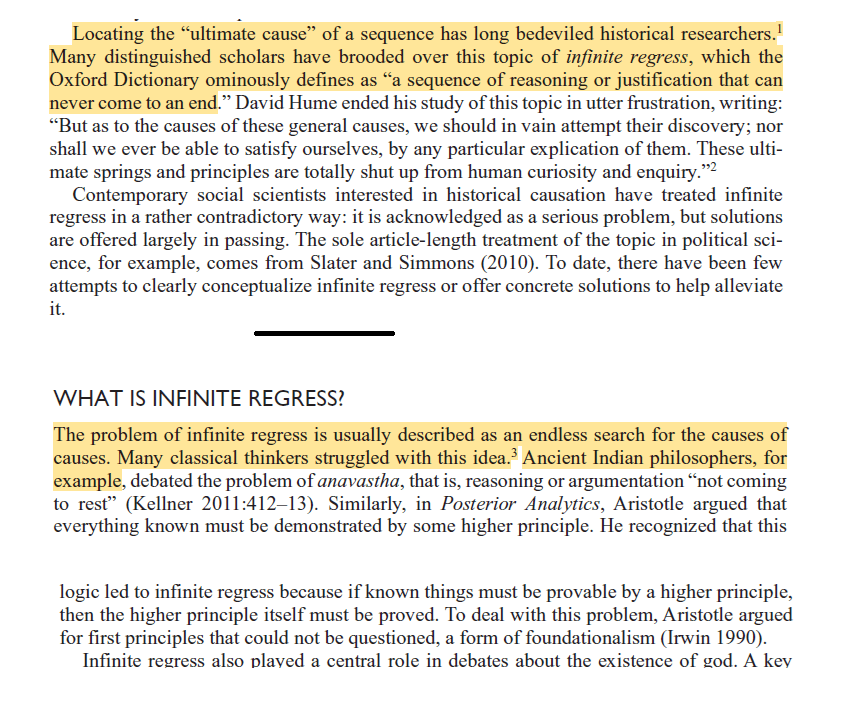
· Hence, “it is always possible that the logically more important cause is simply one step further back in the causal chain than we have analyzed. Therefore, scholars seem cursed to endlessly tumble down the rabbit hole to hunt for the ultimate cause of a sequence”
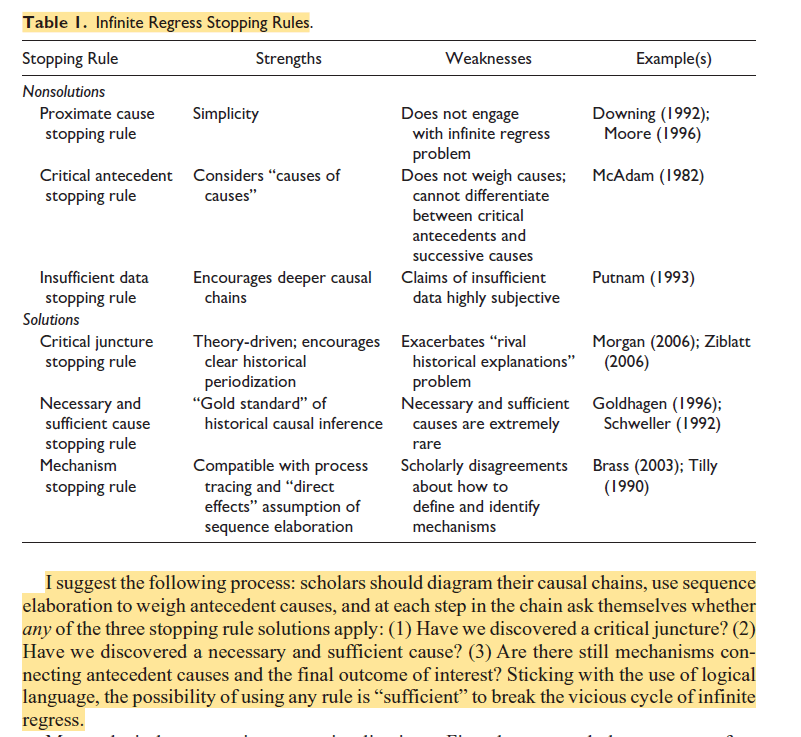
· Image 1 highlights some common stop rules of investigating causes of causes – which the author argues none of which can fully resolve the issue of infinite regression, but may still be useful
· The author proposes the following process for navigating infinite regression: diagramming the causal chain, use sequence elaboration to weigh antecedent causes, and at each step ask: 1) Have we discovered a critical juncture? (2) Have we discovered a necessary and sufficient cause? (3) Are there still mechanisms connecting antecedent causes and the final outcome of interest?”
· In their view, “Sticking with the use of logical language, the possibility of using any rule is “sufficient” to break the vicious cycle of infinite regress”
· However, importantly, this analysis “has some important limitations. First, using sequence elaboration requires a deterministic view of causality, and scholars disagree on this point”, plus some other limitations

Shout me a coffee (one-off or recurring monthly)
Study link: https://doi.org/10.1177/07352751221142929

 SafetyInsights.org