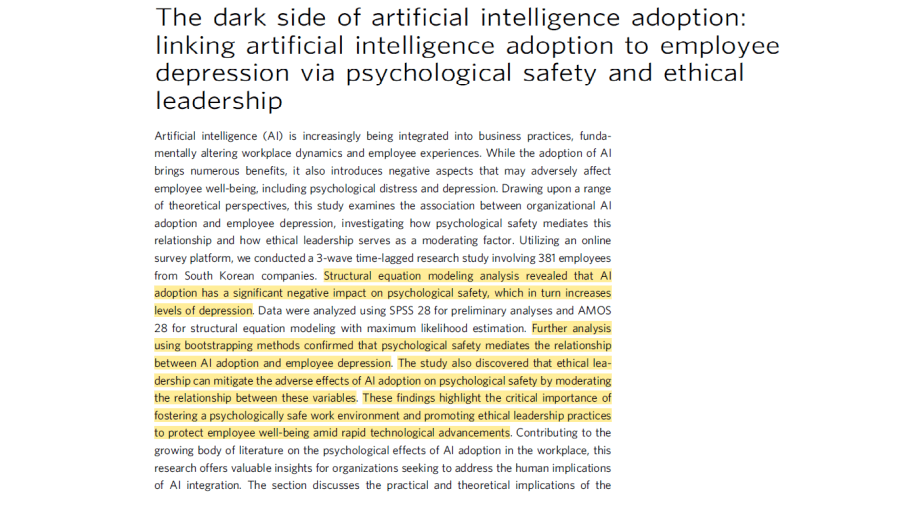

Can adopting workplace AI technologies adversely affect employee psychological distress and depression? Yes according to this study.
Online surveys of 381 employees in S.Korean companies was used.
Background:
· “In AI-centric environments .. AI reshapes jobs and workflows, affecting workers’ psychological health, satisfaction, commitment, and performance, as well as broader organizational outcomes”
· “While AI adoption affects various mental health aspects, we focus on depression for three reasons. First, depression represents one of the most prevalent and costly mental health conditions in workplace settings .. and has been identified as particularly sensitive to technological changes that create uncertainty and threaten job security”
· “Second, unlike more transient psychological states, depression often reflects prolonged exposure to stressors (Melchior et al. 2007), aligning with the gradual nature of AI adoption in organizations. Third, depression has been linked to significant organizational outcomes, including decreased productivity and increased absenteeism”
Results:
· “AI adoption has a significant negative impact on psychological safety, which in turn increases levels of depression”
· Analysis also “confirmed that psychological safety mediates the relationship between AI adoption and employee depression”
· “The study also discovered that ethical leadership can mitigate the adverse effects of AI adoption on psychological safety by moderating the relationship between these variables”

· “This correlation highlights the psychological strains that AI can impose on employees by disrupting established job roles and increasing workplace stress and uncertainty, potentially leading to higher depression rates”
· “research identifies a significant negative effect of AI integration on psychological safety within the workplace .. indicating that AI technologies may diminish the perceived support and inclusiveness of the work environment”
· “The disruption caused by AI can result in a work environment filled with ambiguity and fear, adversely affecting interpersonal trust and safety”
· “Psychological safety acts as a buffer, enabling employees to manage the demands and uncertainties of AI adoption more effectively, thus reducing the likelihood of depression”
· “ethical leadership significantly moderates the impact of AI on psychological safety”
· “organizations should implement structured psychological risk assessment protocols before and during AI adoption”
· They recommend “(1) conducting pre-adoption psychological baseline assessments using validated depression and anxiety screening tools; (2) establishing quarterly pulse surveys focused on technology-related stress and psychological safety perceptions; and (3) developing AI-specific employee assistance programs with specialized counselors trained in technology-related workplace challenges”


Shout me a coffee (one-off or monthly recurring)
Study link: https://www.nature.com/articles/s41599-025-05040-2

 SafetyInsights.org