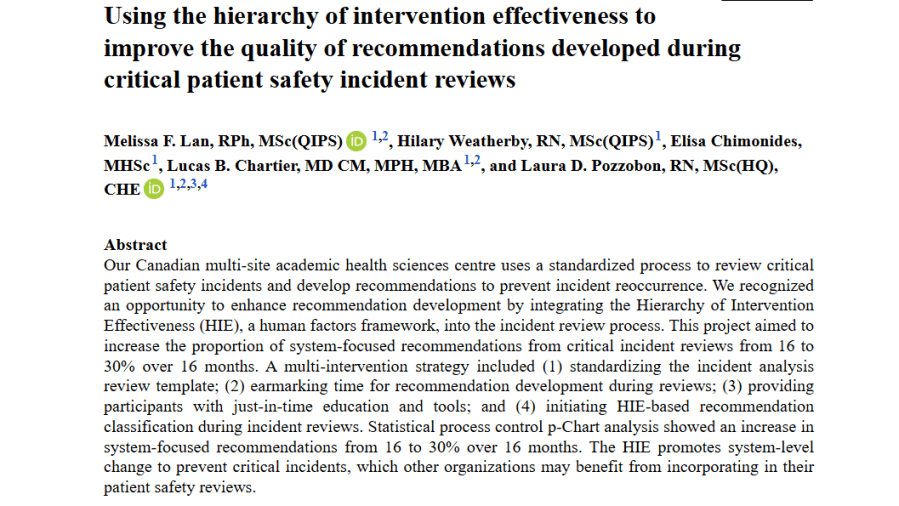
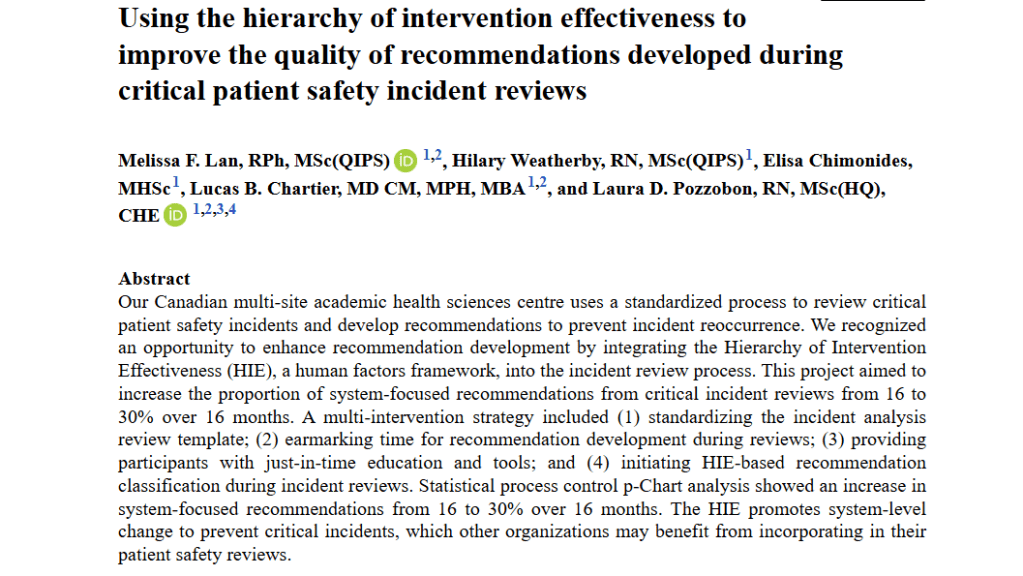
This study evaluated the Hierarch of Intervention Effective (HIE) for improving patient safety incident recommendations.
They were namely interested in increasing the proportion of system-focused recommendations. Data came from over 16 months.
Extracts:
- The HIE is a human factors framework which “asserts that system-focused changes (e.g., forcing functions, automation and computerization, and simplification and standardization) are more effective at addressing contributory factors identified from patient safety incident reviews than people-focused changes (e.g., education and training, rules and policies, and reminders, checklists, and double checks)”
- And “While each level of the HIE can play an important role in error prevention, people cannot be expected to compensate for weak systems”
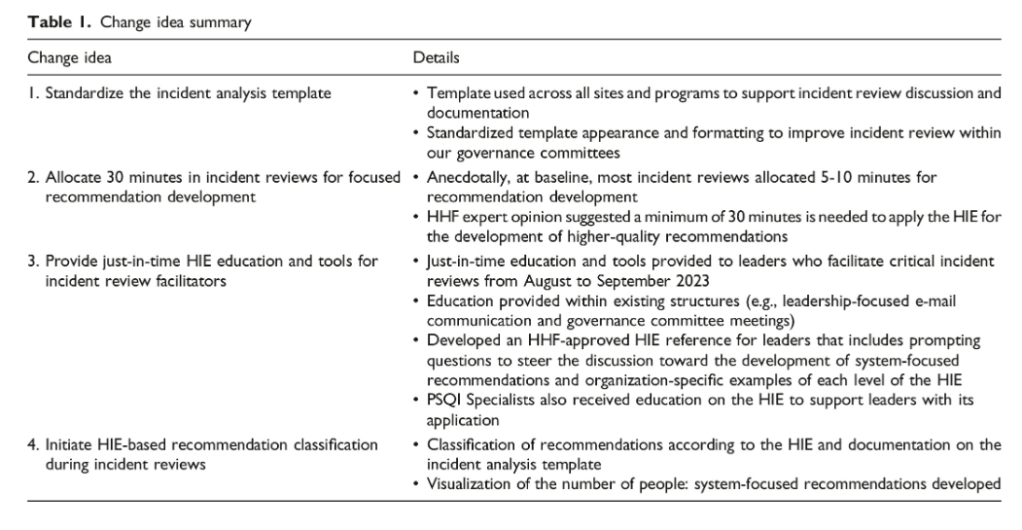
- Image 2 highlights the interventions selected for this evaluation – namely, standardising incident analysis template, earmarking time for recommendation development, use of just-in-time education and tools, HIE recommendation reviews
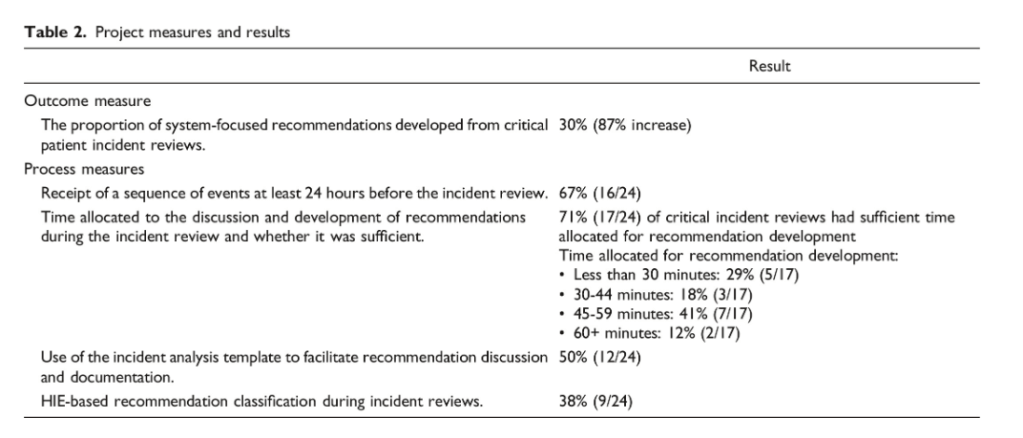
- Via p-Charts, an “increase in system-focused recommendations from 16 to 30% over 16 months” was observed
- The baseline level of 16% of systems-focused recommendations wasn’t surprising, since “as in healthcare, incident review teams gravitate to people-focused strategies to improve human performance and minimize the potential for adverse events.8 Humans are fallible, so there is a need to support people through system resilience improvement”
- “The HIE promotes system-level change to prevent critical incidents, which other organizations may benefit from incorporating in their patient safety reviews”
Ref: Lan, M. F., Weatherby, H., Chimonides, E., Chartier, L. B., & Pozzobon, L. D. (2025, June). Using the hierarchy of intervention effectiveness to improve the quality of recommendations developed during critical patient safety incident reviews. In Healthcare Management Forum (p. 08404704251343260). Sage CA: Los Angeles, CA: SAGE Publications.

Shout me a coffee (one-off or monthly recurring)
Study link: https://doi.org/10.1177/08404704251343260

 SafetyInsights.org