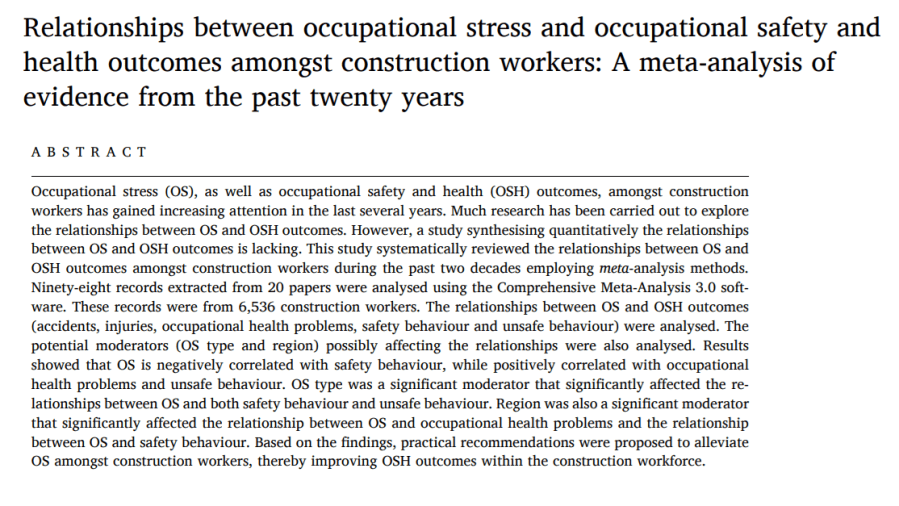

This meta-analysis investigated the effects of occupational stress (OS) on safety and health outcomes in construction.
20 studies over 20 years, including >6k construction workers was included (not such a big sample given all of the research in construction safety, indicative of the relatively poorer quality of research that didn’t meet their inclusion criteria).
[Trigger warning: If you struggle with the term ‘unsafe behaviour’, then maybe skip this study or warm your vocal cords for ‘Serenity Now!’]

For background:
· One study found that symptoms of physical stress were linked to impairments in construction workers’ safety behaviours
· Role ambiguity was linked to detrimental safety performance, and role conflict linked to mental health issues: both key dimensions of OS
· Lack of organisational justice, as a dimension of OS, was linked to increased construction worker error
· Other studies found OS was linked to impaired self-protective behaviours of workers, e.g. not donning safety equipment and the like
Results of the meta-analysis:
· OS was statistically significantly correlated with occupational health problems and impaired mental health among construction workers
· Exposure to OS was linked to impaired mental health outcomes
· Moreover, “OS may result in certain occupational diseases and adversely affect health in non-specific ways”
· Occupational health included things like heart attack and more, and therefore, “OS presents a comprehensive threat to construction workers’ health, impacting their mental well-being and increasing the risk of physical health issues”
· OS also affects safety behaviours of workers, like self-protective behaviours
· For example, “When they are expected to work safely but experiencing OS, they may narrow their behavioural focus to only what is necessary, neglecting voluntary safety behaviour”
· “OS may reduce construction workers’ safety behaviour by exhausting their personal resources and energy required to demonstrate expected organisational behaviour”
· In other words, people have less available cognitive bandwidth and optimise their work for efficiency over thoroughness
· “OS often manifests as psychological distress … which can lead to anxiety, frustration, or irritability”
· OS was also linked to “impair[ed] construction workers’ situational awareness and risk analysis. This leads them to prioritise potential gains while overlooking surrounding risks”
· No statistically significant link was found between OS and construction incidents – however they note that there was only two studies in the sample exploring this link, so was statistically underpowered
· Nevertheless, one study in the sample argued that “OS can indirectly affect the accident rate of construction workers through physical stress and safety behaviour”
· And other work found that “construction workers experiencing high levels of OS are susceptible to workplace accident”
· Moreover, “in the findings of Hussen et al. (2020), the likelihood of injury for construction workers with OS was 3.47 times higher than for those without OS exposure”
· OS was also found to be a “significant moderator that significantly affected the relationships between OS and both safety behaviour and unsafe behaviour”
· Finally, “men in Oceania are often perceived as stoic and emotionless caretakers, leading them to suppress their emotions. Consequently, construction workers in Oceania may be reluctant to express their feelings or seek assistance, which can result in unaddressed mental health issues”

Ref: Man, S. S., Wang, D., Tsang, S. N. H., Liu, L., & Chan, A. H. S. (2025). Safety Science, 191, 106939.

Shout me a coffee (one-off or monthly recurring)
Study link: https://doi.org/10.1016/j.ssci.2025.106939
Safe AF LinkedIn group: https://www.linkedin.com/groups/14717868/

 SafetyInsights.org