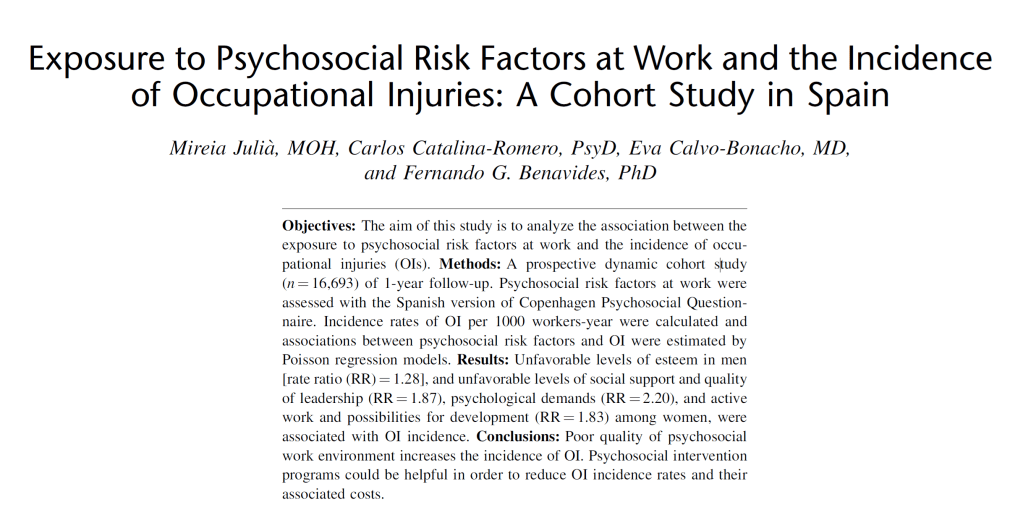
This study explored the links between psychosocial risk factors (PRF) on the incident of occupational injuries (OIs).
Compared to many other studies, they used a dynamic cohort longitudinal design (>16k) participants over 1 year follow-up.
The Copenhagen Psychosocial Questionnaire was used.
For background:
- PRF have been “associated with many health problems, including cardiovascular diseases,3 depression,4 and sickness absence”
- And “Several studies also suggest an association between psychosocial factors and occupational injuries (OIs) incidence”
- PRF were defined as “those aspects of the design, organization and management of work, and their social and environmental context, which have the potential to cause physical, psychological or social harm to workers”
Findings:
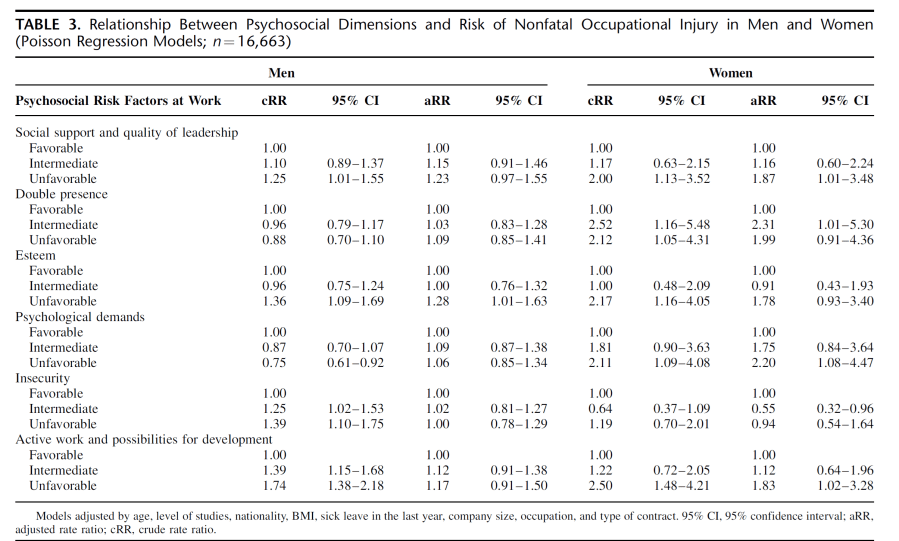
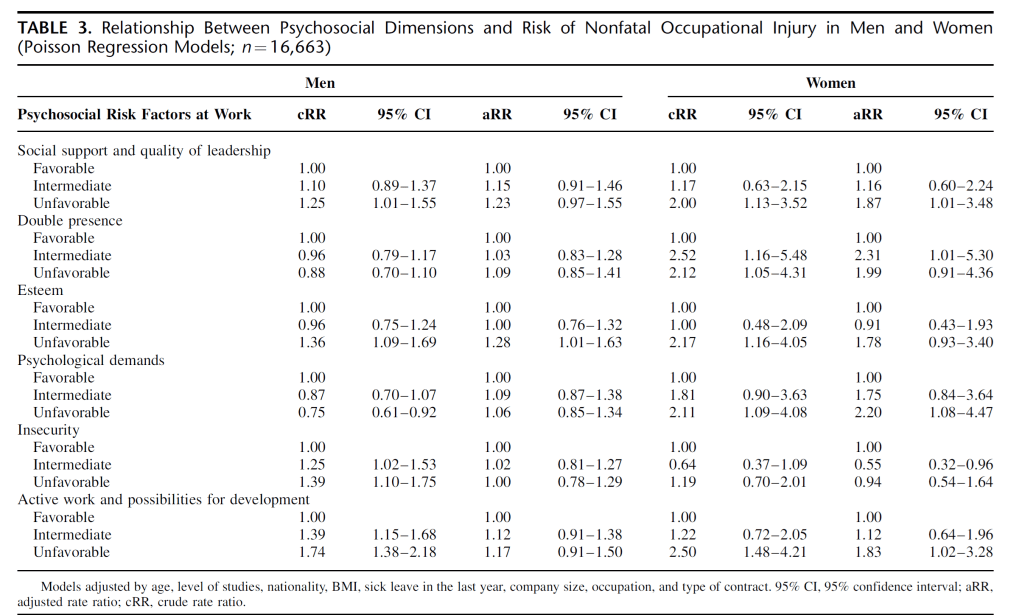
- “Unfavorable levels of esteem in men [rate ratio (RR)1.28], and unfavorable levels of social support and quality of leadership (RR1.87), psychological demands (RR 2.20), and active work and possibilities for development (RR1.83) among women, were associated with OI incidence”
- “With little exception, the highest IR was observed among workers exposed to unfavorable health levels of every psychosocial risk factor”
- “Poor quality of psychosocial work environment increases the incidence of OI. Psychosocial intervention programs could be helpful in order to reduce OI incidence rates and their associated costs”
- “low level of esteem predicts an increased OI incidence among men. Low active work and possibilities for professional development, low social support and quality of leadership, and the need to balance work and family duties also predict an increase of OI incidence in women”
- The findings “display a gender-dependent effect of psychosocial work environment on the risk of OI”, which were still significant after adjusting for confounders
- OI was higher among men, in workers with <25 yrs experience, lower education, and with a BMI >30kg/m2
- After adjusting for confounders, unfavourable esteem was the only significant predictor of OI for men, and unfavourable social support and quality of leadership, psychological demands for women
- Unlike prior work, this study didn’t find job insecurity to be associated with a significant link with OI in the adjusted models (but they did in the crude models)
- However, the overadjustment of the adjusted models might have affected the statistical links
- Moreover, prior work suggested that “insufficient job control, social support from colleagues or supervisors, and effort–reward imbalance could increase the risk of OI”
Why are PRF and OI potentially linked? They suggest:
- Occupational stress, resulting from PRF, could increase distraction, reduced attention on the task and other cognitive effects
- Other research suggests that PRF can alter the protective behaviours of workers (e.g. they take less protective actions)
- Workplaces with higher PRF may also carry higher exposure to other risk factors more directly related to hazard exposure
Limitations were present of course. One being they can’t rule out a selection effect as the sample was based on workers receiving a routine medical check-up.
Ref: Julià, M., Catalina-Romero, C., Calvo-Bonacho, E., & Benavides, F. G. (2016). Journal of Occupational and Environmental Medicine, 58(3), 282-286.

Shout me a coffee (one-off or monthly recurring)
Study link: https://journals.lww.com/joem/abstract/2016/03000/exposure_to_psychosocial_risk_factors_at_work_and.10.aspx
Safe As LinkedIn group: https://www.linkedin.com/groups/14717868/

 SafetyInsights.org