
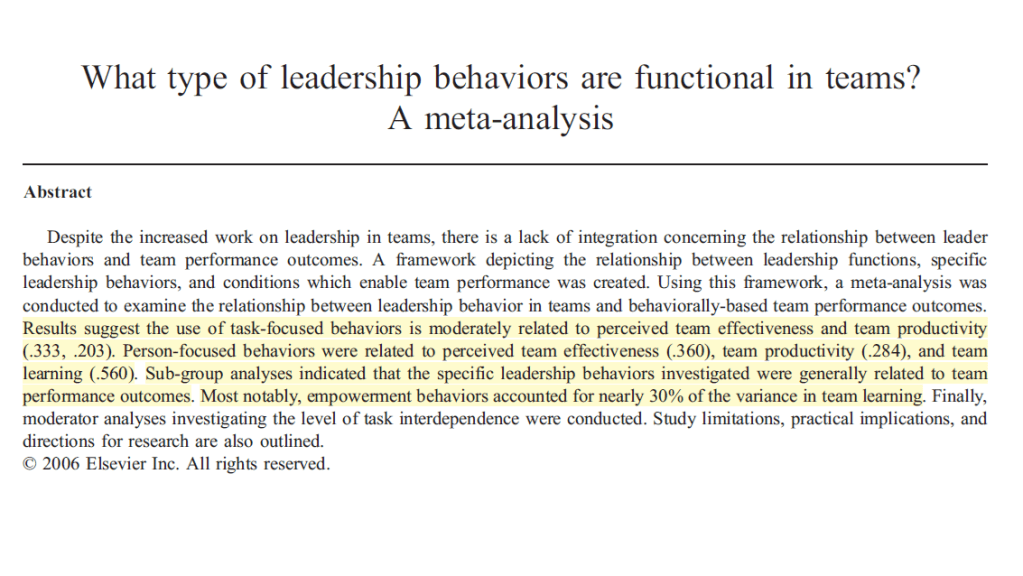
Does leadership behaviour in teams matter? If so, what behaviours for effective teams?
This meta-analysis of 50 studies (from 2006, so note the age) explored the above question, focused on task-focused and person-focused leader behaviours.
It was meant to be a mini-post, but grew into a full post because I couldn’t be bothered cutting it back.
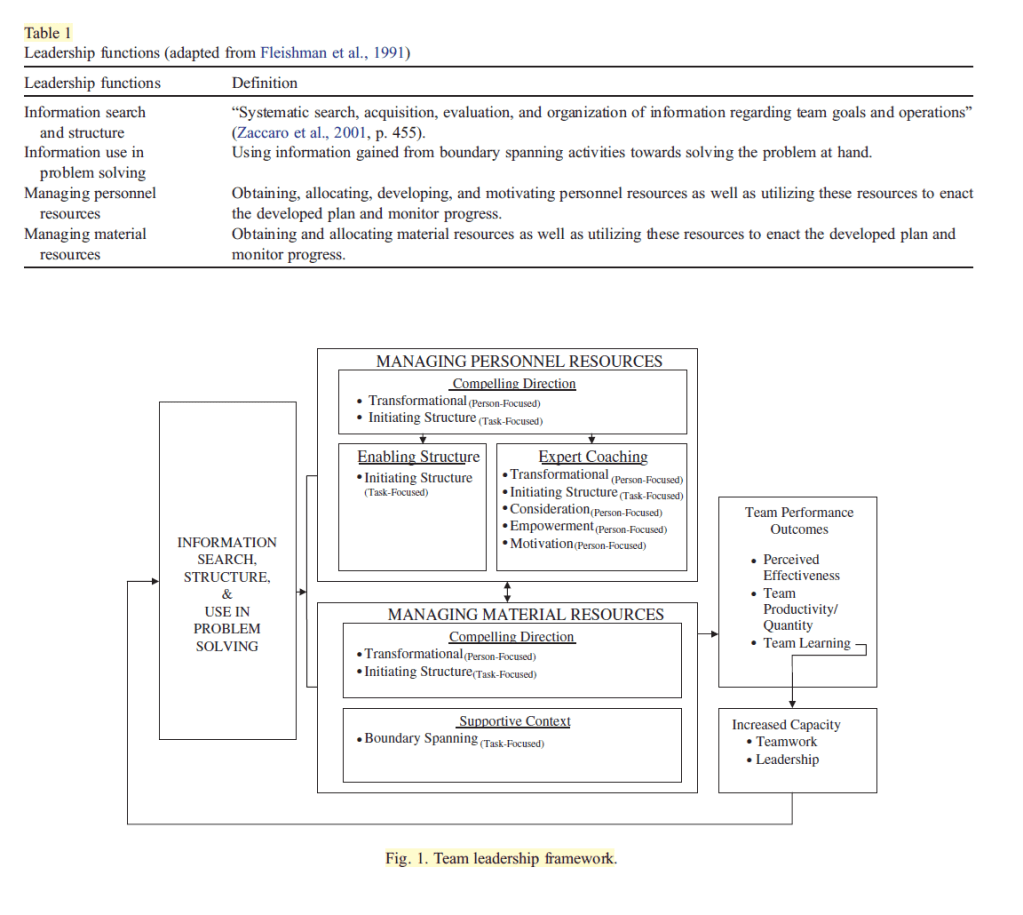
For background:
· While “it is not necessary that the leadership functions be accomplished by a single person (i.e., it may be distributed throughout the team), the leader is responsible for ensuring that these functions are accomplished”
· “team leadership can be described as a dynamic process of social problem solving accomplished through generic responses to social problems”
· The dynamic processes of leadership can be covered under “(1) information search and structuring, (2) information use in problem solving, (3) managing personnel resources, and (4) managing material resources”
· 65 team leadership frameworks were identified from between 1940 and 1986, and most divided behaviours into task and person related behaviours
· Task-focused behaviors “facilitate understanding task requirements, operating procedures, and acquiring task information”
· Person-focused behaviors “facilitate the behavioral interactions, cognitive structures, and attitudes” essential for effective teamwork
· Hackman’s work suggests these conditions for leaders to create effective teams: teams must be real, have compelling direction, an enabling structure (core conditions), a supportive organizational context, and expert coaching (enabling conditions)
· And a real team is one where “there is a team task, clear boundaries, specified authority to manage work processes, and some degree of membership stability (Hackman, 2002)”
Key findings:
· Task-focused behaviors “facilitate understanding task requirements, operating procedures, and acquiring task information”; these factors were found to be “moderately related to perceived team effectiveness and team productivity (.333, .203)”
• Initiating structure was “positively related to perceptions of team effectiveness (r=.312)” and team productivity (r=.203)
• Boundary spanning was “positively related to perceptions of team effectiveness (r=.488)”
· Person-focused behaviors “facilitate the behavioral interactions, cognitive structures, and attitudes” essential for effective teamwork. They were related to “perceived team effectiveness (.360), team productivity (.284), and team learning (.560)”
• Transformational leadership was “positively related to perceived team effectiveness (r=.336)” and team productivity (r=.252)
• Consideration also showed positive relationships with perceived team effectiveness (r=.252) and team productivity (r=.222)
• Empowerment behaviors were particularly impactful, accounting for “nearly 30% of the variance in team learning” (r=.560). They also significantly related to perceived team effectiveness (r=.465) and team productivity (r=.315) and these behaviors include “coaching, monitoring, and feedback”
· Task interdependence may moderate these relationships, with leadership behaviors appearing “relatively more important in achieving efficacious team performance outcomes when task interdependencies are higher”
· For highly interdependent teams, effect sizes were notably higher for both person-focused (r=.344) and task-focused (r=.330) leadership on perceived team effectiveness, compared to teams with low interdependence
· Emphasis on “boundary spanning and behaviors related to empowerment (i.e., coaching, feedback, monitoring, participatory behavior)” is suggested due to their significant impact on team performance outcomes
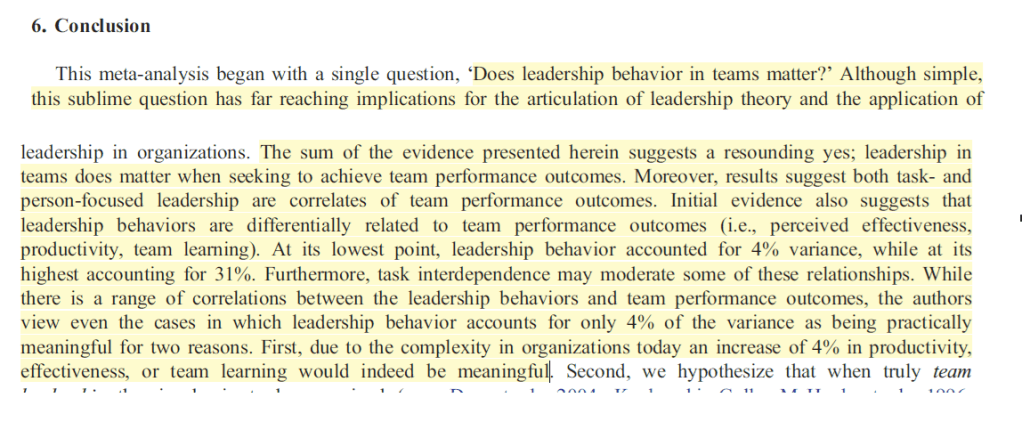
· “both task-and person-focused leadership behaviors explain a significant amount of variance in team performance outcomes”
· But while both were approximately equally important, “leadership behaviors orientated towards the person accounted for slightly more variance in perceived team effectiveness (13%) and productivity (8%) than task-focused behaviors”
· “At its lowest point, leadership behavior accounted for 4% variance, while at its highest accounting for 31”
Conclusion:
· They suggest that leaders should be trained and mentored in both types of behaviour as both contribute and “are needed for teams to be effective”
· Overall, the evidence indicates a “resounding yes; leadership in teams does matter when seeking to achieve team performance outcomes”
Ref: Burke, C. S., Stagl, K. C., Klein, C., Goodwin, G. F., Salas, E., & Halpin, S. M. (2006). What type of leadership behaviors are functional in teams? A meta-analysis. The leadership quarterly, 17(3), 288-307.

Shout me a coffee (one-off or monthly recurring)
Safe As LinkedIn group: https://www.linkedin.com/groups/14717868/
LinkedIn post: https://www.linkedin.com/pulse/what-type-leadership-behaviors-functional-teams-ben-hutchinson-upk4c

 SafetyInsights.org