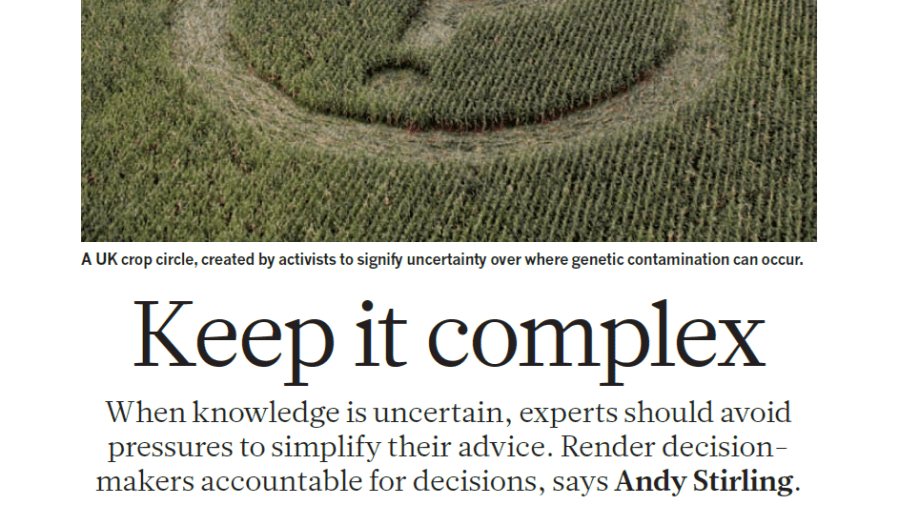
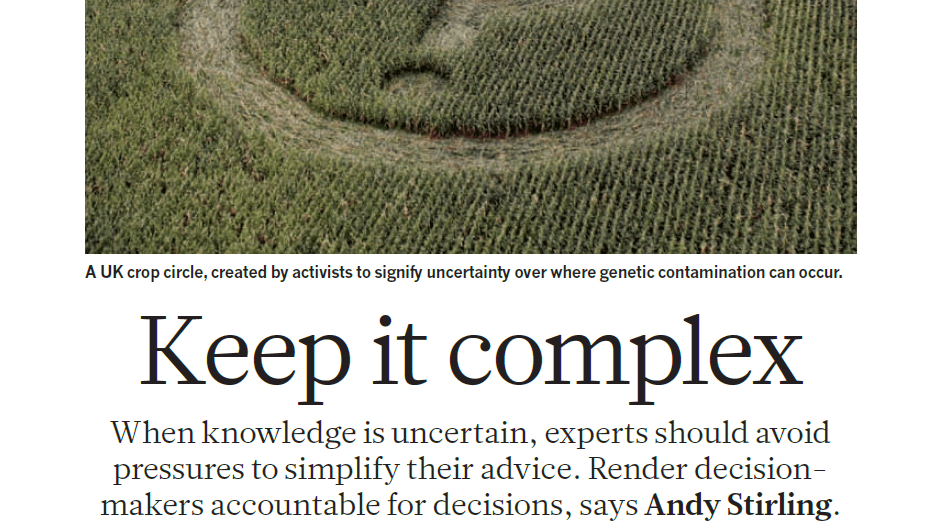
When uncertainty and ignorance is abound on risk, should we ‘keep it simple’? Or keep it complex by debating multiple perspectives and embracing uncertainty and ambiguity?
Extracts:
· “When knowledge is uncertain, experts should avoid pressures to simplify their advice. Render decision-makers accountable for decisions”
· “Expert advice is often thought most useful to policy when it is presented as a single ‘definitive’ interpretation”
· “Even when experts acknowledge uncertainty, they tend to do so in ways that reduce unknowns to measurable ‘risk’”
· “An overly narrow focus on risk is an inadequate response to incomplete knowledge. It leaves science advice vulnerable to the social dynamics of groups — and to manipulation by political pressures seeking legitimacy”
· “For Knight, “a measurable uncertainty, or ‘risk’ proper … is so far different from an unmeasurable one that it is not in effect an uncertainty at all”
· “There are still times when ‘risk-based’ techniques are appropriate and can yield important information for policy … [like] for consumer products in normal use, general road or airline-safety statistics”
· The author believes an improved approach is “in supporting more plural and conditional methods for science advice (the non-risk quadrants shown in ‘Uncertainty matrix’)” (image 2)

· “These are plural because they even-handedly illuminate a variety of alternative reasonable interpretations”
· “And conditional because they explore explicitly for each alternative, the associated questions, assumptions, values or intentions”
· “Under Knightian uncertainty, for instance, pessimistic and optimistic interpretations can be treated separately, each explicitly associated with assumptions” etc.
· Instead of endless debates with unmeasurable uncertainty and “negotiating a single interpretation”, it can be more useful to “accept these divergent expert interpretations and focus instead on documenting the reasons”
· Hence, the author proposes moving beyond simple ‘risk’ conceptions to deeper challenges of ambiguity and ignorance, and the “neglected areas of uncertainty (in Knight’s strict sense)”
· When “the intrinsically plural, conditional nature of knowledge is recognized” science advice “can become more rigorous, robust and democratically accountable”
· And this approach can help “”avoid erroneous ‘one-track’, ‘race to the future’ visions of progress”
Ref: Stirling, A. (2010). Keep it complex. Nature, 468(7327), 1029-1031

Shout me a coffee (one-off or monthly recurring)
Study link: https://www.nature.com/articles/4681029a.pdf
Safe As LinkedIn group: https://www.linkedin.com/groups/14717868/

 SafetyInsights.org