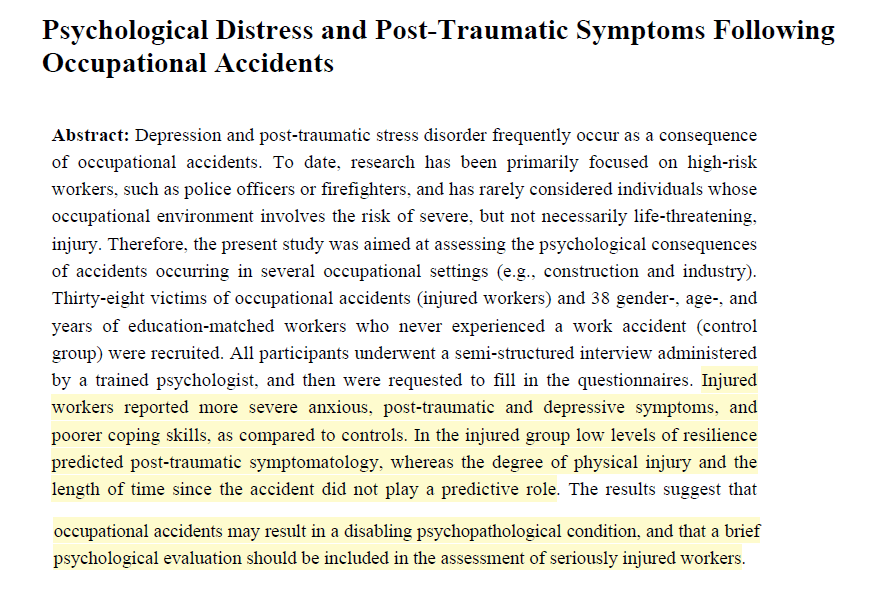
What are the psychological consequences of physical work incidents?
38 occupationally injured persons matched against 38 none injured.
Background:
· Prior work “reported that 34.7% of injured workers with chronic pain achieved full criteria for PTSD, and 18.2% had partial PTSD”
· “victims of work-related accidents showed clinically relevant psychopathological symptoms, including post-traumatic symptoms, anxiety, depression, anger, and lower resilience”
· “high prevalence of PTSD after a work accident could be due to the presence of body injuries in this kind of traumatized individuals”
· “physical injuries following a traumatic event, above and beyond trauma exposure in itself, are a risk factor for PTSD: a greater number of injured trauma survivors develop PTSD compared to non-injured survivors of the same trauma”
· “The presence of bodily injuries may act as a visual and proprioceptive reminder of the traumatic event, causing intrusive re-experiencing and, therefore, triggering and maintaining post-traumatic symptomatology”
· “While this is a likely factor that increases PTSD prevalence among injured workers, the higher rates of PTSD in our study are almost certainly due to the fact that all participants who sustained a workplace accident were bodily injured”
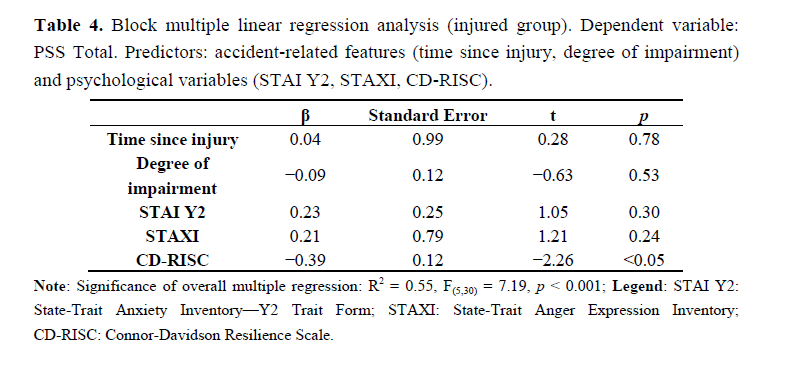
· “results also showed a negative correlation between PTSD severity and resilience in the injured group, suggesting that those with poorer coping skills may be more vulnerable to developing PTSD after an accident”
· “maintenance of PTSD may also be sustained through ongoing issues with anger in injured workers … in some PTSD patients, feelings of anger would allow those with PTSD to avoid intrusive, fear-related thoughts, negative memories, and the associated negative emotions linked to the traumatic event”
· Hence “anger would serve as an emotional avoidance strategy, and the avoidance of distressing feelings would hinder emotional processing, which is necessary to overcome PTSD”
· “low resilience and the presence of other psychopathological symptoms, rather than the degree of physical injury and the length of time since the accident, should be considered as relatively high risk factors for PTSD in accident survivors”
· “Therefore, the assessment of psychological functioning after a work accident may be just as important in predicting functional impairment as is the assessment of physical injuries”
· “presence of psychopathology may have serious implications for those trying to return to work after an occupational accident … Eventually this relationship may engender a downward spiral, since unemployment may enhance depression levels, further reducing the likelihood to return to work”
· Several limitations were present, of course

Shout me a coffee (one-off or monthly recurring)
Ref: Ghisi, M., Novara, C., Buodo, G., Kimble, M. O., Scozzari, S., Di Natale, A., … & Palomba, D. (2013). Behavioral Sciences, 3(4), 587-600.
Study link: https://doi.org/10.3390/bs3040587

 SafetyInsights.org