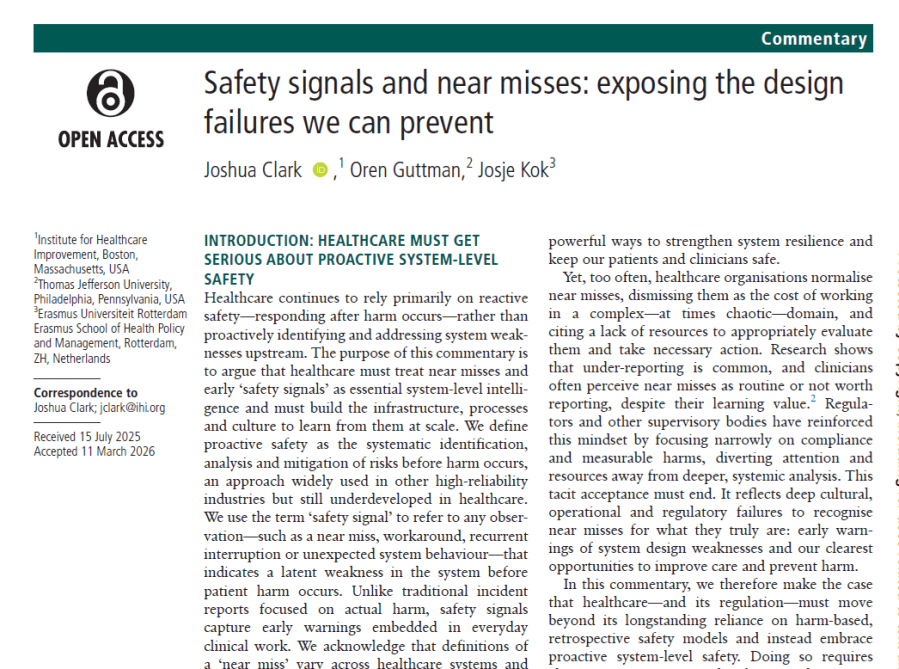
A brief discussion paper on safety signals and moving away from reactive harm-based safety.
Full article provided under open access licence (see end of post).
PS. Check out my YouTube: https://www.youtube.com/@safe_as_pod
Extracts:
· “Healthcare continues to rely primarily on reactive safety—responding after harm occurs—rather than proactively identifying and addressing system weaknesses upstream”
· “‘safety signal’ … refer[s] to any observation—such as a near miss, workaround, recurrent interruption or unexpected system behaviour—that indicates a latent weakness in the system before patient harm occurs”
· One persistent barrier to proactive safety is the orientation towards “lagging indicators—measures that focus only on visible harm after it occurs”
· “This narrow lens has shaped how safety is defined, measured and managed across healthcare systems. Safety is still predominantly framed as the absence of an adverse outcome, be they serious reportable events, hospital-acquired conditions, or mortality and morbidity scores”
· “When harm occurs, the event is labelled ‘serious’, whereas near misses or safety signals—those early indicators that allow harm to be averted—are seen as less urgent, if acknowledged at all”
· “healthcare organisations are compelled to direct their limited resources towards compliance and incident investigation, while ignoring the more abundant, actionable signals that lie upstream”
· “A further consequence of a harm-centric regulatory paradigm is that it crowds out alternative forms of safety intelligence. Approaches such as Learning from Excellence and other positivedeviance methods seek to systematically capture episodes where care goes exceptionally well, revealing the micro-adjustments, adaptations and resilient performance that keep patients safe despite system pressures”
· “This framing and focus reinforce the outdated logic of ‘measure and fix’,23 which assumes that safety is a stable end state, rather than a dynamic process of adaptation in a complex system, that is, a moving target”
· “With such a regulatory focus, the system gets a pass if an adverse event did not happen, even if it nearly did multiple times in 1 week”
· “Today, most ‘Good Catch’ programmes celebrate staff getting in the way of harm before it reaches the patient … However, recognition alone is insufficient. When near misses are treated primarily as individual acts of vigilance rather than signals of underlying design weaknesses, opportunities for proactive system redesign are lost”
· Regarding good catches, “why did our system require a human to prevent that harm? What vulnerabilities enable the error pathway, and how might we redesign the process to surface and address safety signals earlier?”
Shout me a coffee: https://buymeacoffee.com/benhutchinson
Safe As LinkedIn group: https://www.linkedin.com/groups/14717868

 SafetyInsights.org