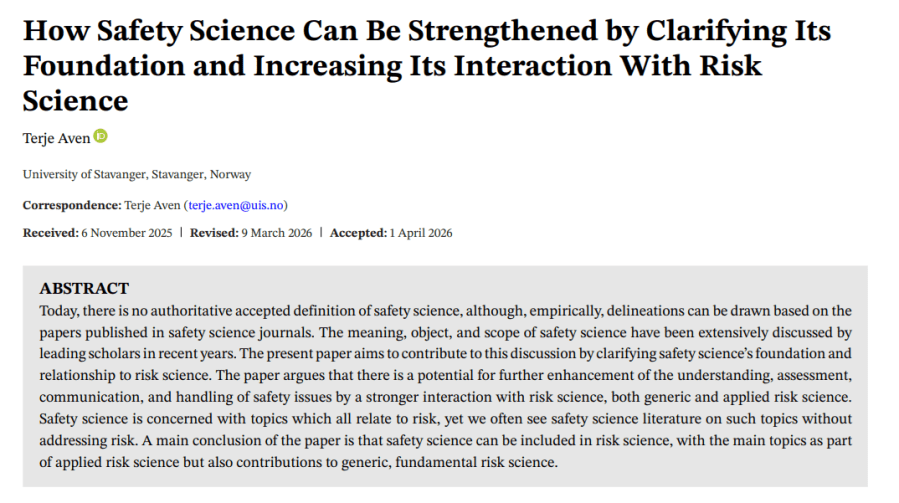
This article from Terje Aven discusses some limitations within the Safety Science (SS) field, and argues for its better interaction, or even its subsummation within Risk Science.
Not a summary per se – but several extracts posted below.
PS. Check out my YouTube: https://www.youtube.com/@safe_as_pod
Extracts:
· There is currently “no authoritative accepted definition of safety science” and “no consensus on how to define safety science”
· One definition is “the practice that provides us with the most justified knowledge that can be made, at the time being, on subject matters covered by the safety discipline”
· Safety Science encompasses “the totality of relevant educational programs, journals, papers, researchers, research groups, and societies”
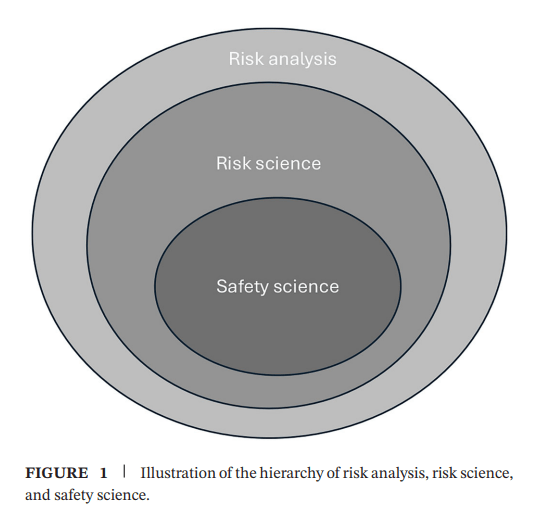
· An argument is that “safety science can be included in risk science” with its topics forming part of applied risk science while also contributing to generic risk science
· Aven suggests that “theoretically, risk science subsumes safety science” and that any perceived separation is a matter of social or institutional delineation rather than “objective, intrinsic differences”
· A stronger interaction with risk science may enhance the “understanding, assessment, communication, and handling of safety issues”
· Per Kuhn’s terminology, SS is said to be “pre-paradigmatic”, due to “lack of unity and lack of consensus on fundamental concepts”
· And while SS is interdisciplinary, it can be still be viewed as a distinct science, because it has a specific study object (safety) and a core knowledge base
· Though it’s said that SS faces an “occupational identification crisis”, because some researchers working with the community commonly do not identify themselves as safety scientists but refer to their background in social science, psychology, engineering, etc
· While definitions of safety vary, there’s broad agreement that safety, in one sense, concerns “the occurrence, potential or actual, of some kind of adverse event or outcome”
· And again various definitions exist, but the author covers one perspective where safe is seen when “the activity is safe if the probability of A [an adverse event]… is judged as sufficiently small, and the supporting knowledge (evidence) K is strong”
· However, concluding that a system is ‘safe’ is not a purely scientific decision, but a judgement involving ethics, management, and politics
· Also, the author discusses models. It’s argued that scientists should be cautious dismissing common safety models, like the Swiss Cheese metaphor and FRAM etc., since they often “provide some insights, some perspectives, despite [their] limitations and weaknesses”
· It’s argued that SS is both a fundamental/pure science, and an applied science
· Risk science is defined analogously to safety science, being the practice that provides us with “the most justified knowledge that can be made, at the time being, on subject matters covered by the risk field”
· “safety science and risk science are closely related, as the terms “safety” and “risk” express similar ideas, concerning the occurrence, potential, or actual, of some kind of adverse event or outcome”
· Risk science has developed a glossary and supporting literature on terminology for basic concepts, including safety, safe, security, secure, vulnerability and more. It’s argued that SS needs to work on establishing authoritative guidance documents on key terminology
Ref: Aven, T. (2026). How Safety Science Can Be Strengthened by Clarifying Its Foundation and Increasing Its Interaction With Risk Science. Risk Analysis: an Official Publication of the Society for Risk Analysis, 46(5), e70244-e70244.
Shout me a coffee: https://buymeacoffee.com/benhutchinson
Safe As LinkedIn group: https://www.linkedin.com/groups/14717868


