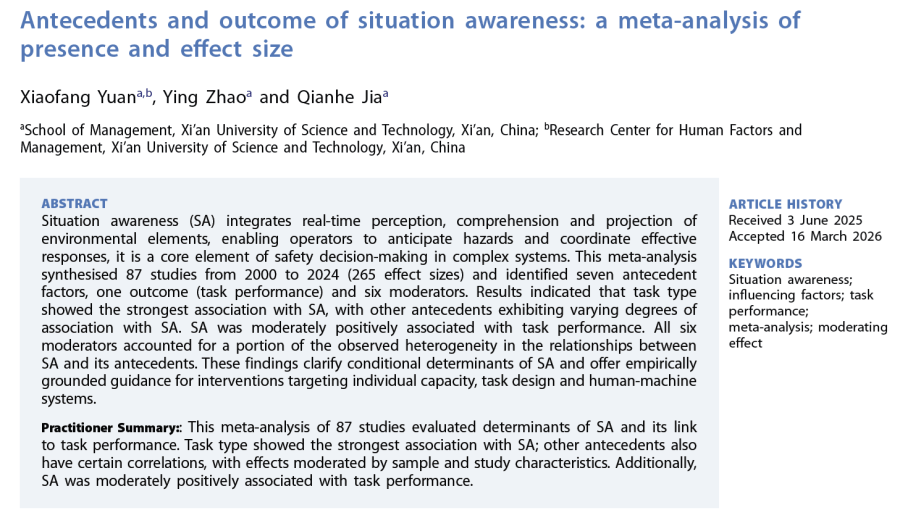
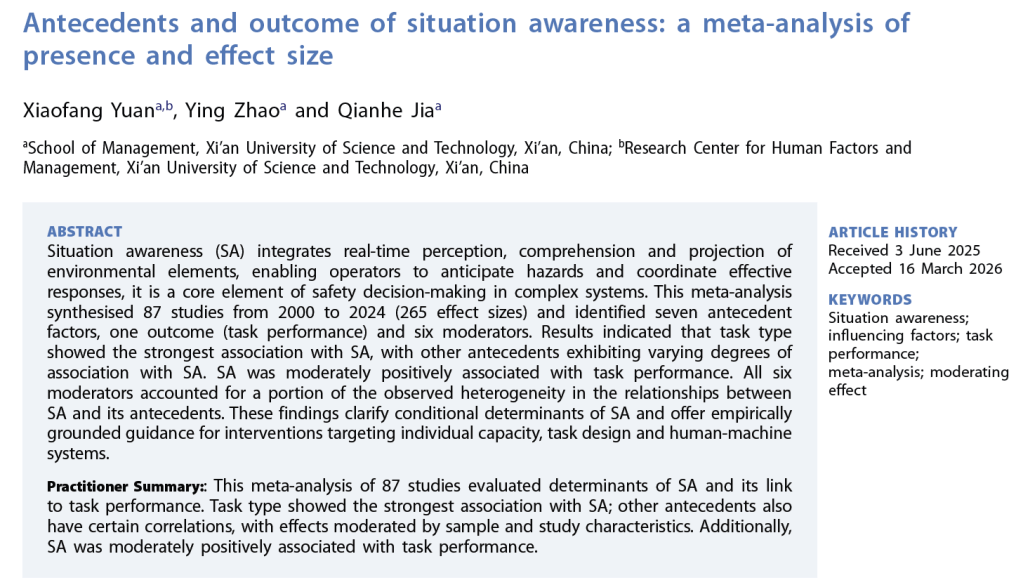
Situational Awareness (SA), what is it good for? This meta-analysis unpacked 87 studies exploring the concept.
WAY too much to cover. But, I’m recording a systematic analysis of this article for YouTube, which will also throw a mildly ill-tempered cat amongst the pigeons by injecting an article from Dekker, which is a little critical of the use of the SA concept (in some use cases and contexts).
PS. Check out my YouTube channel: https://www.youtube.com/@safe_as_pod
Extracts:
· SA is “the perception of elements in the environment within a given time and space, the comprehension of their meaning and the projection of their future states”
· “SA reflects an individual’s dynamic mental representation in the environment”
· “individual-level cognitive ability and expertise were positively associated with SA, whereas cognitive load exhibited a moderate negative association”
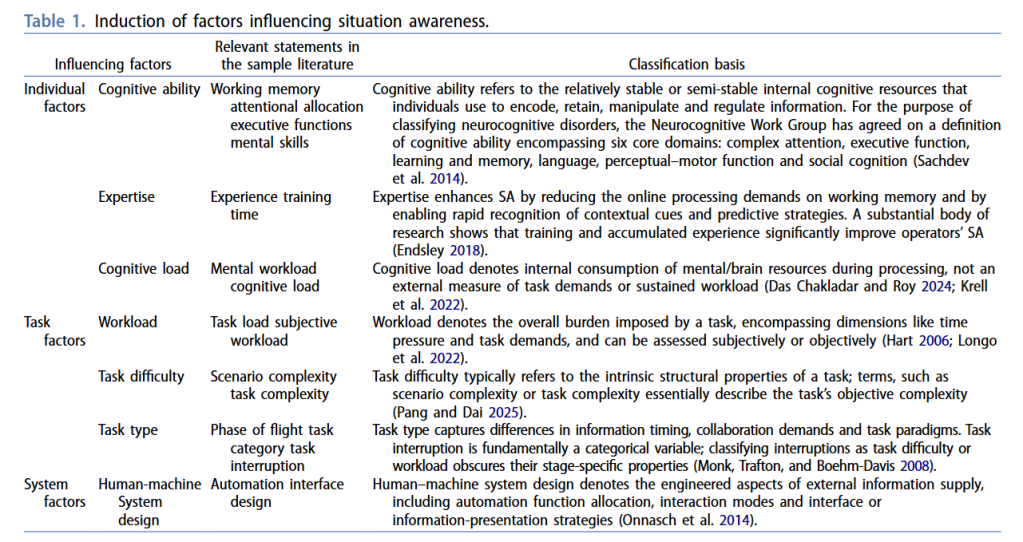
· “Task-related variables showed a mixed pattern: task type was positively associated with SA while task difficulty exerted a strong negative effect, and general workload demonstrated a small negative association”
· A moderate positive correlation was found between systemic factors and SA, where SA itself was “moderately positively correlated with task performance”
· There was a “moderate positive correlation between cognitive ability and SA, indicating that individual differences in attention control, working-memory capacity and executive function are reliably reflected in SA levels”
· “This finding is consistent with Endsley (1995) three-level model of SA, which emphasises that the formation and maintenance of SA depend on cognitive mechanisms, such as attention, working memory and long-term memory”
· “Cognitive ability ensure timely integration and updating of perceptual inputs by maintaining the storage of information”
· They also found a “moderate positive association between expertise and SA, indicating that accumulated experience and domain knowledge are not merely background variables but constitute a substantive source of SA stability”
· Skilled operators structure and encode complex situational info, reducing real-time cognitive load and accelerating perception and comprehension
· “expertise not only sustains SA under routine conditions but also facilitates faster detection and decision making during unexpected or abnormal events, promoting more rapid recovery or preservation of SA in crises”
· There was a “moderate negative correlation between cognitive load and SA”
· “a distinct vigilance pathway [was found where] very low-stimulus or monotonous monitoring tasks can reduce arousal and vigilance and thereby degrade SA”
· “The discrepancy indicates a nonlinear relationship between the two, as cognitive load increases from low to moderate levels, operators may transiently enhance attention and accelerate processing, temporarily improving environmental monitoring and subjective understanding. However, once cognitive load exceeds a critical threshold, SA declines”
· “a strong positive association between task type and SA, that is, SA varied markedly with the nature of the task. In high-engagement phases (e.g. critical flight stages), operators exhibited higher SA (Ayala et al. 2024), whereas task interruptions or engagement in secondary tasks frequently produced loss or marked reductions in SA”
· “Conversely, task difficulty was found to be strongly negatively associated with SA. As task complexity increases, the ability of operators to maintain high levels of SA diminishes”
· “Workload exhibited a small negative association with SA, indicating that higher workload weakly but consistently impairs operators’ ability to acquire and sustain SA”
For implications:
· “Because individual cognitive abilities and expertise showed moderate relations with SA, multidimensional training programs should combine traditional skill training with targeted cultivation of cognitive capacities and systematic approaches to cognitive-load management”
· There’s a need for “dynamic workload-management strategies rather than static task allocation … dynamic workload-management strategies that regulate task allocation and rest intervals should be implemented to prevent information overload”
· “Scenario-based simulation training that improves rapid recognition of task type and builds resilience to varying task difficulty may therefore enhance operators’ resilience across varying task demands”
· “The moderate positive association between system design factors and SA highlights the importance of situation-oriented human–machine interface design. Interfaces that prioritise goal-relevant information, support progressive disclosure and provide context-sensitive cues can facilitate SA, whereas poorly aligned automation may erode comprehension and projection”
Study Link: https://doi.org/10.1080/00140139.2026.2648584
LinkedIn post: https://www.linkedin.com/pulse/antecedents-outcome-situation-awareness-meta-analysis-ben-fqg1c
My YouTube: https://www.youtube.com/@safe_as_pod
My site with more reviews: SafetyInsights.org
Shout me a coffee: https://buymeacoffee.com/benhutchinson
Safe As LinkedIn group: https://www.linkedin.com/groups/14717868


