This commentary discusses the challenge of decluttering / de-implementation of low-value practices in healthcare.
PS. Check out my YouTube channel: https://www.youtube.com/@safe_as_pod
Extracts:
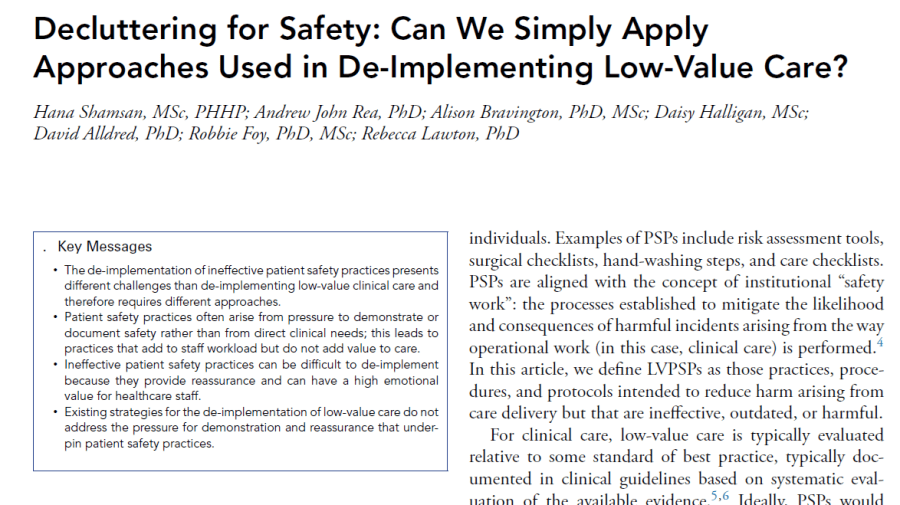
· “de-implementation of ineffective patient safety practices presents different challenges than de-implementing low-value clinical care”
· “Patient safety practices often arise from pressure to demonstrate or document safety rather than from direct clinical needs; this leads to practices that add to staff workload but do not add value to care”
· “Ineffective patient safety practices can be difficult to de-implement because they provide reassurance and can have a high emotional value for healthcare staff”
· “Existing strategies for the de-implementation of low-value care do not address the pressure for demonstration and reassurance that under- pin patient safety practice”
· “Not all [Patient Safety Pratices] PSPs contribute meaningfully to actual patient outcomes”
· “Safety clutter” is “the accumulation of safety practices that are designed to improve safety but do not add value to operational safety”
· Value of safety practices can be judged through “contribution,” “confidence,” and “consensus”
· Staff identified some “falls risk assessments, duplication of documentation, safety checklists, and incident reporting” activities as a “waste of time”
· And many patient safety improvement efforts “are the result of incident investigations that produce sets of non-evidence-based recommendations and actions”
· Reviews of recommendations after incidents found “80% of them to be weak and unlikely to improve operational safety”
· Many “PSPs are adopted and used not because they are underpinned by strong evidence, but because they ‘feel’ like the right thing to do” and the “quality of evidence for new PSPs is often weak”
· Ineffective PSPs can be difficult to de-implement because they “provide reassurance and can have a high emotional value for healthcare staff”
· And there are “often strong beliefs about their value and hence a strong emotional attachment to them”
· “Not doing the practice can lead to blame (from self/others), reputational damage, and in some instances the loss of a professional license”
· Organisations are under “constant pressure to demonstrate their safety efforts to stakeholders”, which leads to PSPs being implemented for purposes beyond patient safety, including “demonstrating safety, social safety, and administrative safety”
· Low value PSPs (LVPSPs) have the “potential to drain resources, creating time and opportunity costs for staff who could be providing more valuable care”, where requiring staff to perform LVPSPs is demotivating
· Existing frameworks “provide far less insight into the behavioral determinants that influence the decisions of frontline staff in the patient safety context”
Study link: https://doi.org/10.1016/j.jcjq.2025.12.004
Shout me a coffee: https://buymeacoffee.com/benhutchinson
Safe As LinkedIn group: https://www.linkedin.com/groups/14717868


