Do permanent night workers have a higher risk of workplace injury?
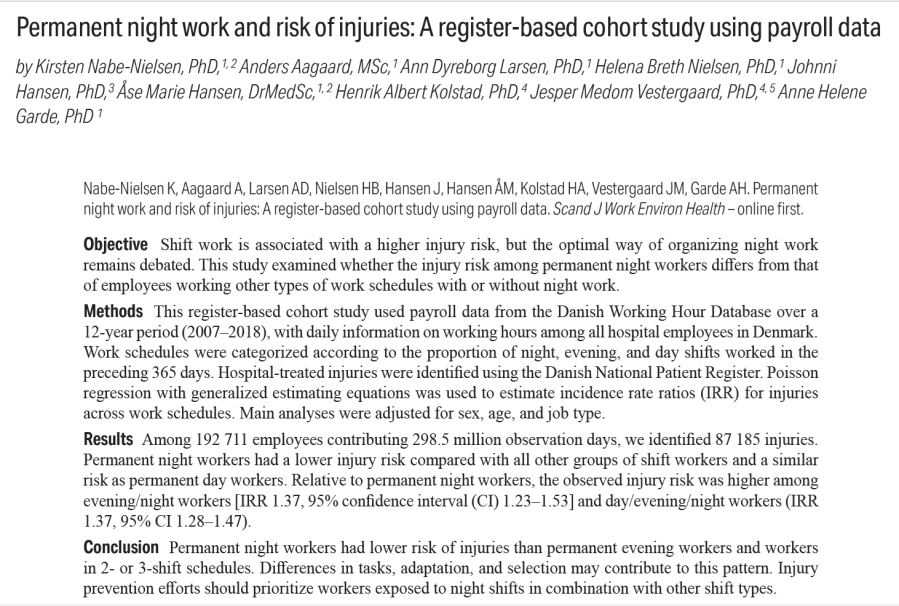
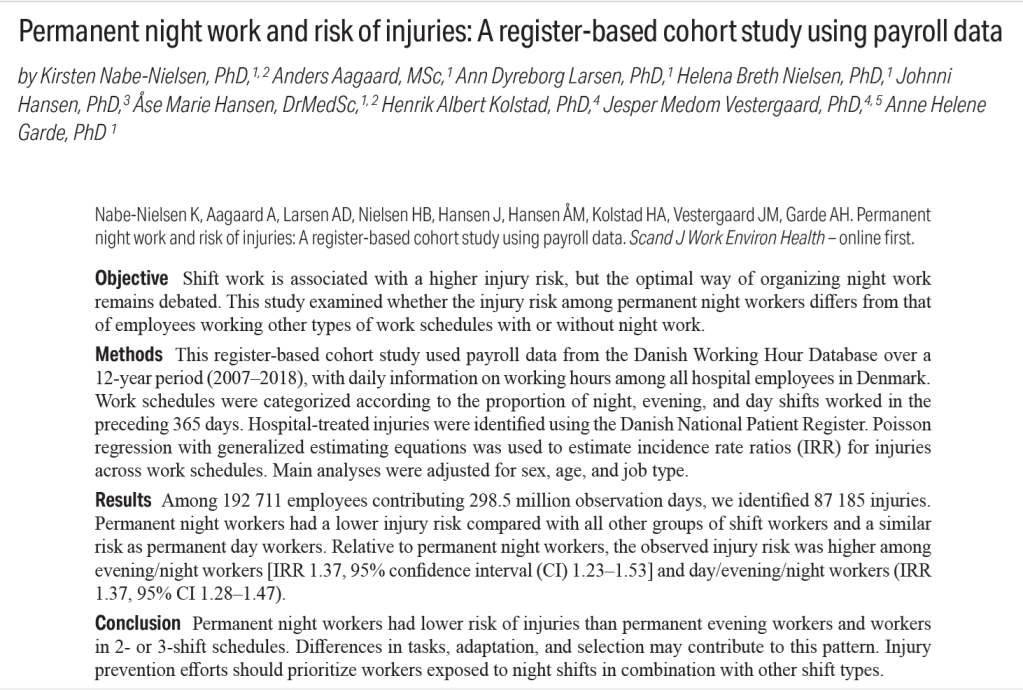
This Danish study used hospital records over a 12 year period, involving >192k employees and >87k injuries.
PS. Check out my YouTube channel: https://www.youtube.com/@safe_as_pod
Background:
· They say “Night work affects 24% of the workforce in the EU (1) and is associated with adverse health outcomes, including injuries”
· “The elevated injury risk may be attributed to the effects of night work on sleep and cognitive functioning, as understood within the frameworks of homeostatic sleep pressure and circadian regulation”
· “night work leads to prolonged wakefulness followed by shorter and less refreshing daytime sleep (7), with sleep deprivation leading to cognitive impairments”
· Also “awake and active during the biological night means that critical tasks are per formed during the circadian nadir of alertness”
· “both physical and mental fatigue related not only to the timing, but also the number of consecutive shifts, shift duration and possibilities for rest breaks seem to play a role for the injury risk”
· It is debated whether “permanent night work yields a lower risk of adverse outcomes due to fewer intermittent shifts in the circadian rhythms (11–13). Consequently, permanent night workers may have better possibilities of adapting their circadian rhythm to night work compared with 2- or 3-shift workers whose schedules alternate between day”
Findings:
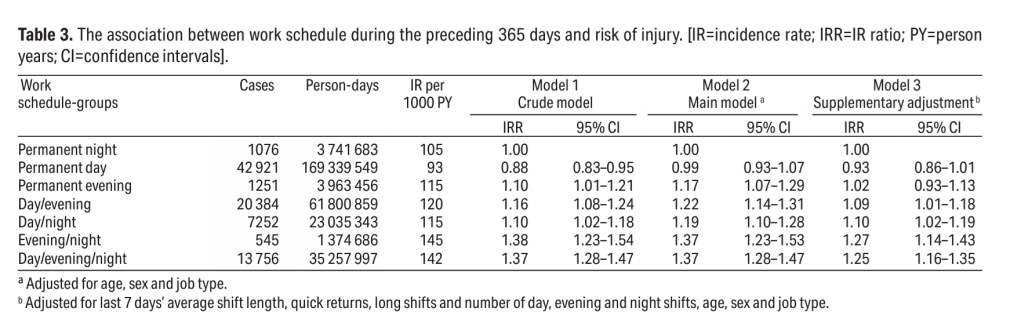
· “Permanent night workers had a lower injury risk compared with all other groups of shift workers and a similar risk as permanent day workers”, including lower than workers of permanent evening and workers in 2 or 3 shift schedules
· “Relative to permanent night workers, the observed injury risk was higher among evening/night workers [IRR 1.37, 95% confidence interval (CI) 1.23–1.53] and day/evening/night workers (IRR 1.37, 95% CI 1.28–1.47)”
· “The highest IRR was observed among individuals working night shifts in combination with evening shifts compared with permanent night workers”
· “In our subgroup analyses, this pattern was not evident among nurses, as injury risks were largely similar across work-schedule groups, with the exception of day/evening/night workers”
“In contrast, among assistant nurses, all other work-schedule groups demonstrated a higher
Shout me a coffee: https://buymeacoffee.com/benhutchinson
Safe As LinkedIn group: https://www.linkedin.com/groups/14717868


