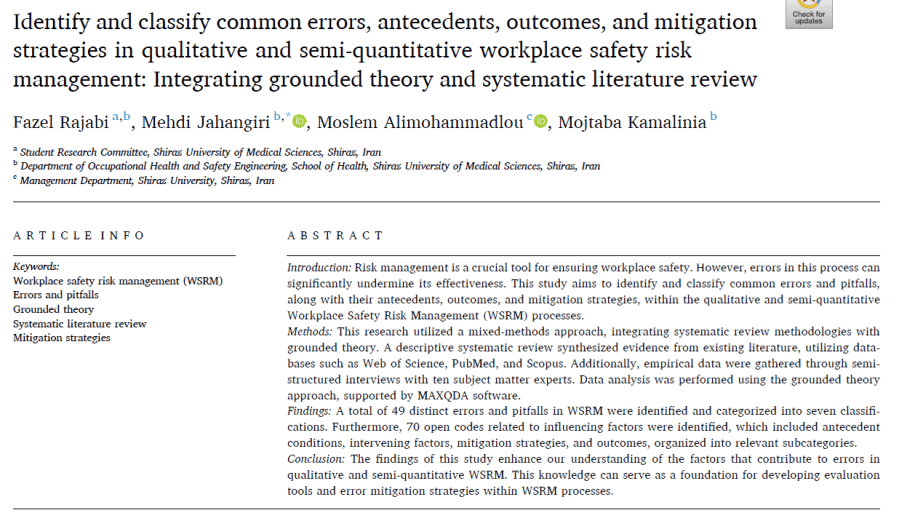
This mouthful of a title looked at some common errors, pitfalls and antecedents associated with workplace safety risk management (WSRM) processes via lit review.
PS. Check out my YouTube channel: https://www.youtube.com/@safe_as_pod
Extracts:
· They identified 49 errors and pitfalls in WSRM, categorised into seven classifications
· These errors and pitfalls included “Conducting risk assessments solely for documentation purposes, legal compliance, or to justify pre-existing decisions”
· “Failure to localize risk management to the specific conditions of the organization”
· “Lack of stakeholder involvement, particularly from operational staff, in the risk management process”
· “Inadequately forming a suitable risk assessment team (considering structure, size, and expertise, particularly of operational personnel)”
· “Choosing inappropriate techniques (for instance, applying general risk assessment methods when specific methods are required)”
· “Incorrect definitions of key concepts such as hazard, risk, and event”
· “Use of non-standard risk matrices”
· “Inability to identify the appropriate risk criteria”
· “Failure to accurately define the concept of ALARP”
· “Generalizing control solutions and providing non-operational solutions”
· “Failure to assess the effectiveness of control strategies after implementation”
· “Lack of revisions and updates to the risk assessment process in response to changes”
· And heaps more
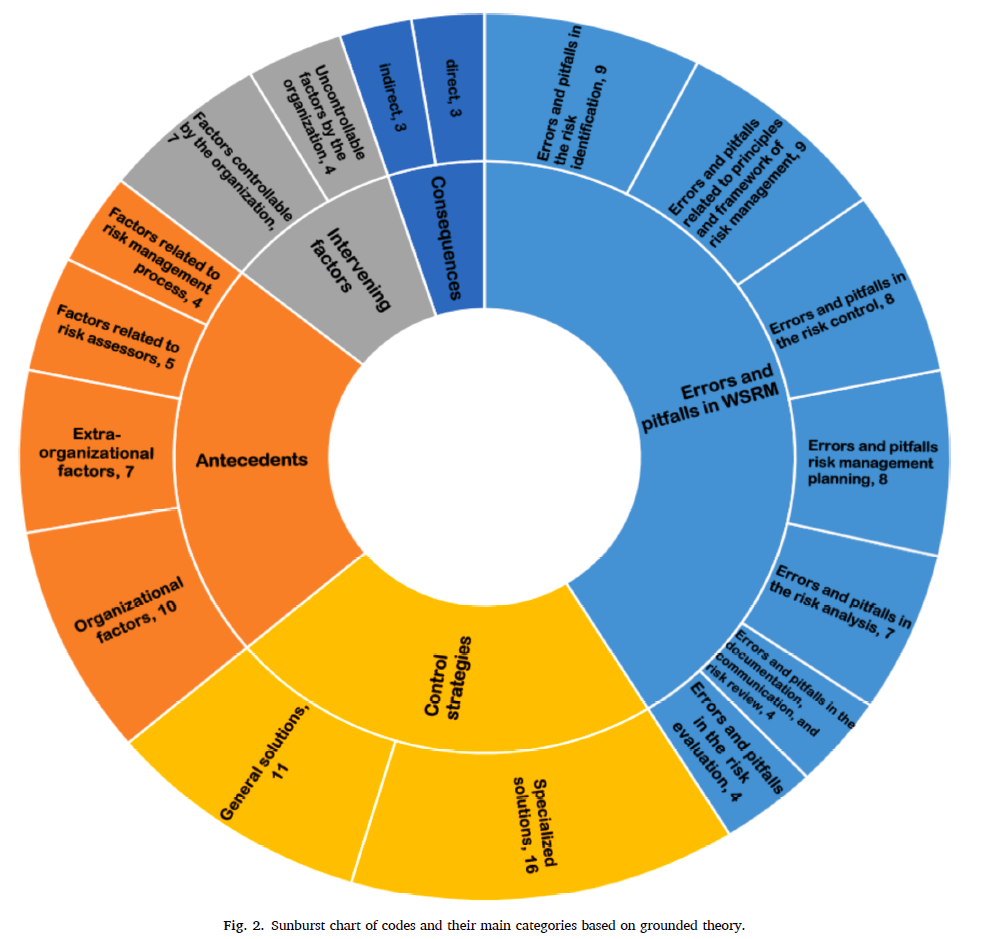
The article suggests some mitigation strategies, including:
· “Providing retraining for risk assessors”
· “Encouraging employee participation in risk assessment activities”
· “Conducting a final review of risk assessment results by an experienced, independent individual”
· “Localizing risk estimation and evaluation matrices within organizations”
· “Developing and utilizing tools to measure the quality of risk assessments”
· “Creating standardized tools for risk identification”
· “Designing an employee feedback form to gather opinions on risk identification and solution determination”
· “Holding multiple meetings to align the perspectives of individuals involved in the risk management process”
· “Utilizing guidelines and tools to select appropriate risk assessment techniques”
· “Developing specialized software for conducting risk assessments based on established guidelines to ensure standardization”
· “Creating a procedure to integrate the results of incident root cause analysis into risk assessments”
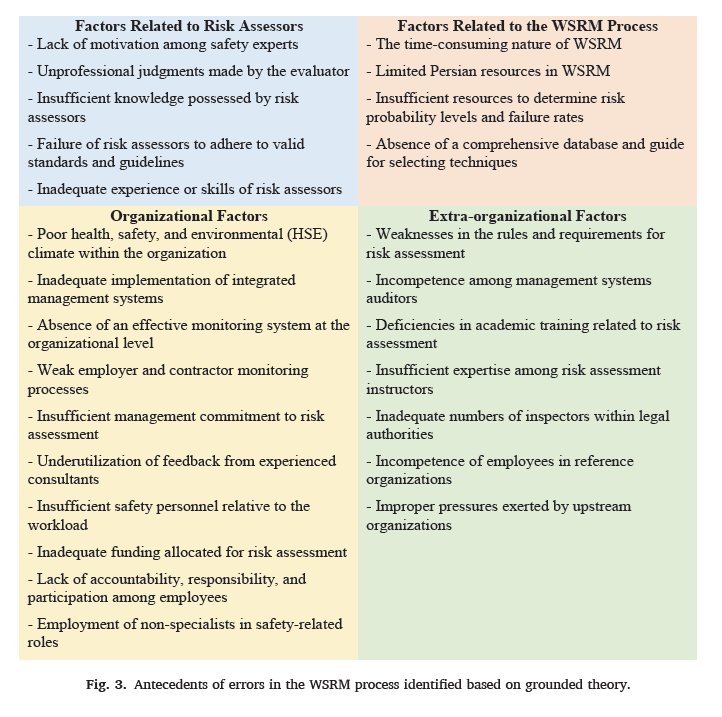
Overall, the article suggests that poor-quality risk assessments aren’t really a scoring issue, as this starts much earlier, with weak purpose, weak team formation, and weak method selection and risk ID.
The article suggests that assessor competence, operational-worker involvement, better technique selection, local tailoring of the tools or assessment process, and a form of independent quality review may help.
The paper also suggests that organisations need a way to assess the quality of the assessment itself, not just the risk ratings it produces (e.g. are our tools, risk matrices etc. producing reliable and valid results).
They also state that these findings may help equip “management system auditors with crucial knowledge to emphasize error prevention and ensure high-quality risk management” and may also assist legal practitioners.
Study link: https://doi.org/10.1016/j.ssci.2025.106851
Shout me a coffee: https://buymeacoffee.com/benhutchinson

 SafetyInsights.org